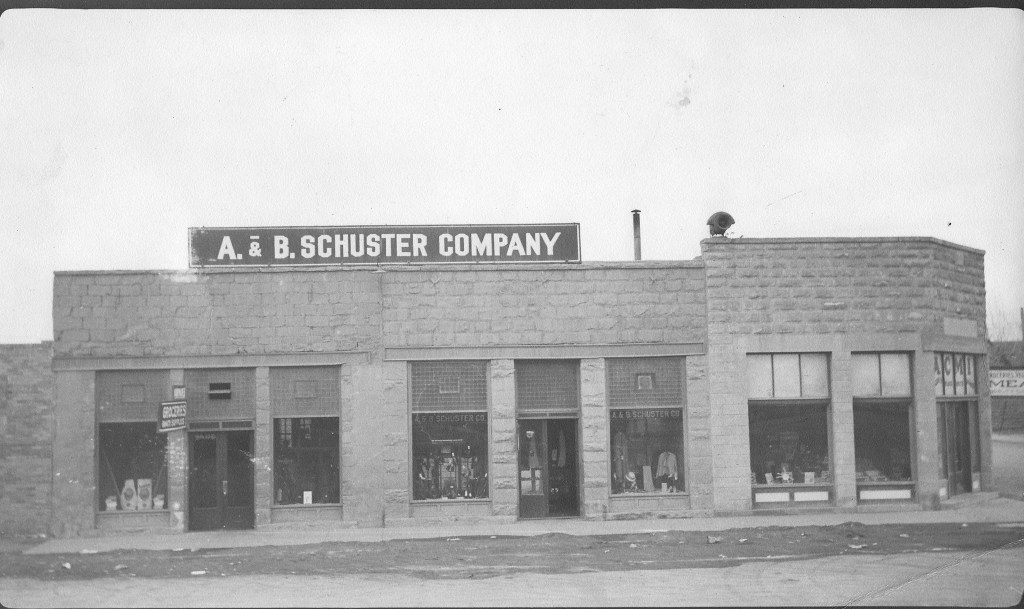
A. & B. Schuster

A year or so ago, I spent some time in Holbrook, Arizona taking pictures of the old buildings and learning more about Holbrook’s part in the sheep business. I was curious about the A. & B. Schuster store but at the time was told they were not in the sheep business only sold mutton in the mercantile store in Holbrook. In a recent newspaper search from various newspapers and relooking at an old one, The Holbrook Argus, 1897, this information was found.

A & B. Schuster was the name the two brothers used for their mercantile store.  Adolph and Ben were natives of Westphalia, Germany.  They settled in Holbrook in 1885 after various business enterprises in New and Old Mexico. They had a lot of sheep at one point, 5,000 to be exact as they were assessed by the Board of Equalization of Apache County for $6,500 on them as reported by the St. Johns Herald, July 1895.  In October of 1895, they trailed the 5,000 sheep to Las (sic) Vegas, New Mexico. Their names appear on Bert Haskett’s list of sheep owners in Arizona for the time period 1891-1906 from Apache County.

As more research is completed, I am sure there will be more information about the Schusters.

unknown date
The Schuster Family. Unfortunately I was not told or maybe it is unknown which man is which. I’ll update if and when I find out.

Shearing and lambing Early 1898

From the January 30, 1898, Arizona Republic it is possible to gleam a great deal of information on the happenings in the sheep industry in Arizona. The newspaper began its article “The Sheep of Arizona Congregated in the Salt River Valley for Shearing” reflecting on how the democratic congress of the past four years had allowed the sheep industry “to go to ruin” under the Dingley tariff.  Many sheep men in not only Arizona but the United States were affected and many went out of business. In Arizona, it was estimated that 50 per cent of those engaged in raising sheep “went to the wall.”

But the article was really on the positive side as it stated that the sheep men were happy and their profits looked good from the bountiful harvest of the previous year.  “And to add to their fortune the elements have given them the most favorable conditions for ‘lambing’ they have had in a long time, ” the newspaper stated. George Scott told the newspaper that the average lambing for an outfit will be 80 percent. Mr. Scott, with one band of 1,700 ewes got 1,900 lambs.

The exact number of sheep that will be in the Salt River Valley for shearing was not known as a band contained from 1,500 to 2,500 and no outfit had the same number. From the number of bands listed below there were 58 in the valley and it had been estimated to be between 130,000 and 140,000 total sheep. Those sheepmen, where they were from and how many bands each had in the valley as reported in the newspaper were as follows:

Winslow – Cart & Noble, four bands

Flagstaff – Campbell & Francis, seven; Bill Campbell, three

Ash Fork – Joe Rice, three; Mr. Sterling, one; C. Hutchinson, two; J. Q. Adamson, four; Frank Evart, two; Mr. Renner, one

Show Low – Scott Bros., four; J. E. Porter, one; Clarence Morrow, one; Cole Campbell, four; William Morgan, three; Mr. Longmore, three; John Nelson, three; A.&B. Schuster, four; Lorenza Baca, one; Archie Cameron, one; Amos Bros., two; J. D. Houck, four.

A side note: Not all the above names are listed on Bert Haskett’s History of the Sheep Industry. There are more names on Haskett’s list than here but many of those on his list would have shipped their wool and lambs from a northern location. (Maybe that would be interesting to record here who Haskett’s has as sheep raisers.)

Charles Goddard had contracted with most of the sheep outfits to shear their sheep. He had set up one shearing camp and another camp had also been established. A wool buyer, A. Vandewert, from Boston was here to buy that wool. He estimated that in Arizona there was nearly 500,000 sheep. He had contracted for 2,500,000 pounds of wool from Arizona; a sheep averages eight and one-half pounds of wool. Another benefit to the wool raisers was that the prices for wool  were up this year compared to last with wool selling between 12 and 14 cents per pound this year compared to 7 ½ cents last year. Selling of sheep in 1897 went for $2.30 and $2.75 per head but it is estimated that they will sell from $3 to $3.50 in 1898.

Other changes that were seen in 1898 included new plans for shearing and handling the wool. The newspaper continued, “The Santa Fe, Prescott and Phoenix Railroad company has prepared plans of a plant for shearing and handling wool which will facilitate the work to a great extent. The company will erect a plant at Peoria immediately, which they will hand over to shearing contractors ten days after the material for construction of the plant arrives. It has been delayed by the tunnel accident on the Santa Fe, but is expected to arrive soon. The plant will contain forty shearing pens, a large dipping vault, and a warehouse for the storage of wool. Machine shears will be put in each pen, and the old shears will be relegated to a place among the crude implements of the old days. The machines will be the means of saving a greater portion of the wool to the owners, as they clip much closer and cleaner than it is possible to do with hand shears.” 

Shearing at the railroad yard also reduced the cost to the wool raisers as they did not have to haul their wool clip to the railroad for shipping to the eastern markets.

It is the goal to continue to find more information on 1898 wool and sheep prices and how the wool raisers felt when they were done shearing and shipping the lambs which would take place in May. The sheep raisers estimated that they would need 250 double decked railroad cars.

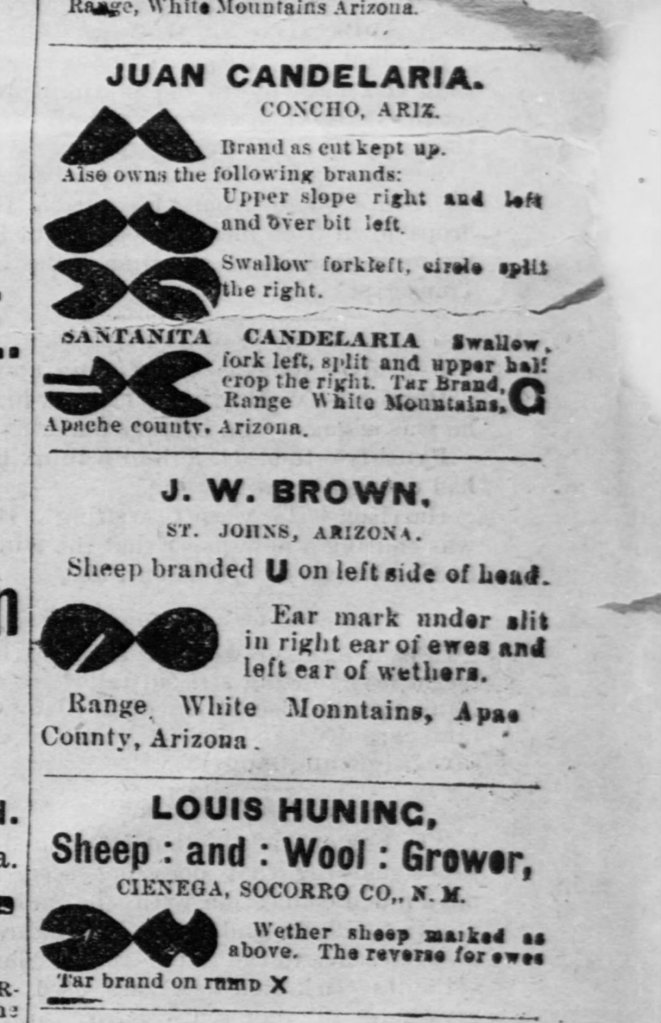
Dilemnas of a Researcher

As I have read in many history books, they all have one thing in common – the author or authors said that many individuals are required to gather, shape and digest all the available information on the topic under research. Many of the individuals have lived through the event, others have knowledge from family members who lived through it and still others have collected many of their family histories and have them stored away. These “stored” documents may include letters, photographs and artifacts of that time. A photograph can tell a great deal about a place, as the old saying goes, “a picture can tell a thousand words.”

Thus, researchers do not do their research in isolation. Granted there are many hours spent in libraries, museums and special collections but then there is the reward of  interviewing “old timers”. New friendships are cultivated that would not have happened if that researcher or researchers did not want to know more. And thus, one more piece of the puzzle found helps to tell a fuller story for future generations to know what took place in the past. That information is now made public through books, magazine articles, presentations, blogs, etc.

While some history is dull and mundane to one person it may be enlightening to another as it helps them understand the larger picture. I have always found reading a variety of genres has enriched my life. It may be just for fun reading as a fictional book or it may be very in-depth study of a subject such as astronomy or religion. Some allow our imaginations to work overtime wondering how the writer thought of the idea as in science fiction that I love to read for total relaxation.

So, as I bring you the history of the sheep industry in Arizona through this blog, my goal is to enlighten those interested in this topic, tell the family histories of the men and women who worked hard and helped build this industry and the state of Arizona – the history that has been hidden in old boxes, on dusty shelves and trunks of museums and in family closets so the history is preserved. Some history of the sheep industry has recently been discovered when someone told me that they bought the contents of a storage shed and inside found a box containing 40 odd years of records for one sheep rancher! The family has been contacted for them to go through and then hopefully it will be passed on to me or a museum.

So, bear with me as I jump around in years and families. Research takes time and new information is being located all the time. Newspapers get digitized. Family members come forward to tell me their story as something previously written has jogged a memory buried deep in their minds or reminds them of something else that was happening along with the event I am bringing forward.  It takes time to digest all the information and then bring that history to life. I love what I do but there are not enough hours in a day……

Colin Campbell, Part III

As one does research, new information constantly appears as more newspapers are digitized from the 1800. Families come forward and share what information that they may have as has happened with this blog. A search of newspapers one day may lead to one or two or more new pieces of information and the next more newspapers are digitized and additional information is discovered. It can be frustrating to not be able to see all the information at one time but it is what it is.  So, with more research the last couple of days a little more information has been found in various newspapers that carried an obituary of Colin.  What I wanted to discover was the year that he came into Arizona.  What I found did not fully answer my question and more research will be needed to one day resolve the question of when Colin Campbell arrived in Arizona, where he was prior to coming to Arizona and just maybe, why he came.

One newspaper, Arizona Daily Star, stated that he came into Winslow, Arizona with a pack train from Utah in the 1860s.  While this may be plausible, it would put his age of arrival somewhere between seven years old (born in 1853) if we consider 1860 as the date and as old as 16 if the date of 1869 is used. It is doubtful he came alone at the age of seven since he was the first member of his family to come to Arizona. This newspaper also stated he died at home. I will come back to this piece of information. Further information on him was that he  had been in the sheep business 40 years. Using 40 years and subtracting backwards we arrive at the date of at least being in Arizona by 1887 since he died in 1927.

But then what about the newspaper that stated he came to the United States when he was 20. That would mean 1873.  The newspaper further stated that he went to Dakota in 1876 and came to Arizona in 1879. What he was doing between 1879 and 1883 has not been discovered as a search of available newspapers do not record any activity.  We know that in 1883, he formed a partnership with Frank Hart and the two men ran sheep together under Hart and Campbell until Mr. Hart passed in 1898. While not germane to discovering more on Mr. Campbell, the newspaper reported that Perkins and Rand, two other sheepmen, bought Mr. Hart’s interest in Hart and Campbell from his estate. But back to Colin, he could have had sheep prior to the partnership with Hart, running them himself so the 40 years in the sheep business may be low.

 Another newspaper, Williams News, stated he died at Hotel Escalante in Ash Fork which differs from the Arizona Daily Star. Is this really important to know? No, but it does make a researcher wonder how accurate any of the information in the paper is. Williams is not far from Ash Fork but Flagstaff is. Does that make a difference the distant one newspaper is from the actual event? It makes a researcher want to check further to verify the accuracy of all information to not continue any falsehood. But for now, it will be left!  One fact that was found in both newspaper was that it reiterated that he was in the sheep business.  

Colin was still in the sheep business when he died in 1927 as his sons reported that in 1929, they could not find herders and sold the sheep.  They may have sold out just in time before the Depression and the sheep industry took a real nosedive.

And that is part of the “rest of the story!” as Paul Harvey would say.