John C. Mudersbach – A Shropshires sheep owner

John L. Mudersbach was born in Flagstaff in 1902 to John C. and Mary Azelia “Beesen” Mudersbach.   His family bought a ranch in Phoenix moving there in 1904.  The ranch had both sheep and cattle.  John, writing in the Arizona Pioneer Ranch Histories, Vol. III,  believed that these sheep may have been the first in the Salt River Valley.  His dad had Shropshires and Rambouillets.  These may have been the first Shropshires in Arizona!  His dad also had a ranch on the west side of the Phoenix area, near Glendale, where he had feed pens for fattening about 700 lambs.

Not much else is known about the dad except he is listed in Haskett’s early history of the “Sheep Industry in Arizona” as having sheep in Coconino County during the period 1891 to 1906.  Gus Mudersbach is also listed as having sheep from the 1880s to 1906.  What relationship existed between the two men is unknown. Neither name shows up in the Arizona Wool Growers Association roll.  This organization began in 1886, but not all sheep owners belonged to the Association.

The Shropshire sheep was introduced into the US in 1855.  From the 1880s to the 1930s it was the most popular and influential breed.  At one time, there were more Shropshire sheep in the US than any other breed.  Today, across the country, families raise these sheep for youth projects such as 4-H or FFA.

shropshireyearlings

A Shropshires sheep.

WRF Rambouillet _0304

a Rambouillets

Glendale Stock Farm, a friendly Mexican sheepherder and the senseless killing of sheepherders

Cecil H. Miller, E.M. Thomas and his son, J.H. Thomas

In continuing my reading of the Arizona National Livestock Show Ranch Histories Volume I little tidbits of information come to life on who had sheep in the early part of the 1900s. In 1926 Cecil married into a family, the Miller’s, who along with the Babbitts had formed the Glendale Stock Farm, a diversified farm operation with both sheep and cattle. This remained a sheep and cattle operation until 1936.  Whatever happened to the sheep of the Glendale Stock Farm will need further research.

E. M. Thomas came to Taylor, Arizona in 1881 with his wife and two sons. In 1890 he moved to a ranch that was northwest of Pinedale and began to raise sheep. He sold all the sheep in 1901 and went into the cattle business. His son, J.H. Thomas, remembers a time in 1907 when sheep were near where he was working cattle as the cattlemen did not carry canteens and only got water in the morning before leaving for the range, when they returned at lunch and dinner. The Mexican sheep herder had a canteen and he asked to drink some of his water which the Mexican shared. Later, J.H. married and moved to his own ranch west of Pinedale. He did odd jobs of which one was dipping sheep for $2.00 a day.

A story about sheep in Graham County in 1889 comes from newspaper articles in the Saint Johns Herald.  The story was called the Bonita Tragedy because of the senseless killing of sheep herders by cowboys of the Chiricahua Cattle Company.  There is uncertainty as to the owner of the sheep as three different articles state two different owners – Sol Luna or Don Pedro Montana.  This is just another example of the dislike that the cowboys had for sheep and those who worked the sheep for a living.

Santa Cruz Sheep – Maybe a connection to Arizona

In the story of Lester Fuller, I mentioned, in 1937 sheep were shipped from Bellemont, near Flagstaff to Santa Barbara, loaded on ships and unloaded on the islands off the coast. These may be part of what became a feral population that were discussed in the article, “From Thriving to Striving,” by Jeannette Beranger in Out Here Magazine, Spring 2018 issue, a quarterly publication by Tractor Supply Company. The article states that the island of Santa Cruz was a “haven for sheep ranchers in the 19th and 20th centuries because no large carnivores prowled the island”. (page 50) The sheep developed characteristics which allowed them to be self-sufficient. The high lanolin content in their wool may have helped them to live in the moist conditions of high rains and fog. Their wool developed a “fine crimpy texture that more effectively insulated the animals against the heat and cold than other domestic sheep”. The article further states that they developed the ability to shed their wool, shearing was eliminated.

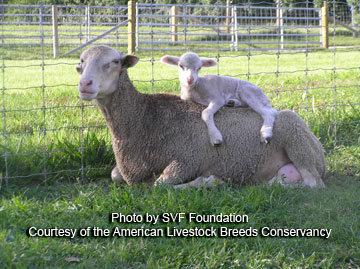
Santa-Cruz-EweLambThis picture is taken from the website http://albc-usa.org/cpl/santacruz.html

In 1978, the Nature Conservancy acquired the rights to the island and set out to protect the native plant and animal species ecosystem. Santa Cruz Island along with four other islands in the chain known as the Channel Islands became the Channel Islands National Park in 1980. With no predators on the islands, the feral sheep population grew. A survey completed in 1989 estimated that over 21,000 sheep lived on the island, but their days of living here were numbered. The eradication of the feral sheep began. But, someone was thinking at the American Livestock Breeds Conservancy and was able to save a small number of the Santa Cruz Island sheep. They convinced the Nature Conservancy that the sheep should be recognized as “a unique genetic resource for the species” (albc-usa.org/cpl/santacruz.html) . In 1988 the first of twelve lambs were rescued and placed with five breeders in California. More of the species were brought off the island in 1991. The article ended stating that the population of Santa Cruz Island sheep has grown to 200. What a shame that only so many of the animals were senseless killed because of a lack of understanding about the species. A family in Lewisberry, PA has taken some of the sheep on their farm to help insure their survival. It will be interesting to follow what happens with the Santa Cruz Island sheep.


Lester Hiram Fuller son of John Hyrum Fuller Part 3 of 3.

As the story continues for Lester Fuller, more sheep were present as can be surmised from the statement about Will Anderson who died from a heart attack in one of the corrals on the Valle Ranch in 1938 while working sheep. During 1938 and probably into 1939, many of the holdings of the Arizona Livestock Company were sold to cattlemen. This included range lands and ranches. By the spring of 1942, 12,000 ewes were at the new headquarters at Red Hill and Blank Tanks. (Red Hill is a ranch south of the Williams area). The sheep could still be seen on the range there in 1943-44.

WWII brought other challenges to ranchers. Trying to get herders who understand the nature of working with sheep were few and far between as sons who knew the ins and out of the sheep business were drafted.  Sometime in 1944, or maybe the end of 1943, Oscar Rudnick bought lambs from the outfit and then he both the whole sheep outfit. Rudnick also bought other holdings of the Arizona Livestock Company including the VVV Ranch. Lester, now working for Rudnick, said in the Arizona Pioneer Ranch Histories that he was given a checkbook, and no one bothered him until lambing season, October 1945. Over the next couple of years, cattle were purchased from many sources to stock the range, but sheep were still a part of the operation as Lester stated that during the summer of 1947, they had 20,000 cattle and 16,000 sheep. All sheep were finally sold in the spring of 1948 and shipped to Lancaster, California where Rudnick had Basque run the flock. From 1950 to 1966 Lester headed the Sheep Sanitary Commission enjoying traveling the state and seeing the sheep men he used to work with. While there were other interesting tidbits about Lester, they did not include sheep and thus, ends the story of another sheep man in Arizona.


Lester Hiram Fuller son of John Hyrum Fuller Part 2 of 3.

We left Lester as he began working for the Grand Canyon Sheep Company. He was given a Dodge truck and he was to catch up to three bands (6,000) of sheep that were on the trail going from Valle Ranch located north of Williams to Springerville and the old Colter Ranch. He caught up with the troubled ban south of Winslow as he was informed by the  foreman that 300 sheep were missing.  Lester had the bands keep moving as was required and he headed back down the trail locating the lost sheep at a ranch.

He now was responsible to get the 300 sheep to Winslow which was a three-day drive from where he found them. Shipping them to Holbrook by train was his first move. He then hired extra burros and two herders to take the sheep and catch up with the rest of the flock which was at this time near St. Johns. Lester stayed with the 300 sheep until they were north of Springerville. By April all the sheep were grazing together. But, he was not done with his work as he headed back to the Double O Ranch near Seligman to take care of the 18,000 ewes ready to lamb within the next month.

Life was not easy for him as he  had not seen his family for three months as they were living in Chandler. He moved them to the ranch and the family remained there until the fall of 1936. Changes took place during this time as the assets once owned by the Arizona Central Bank, Flagstaff, were bought out by a bank in Los Angeles. Will Anderson replaced John Simpson as general manager in 1935. The Grand Canyon Sheep Company was consolidated with the VVV Livestock Company and was called the Arizona Livestock Company.

The sheep and cattle were signed to specific areas.  The 25,000 head of sheep were put on the range southwest of Seligman and some company holdings that were to the south of Kingman. The cattle were north of here. With prices high in 1936, the Double O was sold and 26,000 sheep were moved to the forest south of Flagstaff for the summer and the rest went to Valle Ranch north of Williams. When the sheep were moved to the winter range in 1937, Lester was the foreman and was responsible for the sheep which covered a area from Congress to San Luis on the Mexican Border (over near Yuma). Lambing took place in Litchfield as well as at the Valle Ranch. With the exception of 10,000 ewes, all other ewes and spring and feeder lambs were sold. Those sheep were sold in the fall of 1937 and shipped to Santa Barbara from Bellemont, near Flagstaff. The sheep were then loaded on a ship and turned loose on an island off the coast.

Final part will be posted later this week.

Lester Hiram Fuller son of John Hyrum Fuller

Today’s s story starts out about goats but it will soon turn to sheep.  Without the other nuisances, the story would not be complete.  It is a very interesting story of the early part of the sheep industry in the state.

Lester was born July 18, 1894. While the family lived in Star Valley, he bought his first goats, two, with money he had earned. The herd was built up to 25 to 30 head. He worked the goats in the beginning with his dad.   Lester sold the goats to a member of the family and the goats may have ultimately been sold to Harry Hibben, a sheep man who had a sheep outfit north of Williams. This was all prior to 1906.  (This is the first time Hibben’s name has been mentioned with the sheep industry. Obviously more information is needed to determine who he was and anything about his sheep outfit).

His next venture was with cattle which he purchased with the money he made from selling his goats. When he purchased the cattle is uncertain but it wasn’t long before he lost them as cattle prices fell after WWI.   Lester went to work for Lute Hart Sheep Company in 1922 as he was friends with Lute.  Lester remarked that even though cattle prices were down, sheep prices were still good!  He worked until 1925 as Lute’s foreman then went to work for Verkamp who had 4,000 sheep. Verkamp summer permit was south of Clear Creek on Dane Ranch. This area is near Winslow and the Chevelon Butte.  Lester brought the sheep down to the Salt River Valley over the Mud Tank Driveway that fall.

In July 1928, he was offered a job with Colin Campbell Livestock Company. The company had 35,000 sheep between Ash Fork and Seligman and a winter permit on the Verde River on Forest Service land. This job continued until February 1930 when the depression hit hard. The sheep had to be divided between the bank and the owners of Colin Campbell Livestock Company.

He was now looking for a job for the first time in his life.  He worked part time for the Federal Intermediate Credit Bank counting sheep and cattle. A bank owned many of the sheep at this point and had someone running them for them.  In 1930 Lester was appointed state sheep inspector. He was appointed again in 1931 for 6 months. He did a variety of jobs after this including for a loan company counting sheep, counting cattle and sheep at a ranch that belonged to John Jamison who lived near Oracle and had been a neighbor of the family when they lived in the Mogollon Mountain. He worked for part time at each of these jobs until March 1934 when John Simpson, general manager of the Grand Canyon Sheep Company asked him to work for their outfit. At this time, they were considered to have the largest sheep company in the state and the biggest in the United States.

Stayed tuned for part II as the story is long.


Why Sheep Herders and Ranchers are Important!

Today, as I debated what sheep story I should write about, I decided to change things a little and write about why I want to preserve the stories of the shepherds, i.e., those who are with the sheep 24/7,  and sheep ranchers, i.e., those who own the sheep.  The reason is very simple – they are part of Arizona’s history and the story of the west!  If I don’t remember them, who will?   Their lives may never have been glamorized as the “cowboy” in Hollywood movies; their hard work and perseverance to continue when they became outnumbered by the cowboy and their cattle still make the an important part of the economic and ethic diversity of Arizona.   The Basque came to herd the sheep for the Americans and they are the ones still in the business today.  Their tenacity has preserved this way of life of their forefathers.  For this they should be remembered!

I am still learning new stories as I scour newspapers of the territorial days and into the early years of statehood.  There is so much information that it is overwhelming at times and I need to stop and begin to write the stories.   Not much of the history of sheep ranchers in other states have been preserved so I am glad I have decided to at least preserve Arizona’s history.

Stay tuned for more stories as I find them.


Cordes Station

Cordes was on the trail that thousands of sheep passed through each year heading either to the northern ponderosa pine forests and the grasses, that in the early part of the 1900s was as tall as the sheep were or it was the place the sheep would pass through as they were trailed south to the winter grazing areas in the Salt River Valley.  Fred J. Cordes remembers helping his dad shearing the sheep when he was in his teens. (Story comes from Volume I of Arizona National Livestock Show Ranch Histories, pg. 30).  Sheep were also dipped here.  I heard the other day from a woman that sheep would rest here before trekking either north or south.  Herders would stock up on supplies from the store run by Fred’s dad.  The store still exists but is more a museum than anything.  It is seldom open these days.  The sheep still pass through the area when they are trailed north, but not southward, as they are hauled in trucks to the winter grazing areas.

Just another little tidbit about sheep in Arizona.

The sad tale of Bertha Wahl.

The Wahl family, mother and a least one daughter, as there is no mention that the father also came, arrived in the Springerville area in probably the late 1880s.  The family had to be in the area by 1892 from the events that unfolded.  Mrs. Wahl brought an unknown number of sheep to graze on the lush grasses from New Mexico.  Whether in seriousness or jokingly, she promised one of her herders that if he would work for her tending to the flock of sheep for seven years, she would give her daughter, Bertha, to him in marriage .  Bertha was only seven years old.

When the seven years were up (1899), the herder showed up at the Wahl home to claim Bertha.  Bertha was now a teenager, age 14.  Mrs. Wahl reneged on her promise to give her daughter in marriage to the sheepherder. Unfortunately, the herder did not like that he had worked those seven years and would not get a wife.  One night, he came to the house and seeing Bertha through her bedroom window, shot her to death.  I guess he figured if he couldn’t have her, no one could have her hand in marriage.

Who the herder was or what happened to him still is being researched.  I’ll post an update when I have finalized researching all the period newspapers.


R. C. Jones: Owner of 100 ewes!

R. C. Jones was born in Hannah, Oklahoma in 1915 and the family moved to Gilbert, Arizona in 1923 due to the mother’s health. At the age of 14 (1929), R.C. started in the business of trading livestock, mostly cattle, and just one year later he had the opportunity to purchase sheep. Having no money himself as the time was during the depression, he borrowed from the Salt River Project. Why he was able to borrow from them or why they were willing to loan the money is anyone’s guess as this information was not given.  Anyway, R.C. purchased 100 ewes that were going to lamb. He did pretty well for himself as the wool paid off his debt to the Salt River Project.  The time period for payment of the loan was not given either.  What is unfortunate the document where I found this information did not say anything more about him and the sheep.  There is no evidence that he sold them or kept them.  What became of the lambs?  Did he also profit from selling them? With the time period of the depression, he may have sold them as soon as he could.  Just one of the many little stories of sheep people found scouring past historical documents.

With so little information, you may wonder why I wrote this story.  The main reason is that a great deal of information on the very early years in the sheep industry are obscured little bits of information.  What it does say speaks volumes.  Sheep could make you money!  Someone could at the time of the depression pay for his sheep from the wool.  Dwayne Dobson’s father, a Canadian who came in the early part of the 1900s, also had bought sheep prior to the depression and was able to keep them and continued to raise the woolies for many years before turning the operations over to his sons.

What also should be mentioned is that many of the Anglos sold out to the Basque who had originally come to be the shepherd and because of their work ethic, tenacity, and shear will power, was able to survive the economic downturns or at least had that deserve to rebuild a flock of sheep.  Sheep was in their blood.  It must be remembered that three Basque families still continue the large sheep outfits in the state.