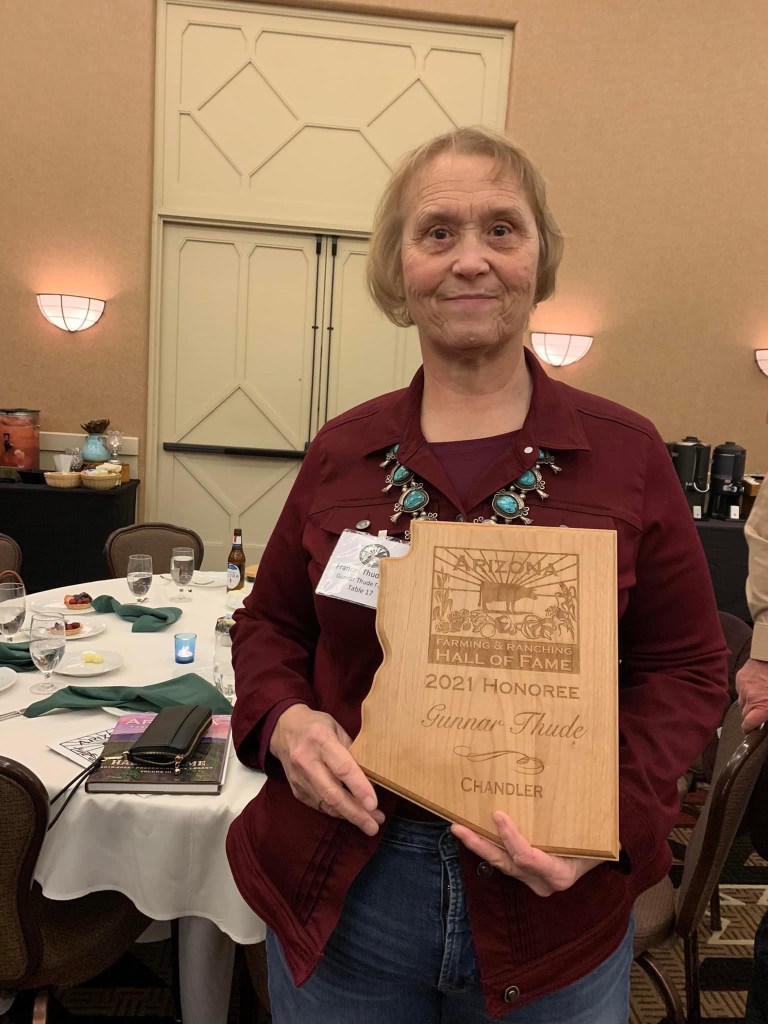
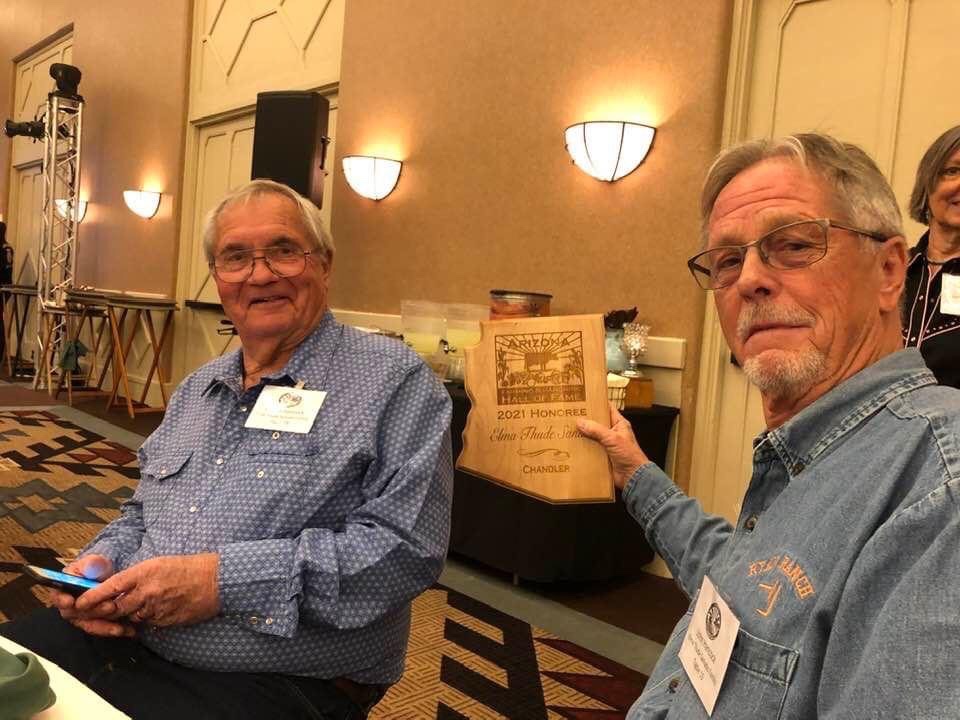
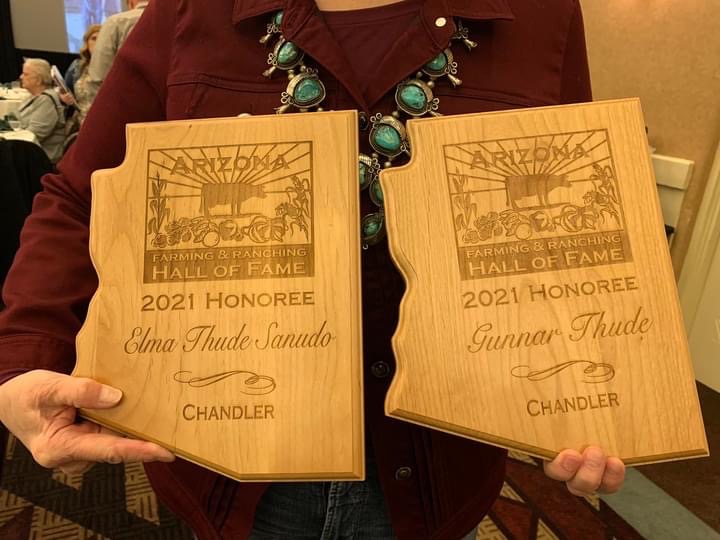
Saturday, March 5th, Gunnar Thude along with his daughter, Elma Sanudo, were inducted into the Arizona Farming and Ranching Hall of Fame (AZFARE.org). It was a great evening, and it was amazing that so many of the members of the two families were able to attend, even two from Denmark and Gunnar’s hometown. A few pictures from the event.
There were nine inductees that night. Congratulations to all of them!Susan Ellegaard, Betty Thude and Steffen Ellegard. The Ellegaard’s came from Gunnar’s hometown, Vilslev, Denmark, to share in the honor.Frances Thude Rice.Gerald Hancock and his brother, Gunnar Hancock; Elma Thude Sanudo’s children.Tony and Tony Lucas, nephew and uncle. Tony on the right was a herder for Gunnar Thude. The other Tony is a livestock inspector here in Arizona.Gunnar Thude and Elma Thude Sanudo – the family today. The woman sitting between the two women holding the plaques is Barbara Etchamendy. Her husband, JB, was also in the sheep business. More on him in another story.Congratulations Elma Thude Sanudo and Gunnar Thude!
The video shown March 5th. It is three minutes long. Please watch as it has pictures of Gunnar and Elma and information about them.
I was honored to be able to help these two families get nominated and inducted into the Arizona Farming and Ranching Hall of Fame. If you want to read more on this family, please see an earlier blog.
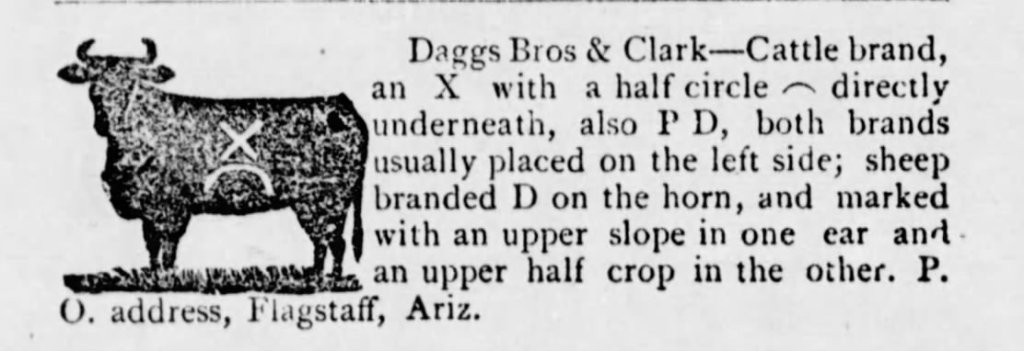
Looking through 1885 newspapers from across the state I found these sheep brands. It was the first time in my research that I had found sheep brands listed with the cattle brands. Only four found so far but the search is still ongoing. I am just half-way through 1885 newspapers.
My last post was about the Amos family coming to Arizona sometime in the mid 1880s. So far in researching the early newspapers the family name has not reappeared. Newspapers aren’t always available, but the search is still on for the Amos family.
In looking in the St. Johns Herald, a few other facts have been found about sheep raising in the first few months of 1885. The newspaper stated that the wool supply was to be unusually large for the spring. The lambing season was about over but had been most successful. The wool raisers would be starting to shear soon. No other details were given in the April 30th newspaper. There was a notice that A. A. Ward had 450 sheep of his sheep stolen and had recovered only 320. Details were not given on who had stolen the sheep and how Ward retrieved the majority of them.
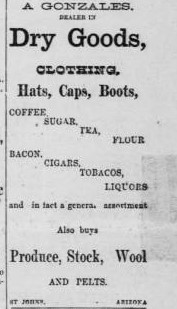
Another interesting piece of information concerned Don Antonio Gonzales, townsman of St. Johns, who had been “entirely happy in the increase of fully one hundred percent of his fluffy family this season.” He was the heir of not less than $50,000 all in wool and mutton. It is my belief from reading the full article that the mutton referred to was actually live animals as it mentioned he had been to see his lambs. The newspaper reported that he was now requiring everyone to address him as Mr. Gonzales! That $50,000 in today’s money would be $1,437,123.71! This researcher will keep an eye out for Mr. Gonzales and see how he does with all that wool and mutton. One other item caught my attention. There was an advertisement for goods that Antonio Gonzales sold. Mr. Gonzales now had another occupation!
And that is just a few tidbits of the sheep industry around St. Johns in 1885.
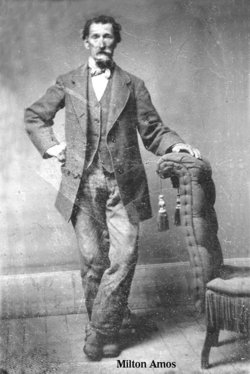
In an earlier post I shared some information on W. N. Amos and George Amos, sheep raisers of Northern Arizona in the late 1890s. Since then, more information has either been given to me or I have found in a variety of sources. The Amos Family, Milton and his wife Allie, came to Arizona from Oregon. Milton was born in either Kentucky or Tennessee,1827. His wife, born Alphidus Fanny, was born in Missouri, 1842. I find references for both in the U.S. Census data. At the time the family moved to Arizona, Milton was in his late 50s and Allie was in her 40s assuming an arrival date in Arizona in the mid 1880s. When the family arrived from Oregon, their children William (Will), Josephine, George, Abraham Lincoln (Abe), Charles D (Dick), Della and Len may have accompanied them. What information that we do have comes again from the 1880 and 1890 census. The first three children were born in Missouri, Abe and Dick were born in California. The last two children were born in Oregon. The family obviously did some moving around before finally settling in Arizona. Using just the date of birth of the children, the family did not remain in California very long as Dick was born there in 1876, five years after George’s birth in Missouri, and Della was born in Oregon in 1879. Why the moves has not been determined either. Looking at the location of births in California and then researching local newspapers may help shed light on what was happening with the family or economically that may have had them moving from Missouri to California, then Oregon. According to one source, all but one child came with them to Arizona. Josie, who had married in 1884 also died that same year and she may have died in childbirth, however that is speculation on the part of this author. More research will need to be done to prove that statement.
As to the actual date of arrival of the family into Arizona there is also debate. In Gene Luptak’s book From Top of the Pines Life in Pinetop and the White Mountains he states that Abe’s parents arrived in Arizona with three brothers-Len, Will and C.D. (Dick). He further states that it was the late 1880s or early 1890s. The St. Johns Herald, his brother Will was in the area at least as early as 1884 because he is mentioned in the February 12, 1885, newspaper being delinquent in paying his poll tax. Will would have been 21 years of age in 1884 and thus of the age to be able to vote. Again, speculation on the part of this author, but was his delinquency in not paying because he had returned to Oregon in 1884 upon the death of his sister and to help his parents and his other siblings move to Arizona? Was he the first to scout out the area in Arizona that they would settle in? Some more research will be needed to answer the question. The father Milton was listed in the 1880 census as being a farmer so Will may have been looking for good farmland. Again, all of this is speculation.
While I do not like that an exact date can not be determined for the family’s arrival into Arizona, we do have other information we can use to tell their story. More searching in the newspapers in St. Johns and surrounding communities will need to be undertaken to write a more accurate accounting of the family, however and that will take some time. Old newspapers are hard to read even when they have been digitized. But we will leave it here for today with that according to the family Milton died in April of 1887 shortly after their arrival.
The month of December wasn’t a good month for me with working on the Arizona Farming and Ranching Hall Of Fame Volume 3 book. But I am glad it is almost completed and about to go to printing stage. The book has many sheep families included-Basilio Aja, Antonio and Marianne Manterola, the Perry family, Frank Auza, Joseph, Pierre and Albert Pouquettes, Gunnar Thude and Elma Sanudo, and the Babbitts.
Many of these families have been honored here and as more information comes to light about each of them it also will be added. The Perry family and Babbitts have not had their stories told and that will be in the next couple of weeks. I am working on getting the Amos family story put together which is long over due. Once their story is added, I will do Babbitts and the Perry family. Then back to the old stories as I find them in the newspapers across the state.
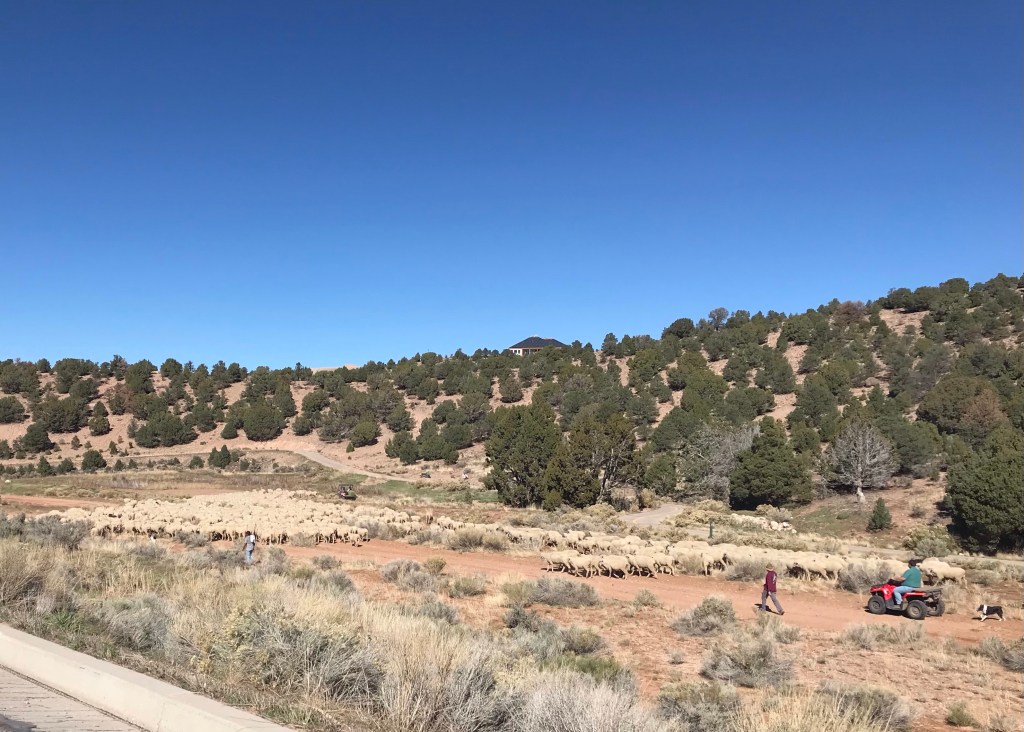
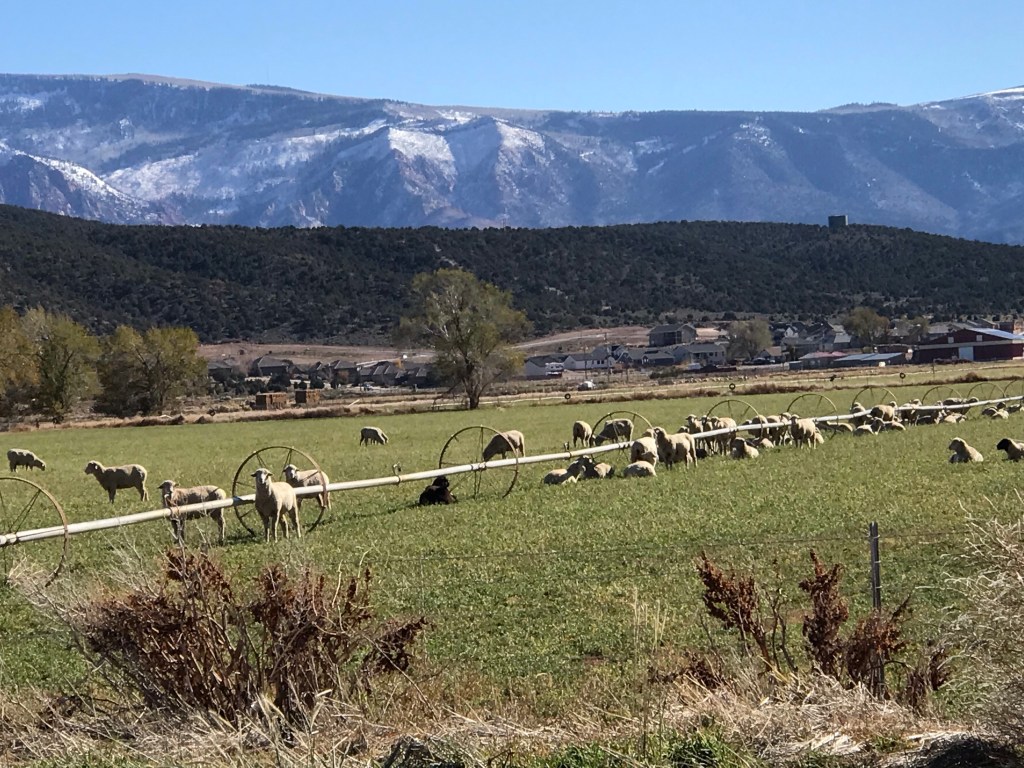
So until early next week enjoy the video from my trip in October to Cedar City’s Livestock Festival. it may not be Arizona but who cares, they’re sheep!
The June 19, 1897 issue of The Argus, Holbrook stated that one of their permanent sources of wealth was the sheep and wool industry. It went on to state that everyone showed an interest in being owners of sheep. Quoting, the newspaper stated, “It has been found to be a safe investment and exceedingly profitable. It beats stock speculations, gift-edge securities, money lending, bond purchasing or any other branch of business venture.” The newspaper further stated that a person could purchase sheep with a small investment and if was careful in their attention to the sheep business especially in husbandry they would reap benefits to the tune of being “comparatively well-to-do and enjoying a liberal yearly income.”
The newspaper continued, “Nature has lavishly fitted this section for the successful operation of this industry. The vast regions covered with nutritive grasses added to the varied altitudes in different localities, so that the flocks can be moved slowly from one place to another and obviate the extremes of the climate of one altitude, renders it a veritable paradise to the sheepman.” Sheep found shelter into the deep canyons and lower valleys of the county during the winter extremes. In summer when the heat began to be felt in these deep canyons and the lower valleys, the sheep could be moved to the slopes of the mountains where they would have “cool nights, the pure mountain water and the abundance of rich grass.”
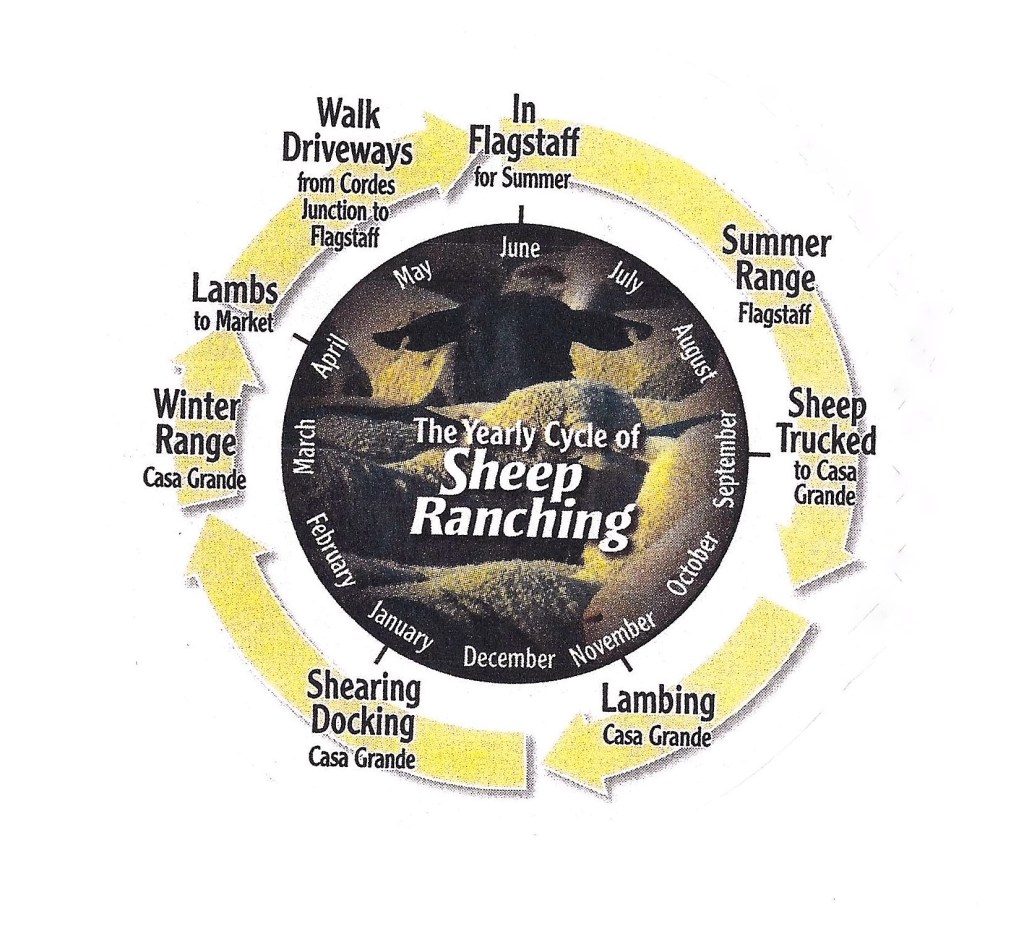
With following the sheep industry over the last few years and what was reported in the newspaper, it can best be described in what Carmen Auza called “The yearly Cycle in Sheep Ranching.” There are two differences from this chart to that as reported in the 1897 newspaper, and they are, the sheep were not moved long distances between summer and winter grazing land as they are today and mostly by truck, and lambing took place prior to shearing, not afterwards as in 1897.
The shearing season brings men work as the woolies all needed sheared. Shearing camps would be a frenzy of activity as fences were built, the shearing shed assembled and the sheep were brought in to be sheared. It was reported that over 100,000 were ranging in the county in 1897. More men could find jobs in the hauling of the wool clip to Holbrook for shipping. These activities took place from late March into May. Wool bags weighing upwards of 400 pounds were loaded on trains heading east. The Eastern wool buyers had already purchased the clip at the shearing camps. It was reported that in 1897, over a million pounds of wool was shipped from Holbrook. There was also additional wool that was on consignment from Winslow.
The newspaper went on, “During the last four years, while wool was on the free list, the sheep and wool industry languished. The Australian and European wool poured in and flooded our markets making the wool industry in the far West unprofitable through the lack of the cheap transportation by water which Europe and Australia enjoyed. Since the change of administration, with a reasonable prospect for the tariff upon wool to restored, the price of wool has been more than doubled, and the price of sheep has jumped from $1.25 per head to $2.75 and $3.00 per head. It is estimated that the wool sales in Navajo county last spring were $60,000 more than the year preceding, and the mutton sales will exceed last year by another $60,000. These excesses can be reckoned as clear profit to the sheep and wool growers of Navajo county, in addition to the increased value of their herds, due to the rise in the price of sheep. The sheepmen are jubilant and feel that the next four years to come will continue to be a season of golden harvests.”
During the 1897 season lambing season was in May. Most sheep owners had reported a 100 per cent increase in their herds so they were quite happy with their herds. Once lambing is over the flocks are slowly moved to their summer grazing areas in the cool pines of the mountains.
The newspaper reported that the sheep had no diseases. Sheep were dipped because of scab and sheep with scab were not allowed to be used for sacrifice as described in Leviticus 22:22. The disease may not have hit the area during this time but was definitely a problem in the west during the early 1900s. Dipping stations were established along the trails for the eradication of the disease in a flock and its spreading.
The newspaper also reported that there was greater profitability for the sheep owners if a scouring plant could be built in the area. Clean wool would ship at a lower cost than the unscoured and save the sheep owners money in freight cost. As the newspaper stated, “Dirt is cheap to pack up and ship to Boston at about three cents per pound. In the second place the wool would sell for vastly enhanced prices, enhancing the profits of wool-raising in addition to fostering a home enterprise giving employment to the laboring element in our midst. Then on the heels of this should follow a woolen mill. Few places on the face of the earth offer such unusual facilities for the profitable operation of a woolen mill. In numberless places along the Little Colorado, and on Silver Creek, and Show Low plenty of waterpower can be obtained at very little expense, and the raw material right at their door. These enterprises should be investigated and pushed to completion at once by our citizens. They are paying propositions and confer incalculable benefits upon this section.” The newspaper had high ambitions for the sheep industry in their county.
And that is a look at the sheep industry in 1897 as reported by The Argus, Holbrook and me, the jolly sheep lady.
It has been a few weeks since I have posted information that was found in the Argus, Holbrook, June 19, 1897, newspaper. The book that I am collecting the stories of the nominees for Arizona Farming and Ranching Hall of Fame Volume III, 2018-2022 is about completed. Once it is off to the publishers, I will be able to concentrate once again on the Arizona sheep industry. Of course, there are a few nominees being honored that were sheep raisers here in Arizona – Anthony “Tony” and Marianne Etchart Manterola, Frank Auza, the Pouquette Family (Joseph, Pierre and Albert) and the father/daughter team of Gunnar Thude and Elma Thude Sanudo. More will be posted about those that have not already been written about here after the book is published and distributed at the Arizona Farming and Ranching Hall of Fame dinner, March 5, 2022. But back to 1897….
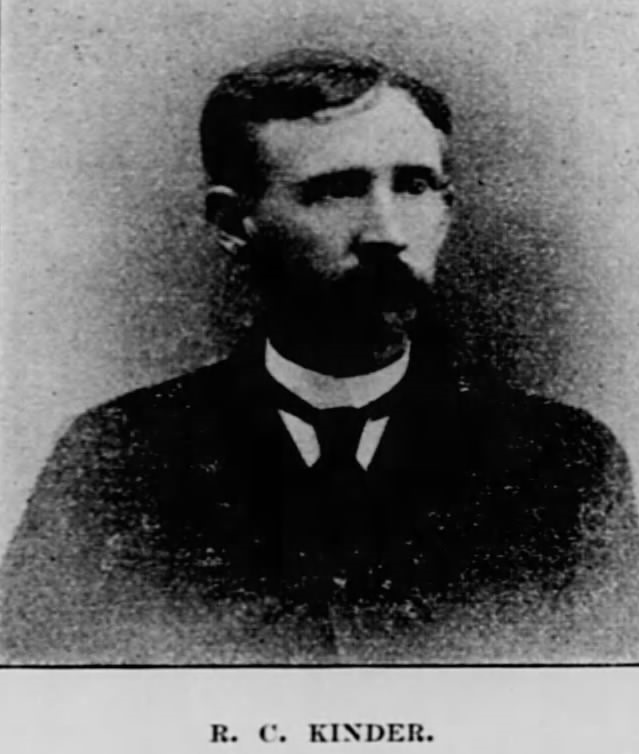
We have six sheep raisers that were given a nice little write-up in the Argus. All but one I have included the picture that accompanied the story. There were pictures for all the men but one had a streak across and was not able to be copied. In most cases, the story about each has been left to be the exact wording from the newspaper as I personally found their stories interesting. Where a place is named that is not common to most people, I have given a general location for them.
Hon. James D. Houck is a native of Meggs county, Ohio. (Meigs County is southeast of Columbus, Ohio along the Ohio River with West Virginia). During the rebellion he enlisted in the Thirty-first Wisconsin regiment, belonging to Company “H”, where he saw considerable hard service, being with Sherman on his march to Atlanta and the sea. Shortly after the war he came West and roamed over Wyoming, Colorado and New Mexico prospecting. He came to Arizona in 1872 and in 1874 he carried the first mail between Sunset Pass and Fort Wingate,(Sunset Pass is on Route 87 south of Holbrook and Fort Wingate is near Gallup, New Mexico) and in 1875 and 1976 he carried the mail from Beaverhead to Rock Station (have not been able to identify these two locations, but most likely Beaverhead is the formation near Oak Creek). In the fall of 1876, he built a ranch and trading post at what is known as Houck’s Tank (probably Houck, Arizona today), where he remained trading with the Indians until 1883, when he removed to Holbrook and went into the sheep and cattle business. Mr. Houck has now disposed of his cattle interests and confined himself entirely to sheep raising. He is a successful businessman and by through honesty and fair dealing has made hosts of friends in this section. He is a man of determination and nerve and served as deputy sheriff of Apache county under C. P. Owens and rendered valuable assistance in suppressing the lawlessness which existed in those turbulent days. Mr. Houck also served as member of the Thirteenth Legislature of Arizona. During his long career in this section, in public as well as private affairs, he has exhibited a sterling integrity, and has always been an honest and upright citizen, and has won the confidence and respect of all who know him.
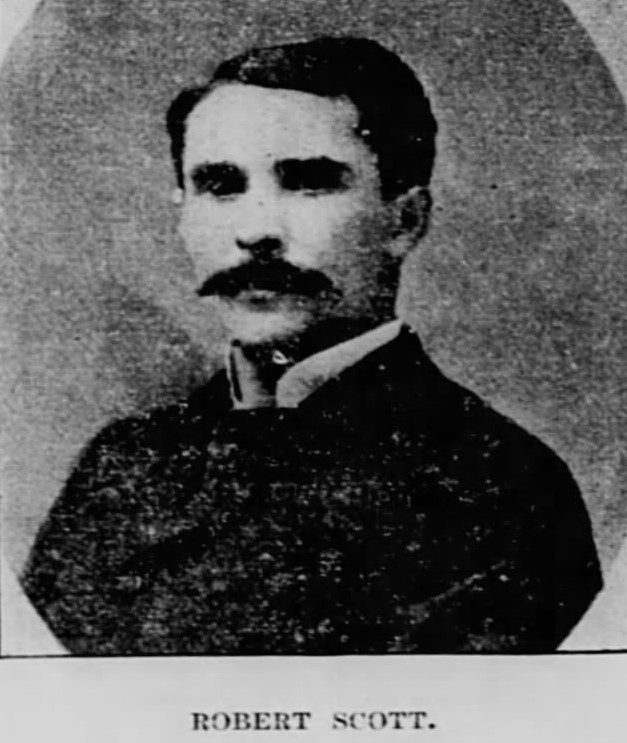
Robert Scott was born in the state of Oregon, and came to Arizona in 1887, settling on the Show Low. He became interested in sheep and horses and has enjoyed an unusual degree of prosperity. He owns several fine bands of sheep, and splendid horses. He also owns several ranches near Show Low and in connection with his other business farms on an extensive scale. He is a thorough businessman, square and upright in his dealings with his fellowmen, firm, trusty and reliable; he enjoys an enviable reputation among his acquaintance. He has never held any public office. Though often urged to become a candidate he has steadfastly refused preferring to devote all his time and attention to his extensive business interests.
George Scott came to Arizona after the arrival of his brothers, Robert and James Scott. Like his brothers he engaged in sheep raising and is now the owner of quite a large herd. He is a pleasant, affable gentleman, and is well thought of among his friends and acquaintances. Mr. Scott in connection with his sheep interests owns several ranches around Pinetop, located among the beautiful pines on the crest of the Mogollon’s. He is a single man and would be a prize for any marriageable young lady to capture.
W. N. Amos of Pinetop is a native of the state of Oregon, and came to Arizona in 1883, where he embarked in the business of sheep raising. He is a young man of only 33 but possessing good judgment and rare business faculties he has been eminently successful, and the firm of Amos Brothers is now one of the prominent sheep raisers in this section. In addition to their sheep interests, they own several ranches around Pinetop. W. N. Amos is a man of family and has an estimable wife and two interesting children. He is now erecting a beautiful resident among the fragrant pines on the banks of the Show Low about four miles from Pinetop. Mr. Amos is a member of the Masonic order, an exemplary citizen, and has the confidence and esteem of everyone who has had contact with him.
George Amos like his brother W. N. was born in Oregon and came to Arizona about four years after his brother, 1887. He went into partnership with his brother W. N. and through their united energies they have accumulated a goodly portion of this world’s goods. George is a single man only about 27 years old, and lives with his brother, having, so far not entered the matrimonial state. He has the reputation among his acquaintances of being the best-informed man about sheep raising, and wool growing in this part of the country, and his keen faculties of observation, strict attention to business has contributed largely to their success. He is a quiet, sober, industrious fellow, has but little to say, yet it is the lot of only few men to have more friends, and to be more universally respected in the community in which they live than George Amos.
R. C. Kinder was born in Illinois in 1857. He went to California while a youth and remained until he was 19 years old when he decided to make Arizona the base of his future operations. He landed in this territory in 1879 and engaged in the cattle business. He finally disposed of his cattle interests and has for several years devoted his attention to sheep raising. He was married eleven years ago to an estimable lady in Texas and resides with his family at Holbrook. Mr. Kinder, besides his sheep interests, owns considerable property in the county, and valuable property at Fort Worth, Texas. He is a member of the Masonic order and has twice held the position of Worshipful Master of his lodge.
And that is just a few of the early sheep raisers of Arizona in 1897. Next blog will be on the health of the sheep industry in 1897.
Just a few mentions of the sheep industry from the 1897 Holbrook Argus today.
The Holbrook Argus reported that “Navajo county offers excellent facilities for various kinds of manufactories, such as wool scouring plants, woolen mill, tannery and a beet sugar factory. The raw material can be produced in abundance at their doors; water- power for such plants is easily obtained with fuel in easy reach.” I know that a woolen mill was at Tuba City but that is Coconino County. Later in the paper, there is mention of “a wool scouring plant has been built at Concho, which has been operated with profit.” It would be interesting to know how many years it was in operation, those years and what happened to the plant in Concho? More research to do!
This edition of the paper has many unreadable portions and thus it is hard to write about all the sheep happenings. It mentions that in the Show Low area Henry (Huning) had a magnificent ranch and he managed an extensive sheep and cattle interest. I put Huning as Henry’s last name as it is only possible to read Hun. Bert Haskett’s “History of the Sheep Industry in Arizona” listed Henry Huning from Navajo County. Huning is listed several other places in newspapers so I am fairly certain that I have the correct last name. Heber was listed as a thrifty community with sheep men. Linden and Pinedale were reported as having excellent grazing in the surrounding timbered region where sheep flourished.
Two more towns were mentioned. Linden and Pinedale lie in a westerly direction from Show Low. In both of these places crops are raised without irrigation. Excellent grazing is afforded in the surrounding timbered region: stock and sheep flourish.
One of the four general merchandise companies in Holbrook was A. & B. Schuster. They were on the 1903 list of the Arizona Wool Growers’ running sheep in the St. Johns vicinity.
That concludes our look at 1897 for today. Next will be stories on James Scott, J.X. Woods, and Ben Schuster. But there will be more stories too.
Courtesy of the Navajo County Historical Society, Holbrook, Arizona
I owe the next several stories to Lonnie West who read an earlier blog and commented on it. Through that comment we exchanged emails and he proceeded to send me more information on his family – Amos. From one of the articles he sent, I decided to do my own research of the first newspaper mentioned and what a wealth of information awaited me to read, digest and write about. This newspaper, The Holbrook Argus, 6-19-1897 was a compilation of events in Apache and Navajo Counties of northern Arizona, the people who settled the area with pictures of these men and some women and pictures of other events that took place. It will be days before I can relate all the information to you, but let’s get started.
The paper began giving some basic facts about Navajo County. It stated that there were about 75,000 cattle and 100,000 sheep. Further, it believed that the section north of the Little Colorado, with an occasional ranch and/or settlement would remain a grazing country forever. Think about it, the year is 1897 and thousands of sheep and cattle roamed the northern portion of the county. Today, sheep may be gone except what is found on the Navajo and Hopi Reservations but there are still cattle in the area.
The paper also looked at the livestock industry for Apache County. Here though sheep really outnumbered cattle; 15,000 cattle to 98,500, sheep. Previous years had not been good for either sheep or cattle in Apache county though. Drought during the previous years reduced the number of livestock. (it makes me wonders if there were that many sheep and cattle, how many were there before the livestock men reduced their herds?) An abundance of rain fell in 1896 and the ranges were covered with lush grasses. The winter snows saw heavy snow falls in the mountains during the winter of 1897 and the rains that had started in June had given hope to the livestock men as they gazed out on the land. It looked like the future was promising for good grazing. That particular portion of the paper ended on a high note stating that herds were being increased instead of decreased.
I find it fascinating that sheep outnumbered cattle two to one in these two counties. It would be interesting to find statistical information for the next years to see how the numbers fluctuated in both cattle and sheep. Ah, research is so fun!
We will leave our story for the moment. There is much to write about for the sheep industry in the days ahead.











 ArizonaSheepHistory.wordpress.com