
To finish the March newspaper articles that may be considered of interest to those who once raised “woolies” I have condensed those articles here.
There were two concerns in the state – “Sore Lip” and Foot and Mouth Disease. Sore lip is a disease that affected sheep, goats, and hogs and in the later part of March was a problem in southern Arizona among mainly goats. Foot and Mouth disease had affected nine counties in California and Arizona Governor Hunt had proclaimed an absolute quarantine against any and all kinds of livestock and agricultural products from entering the State of Arizona. The disease had also been declared a national emergency by the President of the United States. He had asked Congress for one million dollars to help fight the disease. This was not the first outbreak of the disease. The first occurred in 1870 when imported cattle from Scotland were found to have the disease. Other outbreaks occurred in 1880, 1884, 1902, 1908 and 1914. Each epidemic seemed to been a little worse than the last, but 1914 was the worst year when 22 states and the District of Columbia were infected.
A formal designation was made for three Arizona forest areas, on which extensive studies were to be made by the Forest service to determine the “carrying capacity” of various types of grazing land for sheep and cattle. This was announced by T. T. Swift, district forester. The three studies areas were:
- A browse study was to be conducted on the Clark allotment in the Cook National Forest.
- The second area was to be on the Horrell allotment of the Tonto National Forest for determining the desert type grazing capacity.
- The final study, a production study was to be conducted on the Tom Cavness allotment on the Tonto Range on Lime Creek. This allotment was a mixed grass and browse run.
A fourth area would to be announced for the Coronado Forest.
These experiments would be conducted over a period of years to determine how many cattle and sheep could graze on a given area. Each allotment had about 11,000 acres.
While the study was to be for grazing capacity of lands for both sheep and cattle, these were all cattle allotments. It will be of interest to this researcher if more information will be found on these studies, if only cattle, or if sheep were included. I will keep my readers posted if such information becomes available.
Wool and its stockpiles on the railroad station in Wickenburg by the sheep companies Babbitt and DeRyder were announced as wool was one of the major products shipped from this city to the east. It was important for the city for its economic well being but also to the sheep companies as two armed guards were reported to be on duty 24/7!
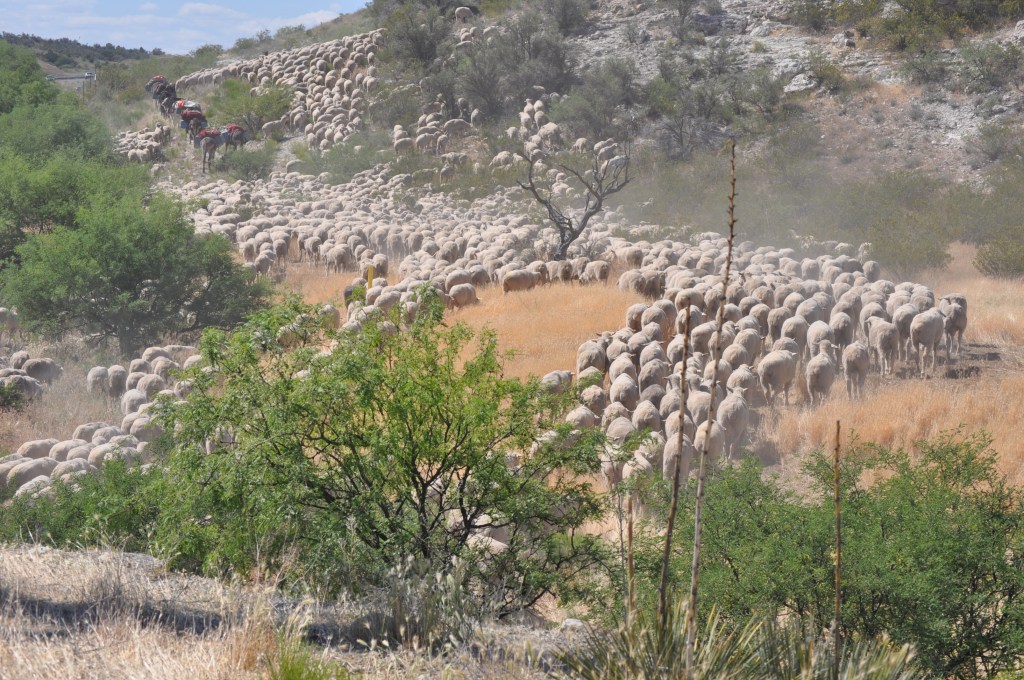
And finally who could not enjoy knowing that an army of 65,000 sheep were about to head north on the Heber-Reno trail within the next few days to enjoy their summer vacation in the cooler temperatures of the White Mountains!
That concludes the sheep news for March 1924. I will be working on April this week.


 ArizonaSheepHistory.wordpress.com