137 Years Plus of Arizona Sheep Producers

This year, 2023, marks the 137 year of Arizona sheep industry, raising sheep for their wool and meat. In 1886, sheep men realized the importance of joining together for the good of their industry and to preserve a way of life that many coming to the United States had participated in in their own countries but could not sustain that lifestyle in their own country for a variety of reasons. Sheep raising had taken place in Arizona from the time of the Spaniards who brought them into the pueblos of New Mexico and the Navajo brought them into Arizona. And Father Kino is also credited with bringing domestic sheep into Arizona in the late 1680s. But this was the first time the men joined together to promote the industry. While not germane, the cattle people didn’t organize as early as this. Forgive me if the date slips my mind!

In 1961, the 75th anniversary of the industry, The Arizona Wool Growers’ Association, took place in Flagstaff as it had in past years.  The men and a few women would have the opportunity to “talk shop” – discuss common problems of the sheep raisers, the problems of the trade and seek ways of maintaining their rightful position in the ever-changing industrial world that had seen synthetics developed that resulted in a decline for wool to be used for fabrics. Today, there is no meeting of the sheep families in Arizona as there is only one family of three generations still in the business of raising sheep.

In 1961, sheep numbers had been decreasing and in fact, every year since the end of World War II when wool was used for service personnel uniforms, backpacks, blankets, and other items. Military uniforms, or at least dress blues, are once again being made from wool. But the amount of wool needed to produce these uniforms will never equal what had been used by the military in the past.

There are sewing contests across the country to promote the use of wool by both men and women. In Arizona the contest is sponsored by the few ladies and those interested who have joined together and are known as the Arizona Wool Growers’ Auxiliary. Each year, the contest is held in November and price money is given for the first, second and third place winners in each of the categories.

Other ways that were used in the past to increase the interest in and buying of wool and sheep meat will be presented in a future blog.

A picture and a Conference.

Thanks to everyone who continues to follow my blog. I don’t always get the time to post as much as I would like to. Today’s blog will include a picture from The Stockman, July 1959. I love when I can add pictures as a picture is worth a thousand words and, in fact, we are getting three pictures in one here. The caption has been included.

I am also including information of the first national lamb and wool conference that was to be held during August of 1960 in Laramie, Wyoming.  In the 1950s lamb and wool prices were down and the industry was being reduced – by the numbers in the business, price for the wool and lamb sold for meat.  This not only affected the sheep raisers but the textile manufacturers, who also attended the conference.

The main aim of the conference was “to improve the economic position of the sheep industry and to enable it to better fulfill its responsibility to the consuming public and to the nation through… examination of problems, … review of new developments, and … stimulation of industry action”. 

Hopefully in future The Stockman information will be forthcoming on the decisions that the two industries agreed upon to improve the economic outlook for both sheep raisers and the textile manufacturers. Nevertheless, I will be pursuing this conference from other sources if The Stockman does not report on it. The magazine had a few more years of publication; however, I have only found two more years. Luckily, this won’t be the only source of information for this conference.

So, stay tuned as further research is needed to report on the happening at this conference!

Sheep crossings

Found this on the front cover of Stockman magazine. There are some problems with their description.

“For many years the sheep and wool industry has played an important part in the economy of Arizona and the southwest.

“From the irrigated pasture lands of the Salt River Valley to the natural grazing range land near Springerville in the White Mountains some 200 miles to the north, each year sheep by the hundreds make their way across the rugged desert and mountain land along the Heber-Reno Stock Trail, cross rivers and streams to reach this summer grazing area.

“In more recent years a sheep bridge has been constructed across the Salt River northeast of Mesa to provide faster crossing and eliminate the loss by drowning previously experienced. Here on our cover are scenes of a typical crossing of the Salt. Sheep are funneled on the suspension bridge approach, and as the leaders are crowded forward the bridge swings and sways under the thousands of trampling feet.”

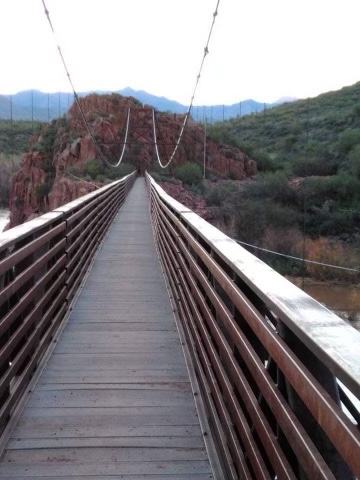
Author’s note: The picture of the bridge above is on the Verde River built during World War II by Frank Auza and other sheepmen. A new bridge was built across in the 1980s (I believe that is the correct time period because it was dangerous to cross when campers began taking its wood for camp fires.

Salt River Bridge

I received the above picture from Gerald Hancock whose grandfather, Gunnar Thude was in the sheep business.

Back to their description of the pictures: “Long time secretary of that organization, and one of the most popular and well respected men in the industry is the genial Harry Embach shown in the inset of our (Stockman Magazine cover picture. Mr. Embach has been secretary of the Arizona Wool Growers for more years than he cares to recall, though he insists they have been pleasant years.”

Verde River Bridge today. Courtesy of Gerald Hancock!

I have been to this new bridge and walked a portion of the trail. I would have loved to have been there when the sheepmen brought their sheep across. A perfect place for photographs would have been on top of that little hill or on that hill tucked away out of the way of the sheep and sheepmen and herders. The forest service would have a ranger here counting the sheep for assessment to the sheepmen for use of the trail on the forest.

Keep watch for more Arizona sheep history.

Wool for New 1959 Cars

Did you know that wool upholstery was used in many cars back in the 1950s?  While this story isn’t about Arizona and the sheep industry, who is to say that Arizona’s sheep wool wasn’t used in that upholstery? We may never know. Here is the rest of the story:

According to Edward Loerke, Detroit representative for the Wool Bureau, the Lincoln division of the Ford Motor Company delivered in early 1959 the new Continental town car upholstered entirely in gray wool broadcloth. The first limousine model to be introduced by Lincoln in more than 20 years, the town car brought to five the number of 1959 cars that carried wool upholstery as standard equipment.

The 1959 Imperial LeBaron and Crown Imperial feature wool broadcloth in deep tones of green, blue, brown, ruby and gray, while the Chrysler New Yorker four-door sedan used rich wool broadcloth in a variety of light and medium colors to blend with the exterior finish.

Cadillac’s Eldorado Brougham for 1959 was upholstered in solid and patterned all-wool broadcloth in light blue, light gray, and beige. These same colors were used in the interiors of the Buick Electra and Electra 225 series. In buying the Buick, the customer had a choice of either wool upholstery or a substitute fabric at no extra cost.

Many of a sheepmen told me that sheep rode in their cars when they were needed to be moved for various reasons. Why you ask would someone allow a sheep in their car? Well, the sheepmen told me the sheep paid for the car!

Somewhere in all my pictures given to me by the different sheepmen in Arizona, I had a picture of a sheep in a car, but its location eludes me at the moment! Will keep looking.

Wool Production Increases 1958

Arizona Wool production in 1958 was estimated to be higher by two per cent over that of 1957. Projection for 1958 is estimated at 3,141,000 compared to 3,055,000 in 1957. It was 10 per cent higher than the 10 year average for the years 1947-1956. The increase for 1958 was due to 2,000 more sheep shorn this year (431,000) and the increase in average weight per fleece.

The United States as a whole saw an increase of two per cent increase in wool shorn for 1958. There was an increase of three per cent more sheep shorn across the states but with a decrease of 1 per cent in average fleece weight. Total wool shorn was 240,446,000 pounds in the United States. There were 29,418,000 sheep shorn.

Arizona was only a small percentage of the total for the United States. At this time in Arizona there were few sheep outfits, but then Arizona never had more than 200 sheep outfits at the height of the industry, and it was probably more in the neighborhood of 150, and the state had just shy of two million sheep.

The above information comes from The Stockman, September 1958.

For comparison, as of January 1, 2023, the United States has 5 million sheep with sheep found in every state, including Alaska and Hawaii. Arizona is listed as having 90,000 sheep which includes those sheep on the reservations. Arizona ranks second in the number of total sheep operations, 7,509; and with Texas having nearly double that number, 14,672. These figures are found at http://www.sheepusa.org – The American Sheep Industry.

A Man, A Few Sheep and Greenlee County, Arizona

In April 1923, The Morning Sun, Yuma, reported how one farmer in Greenlee County showed the value of raising sheep on the Arizona farm. Quoting the newspaper the man showed “just what can be done by a progressive man, alone.” The man moved into the county a few years ago bringing with him in a wagon a few Mexican ewes. As of the writing of the article one of these ewes was still on his farm. She had proved her worth by producing some of the best shearing ewes. The ewe “is of the open-faced, clean-legged kind, with a good smooth covering of flesh”. Rambouillet bucks were used for breeding when he first began until the quality of wool had increase and, as of the writing of the article, now used pure bred Hampshire bucks. Very robust lambs are now being obtained. He cannot keep up the demand for market lambs and had used his power to encourage other farmers to also raise sheep. The man believed that two or three other flocks would do well in the area.

The man had used the sheep to clear out Johnson grass in one of his pastures. The article also stated that “The worth of sheep on ditch banks is well known all over the State, and once a man has tried it, he is only the more convinced that this is, by far, the best solution, even though a little extra initial investment is required for fencing the ditch banks and obtaining the foundation flock.”

The article concluded that sheep raisers figured that one lamb paid for the ewe’s winter keep and the wool and other lamb, as most ewes have two lambs, represent the profit to the farmer.

What is unfortunate about this article is that we do not know when the man started his sheep flock, the number of sheep he ran after his initial bringing of the ewes into Greenlee County, where he obtained the bucks for breeding, no do we know who he was. But sometimes that is all the information one can find in the early newspapers and as more newspapers are read, hopefully more information will come to light about the gentleman!

April 1923 Sheep Facts

Just some short snippets of sheep happenings appeared during the month of April 1923 to report on the sheep industry. Leonard D. Cox applied for sheep brands as was posted in the Winslow Daily Mail, April 6, 1923.

Even back in 1923, sheep raisers had lots of sheep as found in the April 13, 1923, The Coconino Sun. It seemed that John Pollard had been in Seligman the better part of a week where he was supervising the dewooling of some 25,000 head of sheep for the Hudspeth Sheep Company.

Other sightings were that sheep raisers, Ramon Aso, Harlow Yaeger and Charlie Woolfolk had spent time in Flagstaff as they took a break from their flocks. But sheep raisers Dan. M. Francis and Charlie De Ryder were heading to their shearing operations to oversee the work. It was reported that De Ryder had extensive sheep ranges in the Yuma area. M. I. Powers was also supervising the shearing of his sheep.

Little pieces of news about different sheep raisers help to tell who was in the business at any given time and thus those names can be looked for in newspapers in future months and years. As I look at earlier newspapers, I have names to search for also. Someday I will have a complete record of all those sheep raisers as not all of them were members of the Arizona Wool Producers Association.

Yuma’s Sheep

A new name in the sheep industry in Arizona was found while researching newspapers from 100 years ago this month. The headline “Yuma Lambs Bring Good Prices in L. A. Markets was found in The Morning Sun, Yuma, March 24, 1923.  It seems that James Maxey had just shipped three carloads of lambs to the Los Angeles market. He had a ranch in the upper valley of Yuma.  Quoting from the article, “they were born after November 16, and weigh now slightly more than seventy pounds each. They were sold on contract for fourteen cents, which is considered a very good price. Mr. Maxey has gone quite extensively into sheep raising and he is of the belief that sheep raising for both wool and mutton will put the Yuma country on the map and bring more real money to the valley than many other lines of farming.”

The Yuma area did have other sheep families and their stories will be told as my research continues. More research of The Morning Sun, Yuma must be undertaken to see what other tidbits are found on Mr. Maxey and his sheep and the other sheep families in Yuma. I’ll keep you posted on my findings.


Etchamendy Sheep Family

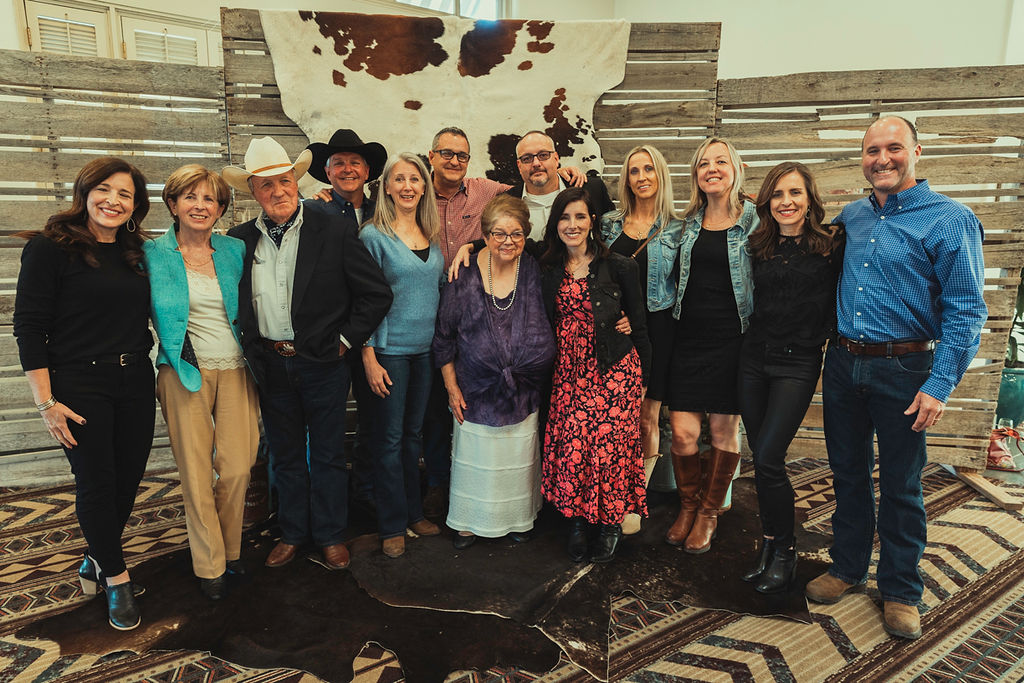
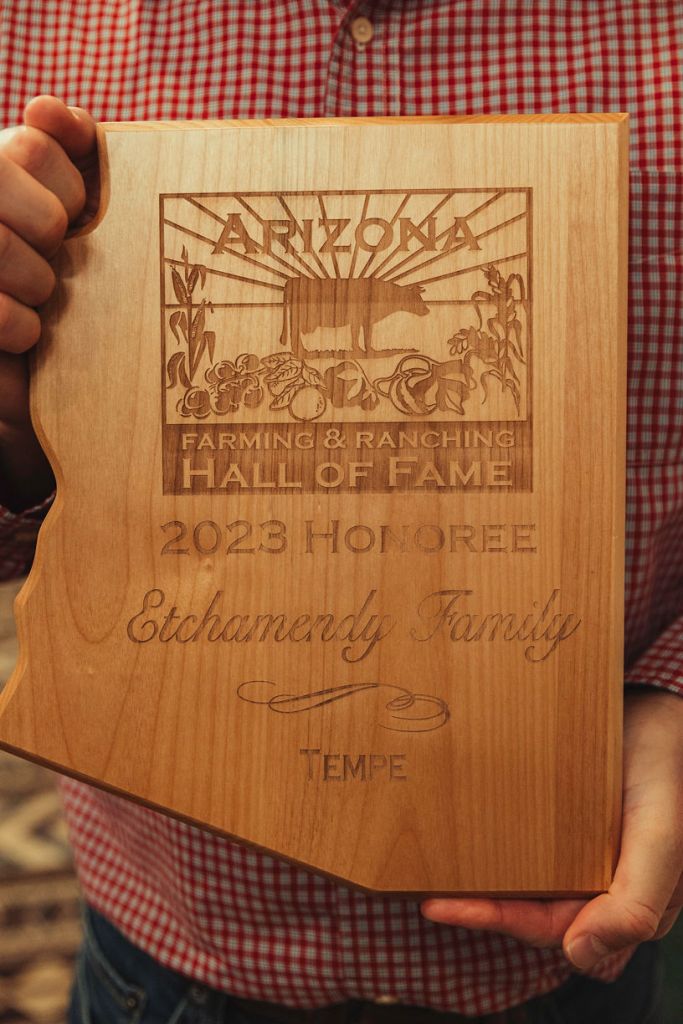
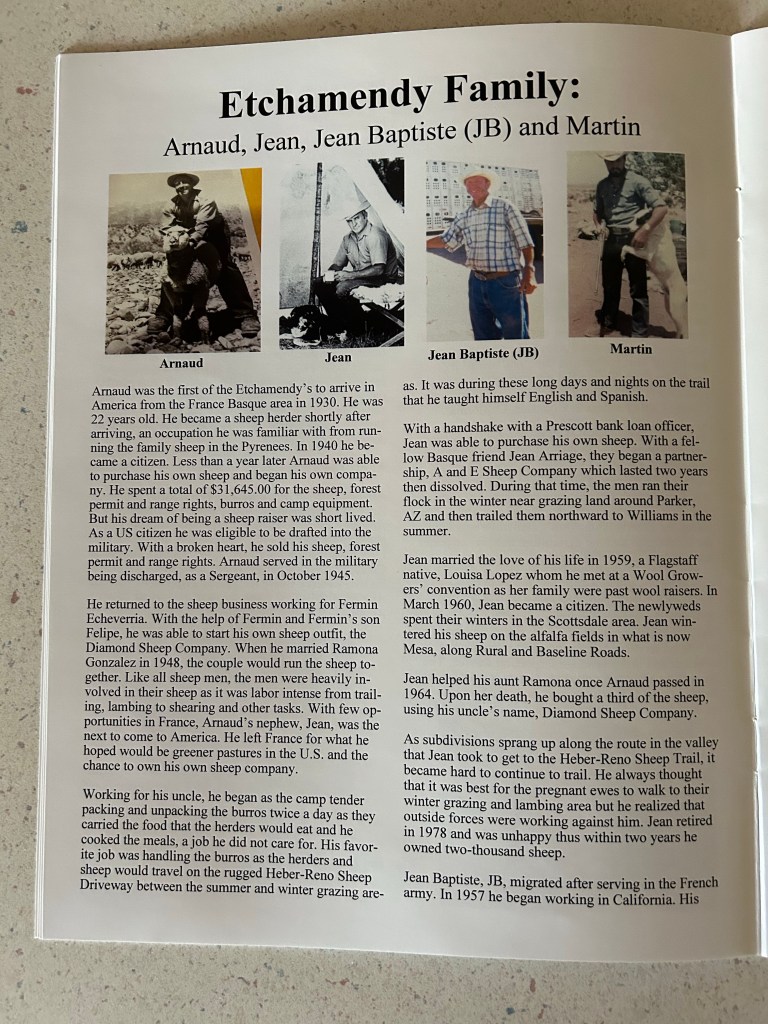
Last Saturday night, March 4, 2023, Arnaud, Jean, JB and Martin were inducted into the Arizona Farming and Ranching Hall of Fame. It was a great evening and the Etchamendy’s certainly deserved this honor. Accepting the award for the family was Martin, the last surviving Etchamendy man in the sheep business. He still has sheep but he has his flocks in the Bakersfield are of California.

One last picture

Sheep in the Buckeye Valley Again

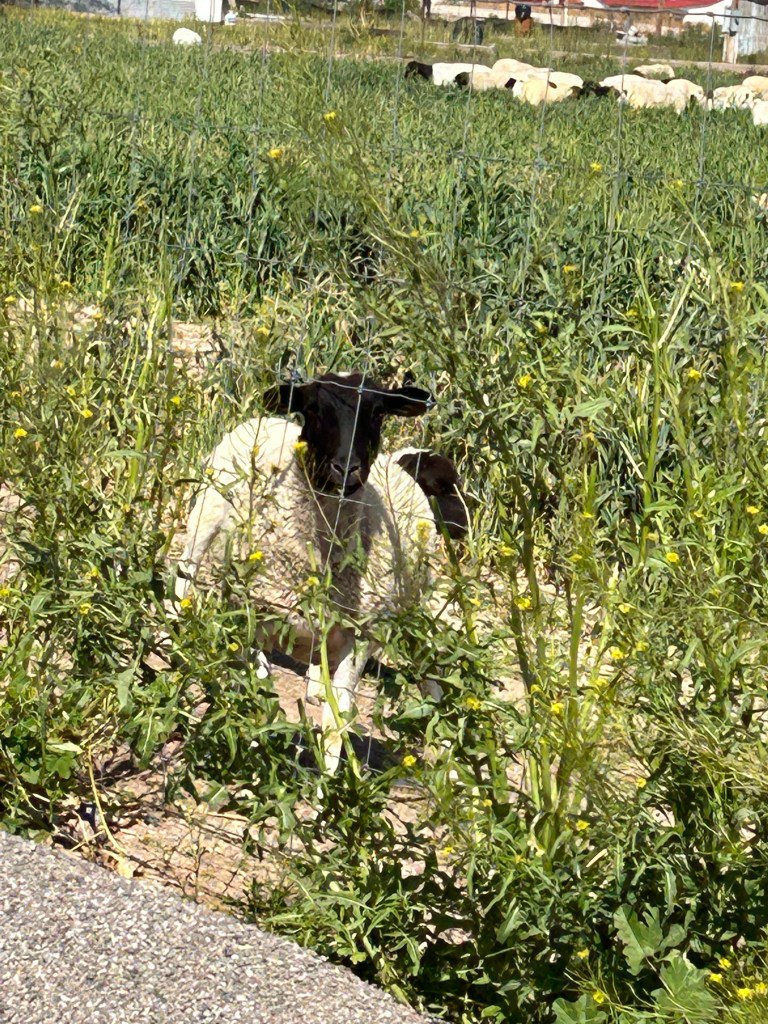
For several weeks I have been watching a small flock of sheep in a field in the Buckeye area. At one time thousands of sheep could be seen in the winter time grazing on the grasses here. The sheep had been either trailed, pre 1950s and then trucked afterwards to the Buckeye area from their summer grazing area in the high country of northern Arizona. At this time the ewes were pregnant and would start to have their lambs between November-February.

The sheep could cause traffic jams as they were moved from one pasture to another. They had the right of way and heaven forbid you were in a hurry to get someplace. Sheep only move as fast or slow as they want. It took careful planning and help of trained dogs to get the sheep between pastures. Shearing would follow in February.

Just a little history from the past.