The River Crossing

Today we concluded the final stage of my husband and I following the sheep. While I have been on the trail many times I never regret the time I get to spend watching a part of the Arizona history that has taken place over the last one hundred years. The Auza’s have been part of this history since the mid 1910s with Frank Auza came to the United States as a young boy and went into the sheep business during the Spanish flu pandemic. I have written about the Auza’s history in an earlier blog so I will not repeat it here.

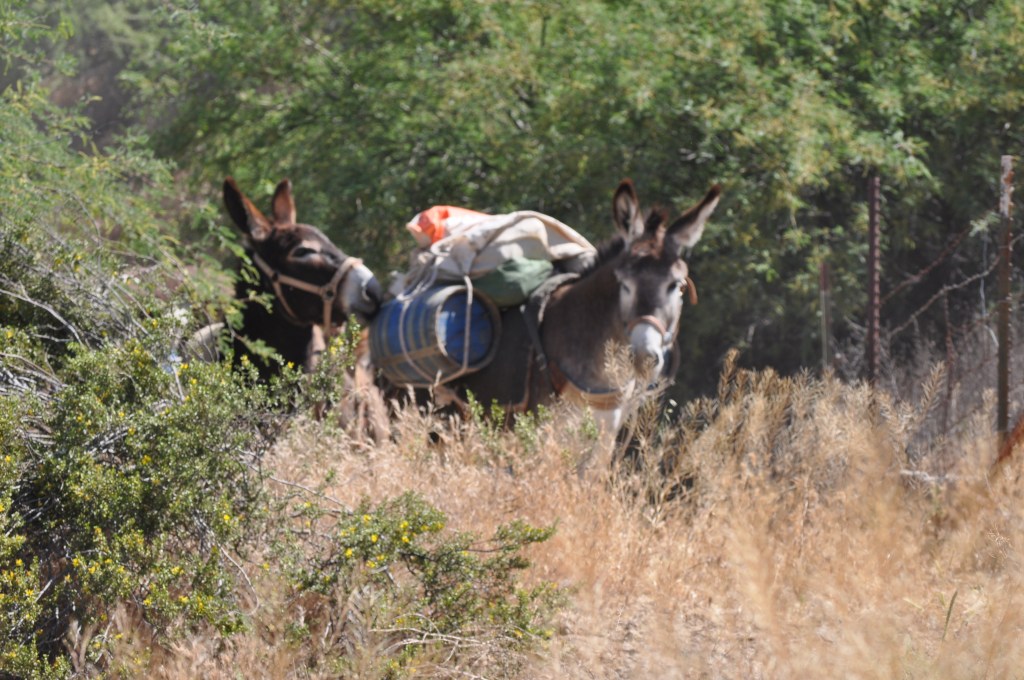
The Auza’s, other family members and friends begin to arrive at the park about noon.  An area on the grass under the trees was hastily made into a picnic area. Tables were set up, tablecloths graced the tables and food: fried chicken, cooked beans, a variety of salads, vegetables, potato chips, and dessert. Water and soft drinks were already chilling in coolers. The herders arrived with three donkeys and removed the boxes that they carried. Supplies for the next few days was unloaded from the owners’ trucks and piled on the ground. Eggs, potatoes, fruit, ramen noodles, etc., were then loaded in the boxes and fastened back on the donkeys once again.   Any supplies that could not be put in these boxes was carried down to the river by the men and would be loaded on the other donkeys. The herders were not gone long as they were the guest of honor at the picnic and went through first to be feed.  Then everyone else helped themselves. It was during this time that I gave Jose the pictures from Friday’s adventures and he seemed pleased that I remembered to make copies for him.  I promise that when I saw them the next time, I would have more pictures for them.
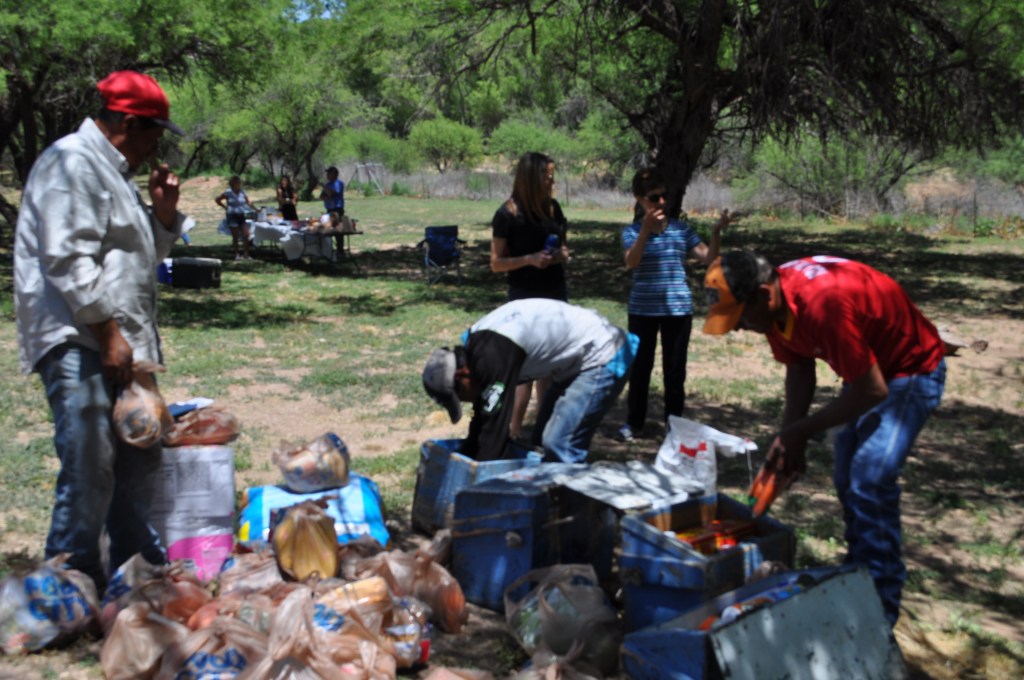
Supplies for the herders.
Family, friends and herders enjoy a picnic lunch. The herders are in the background next to the tree.

After eating, two of the herders left and headed back to the river along with some of the family members and friends. Jose stayed and grabbed chicken and other items that they could take with them on the trail. Tonight, the camp tender would not have to cook! The family worked together and picked up food that needed to be kept cold. Then the rest of us headed to the river. Margaret accompanied Carmen and me.

Other onlookers had started to gather at the designated time of 1 PM and were watching for the family to head to the river. Others had already gone down to where the sheep were. One family had two small children, one in a stroller!  The men headed to help the herders as two donkeys were not cooperative and did not want to stand still while the boxes were loaded on them. With the donkeys loaded, a herder set out with them to take them across the river.

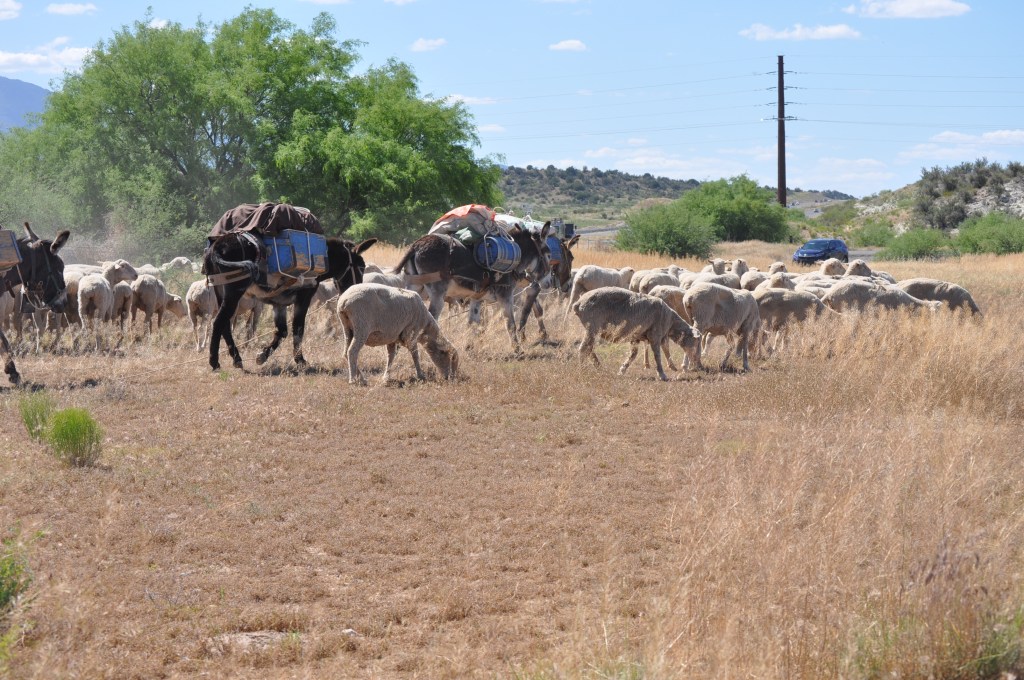
Donkeys heading to the river.
Three generations of Auza’s

I am sure that anyone who was watching from above in a plane or flew a drone over the scene would think pandemonium had set in. But there is a process to move the sheep and the herders and those who have done this before knew what needed to be accomplished to get the sheep across the river. The family and friends began to move around the flank of the sheep.

Family and friends head to the river behind the donkeys.

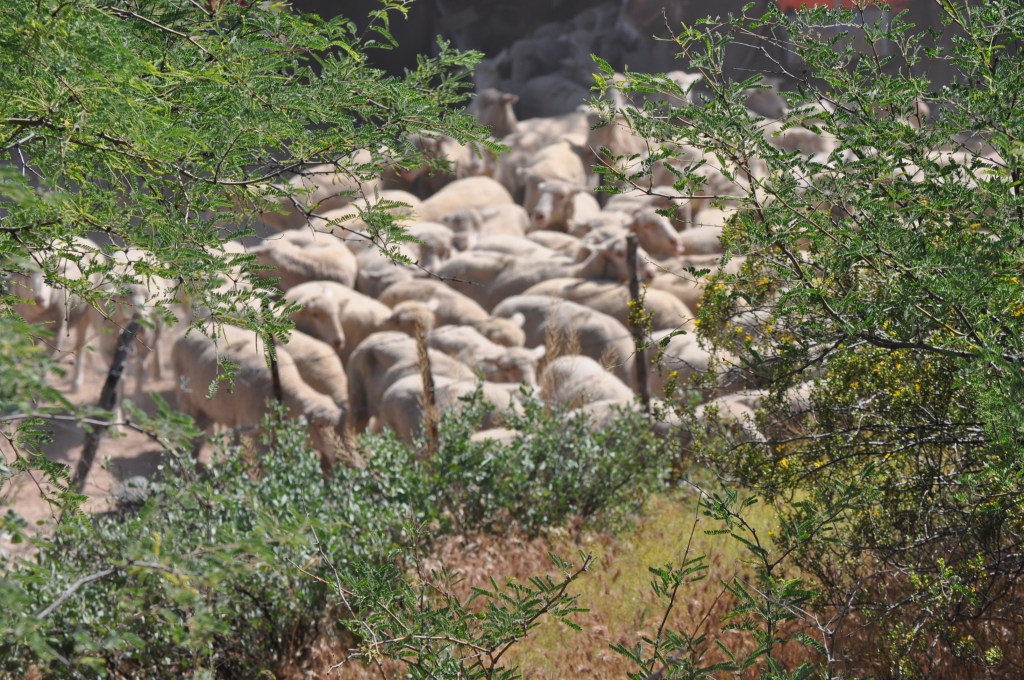
The herders moved toward the water pushing the sheep that direction. Dust began to be kicked up by the hooves of the sheep. The sound of sheep bells and bleating were heard. Onlookers were everywhere. Joseph Auza held some onlookers back as herders, the family and dogs began to push the sheep more and more to the river. The path to the river now went through wet gullies. The sheep were wet from crossing these gullies. It was now time for the onlookers to cross these. Some of us helped each other. After one obstacle was crossed there was the second to cross; it was much wider. Everyone was in a hurry to get to the river’s edge to see the sheep crossing. I moved around to the right flank when I could not penetrate through the sheep or the onlookers to get my pictures on the left flank. Even as the official photographer for the Auza’s, I tried to be courteous and let others get to the front and take pictures. Being short usually means I can be in the front and others take their pictures over me!
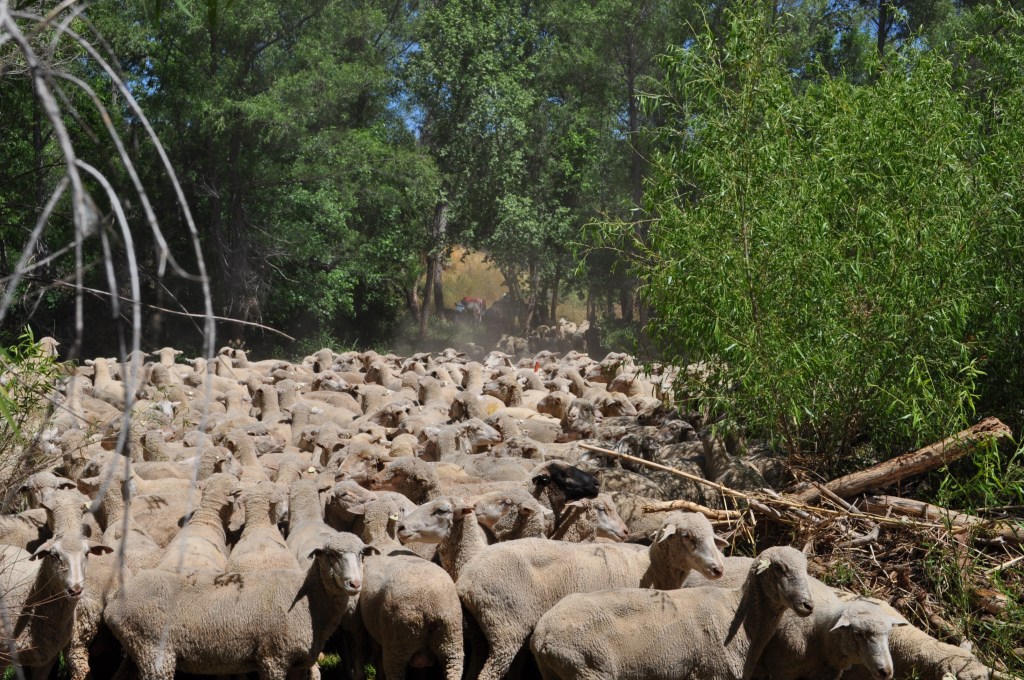
Moving toward the river is a slow process in the beginning.
Sheep begin to kick up the dust.

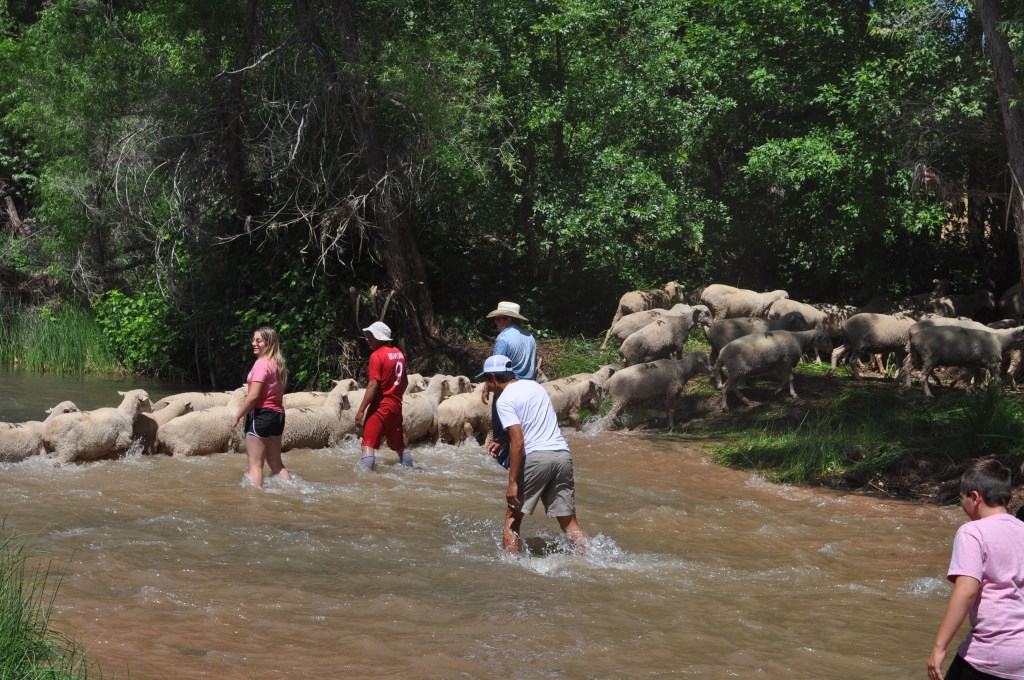
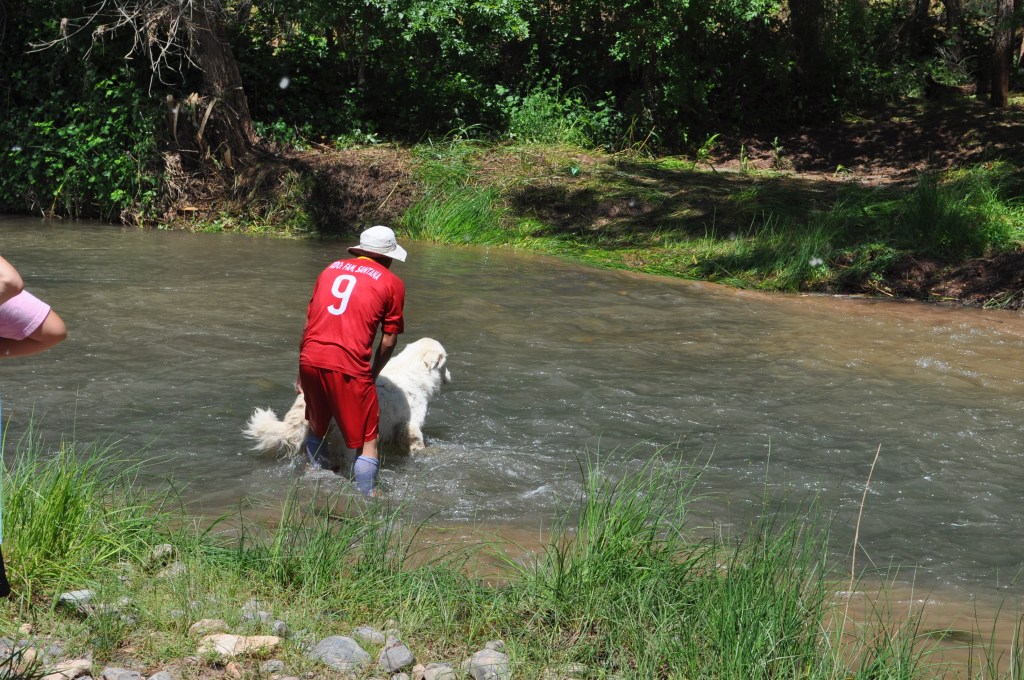
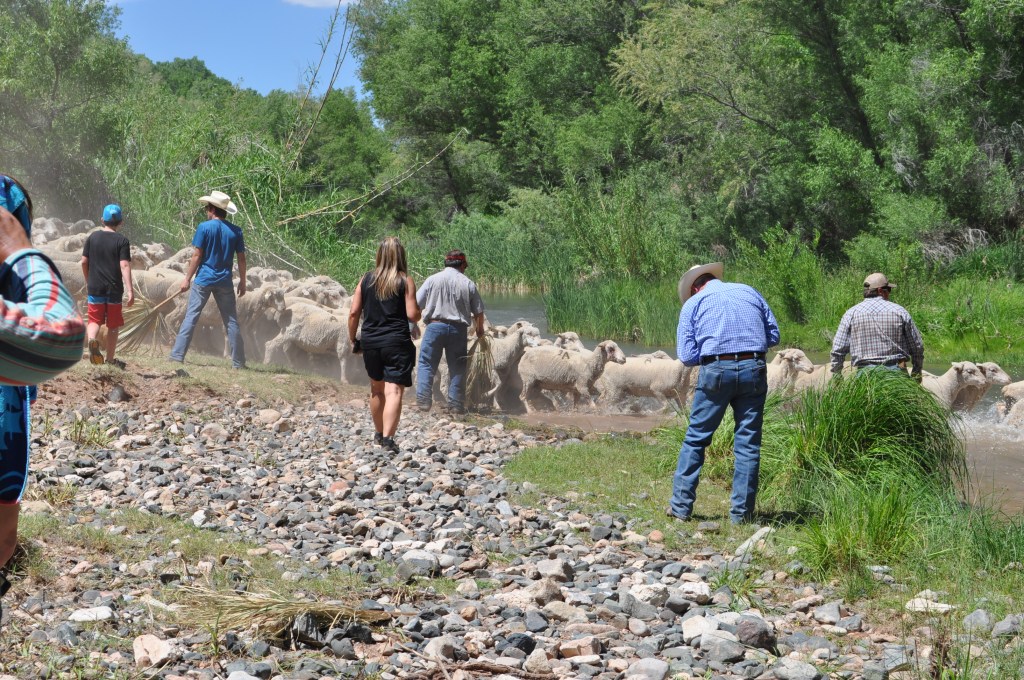
Margaret, who had been near me as we started down to the river, was soon caught up in the action of the day and moved mostly where she could get a good glimpse of the crossing. Lila had known to flank to the right to be down river of the crossing. Herders and some of the young family members were in the water keeping the sheep moving. In about fifteen minutes the sheep were across the river. It was now just to get the last of the dogs to cross over with a little help from a herder. And this portion of the trailing was in the history books!
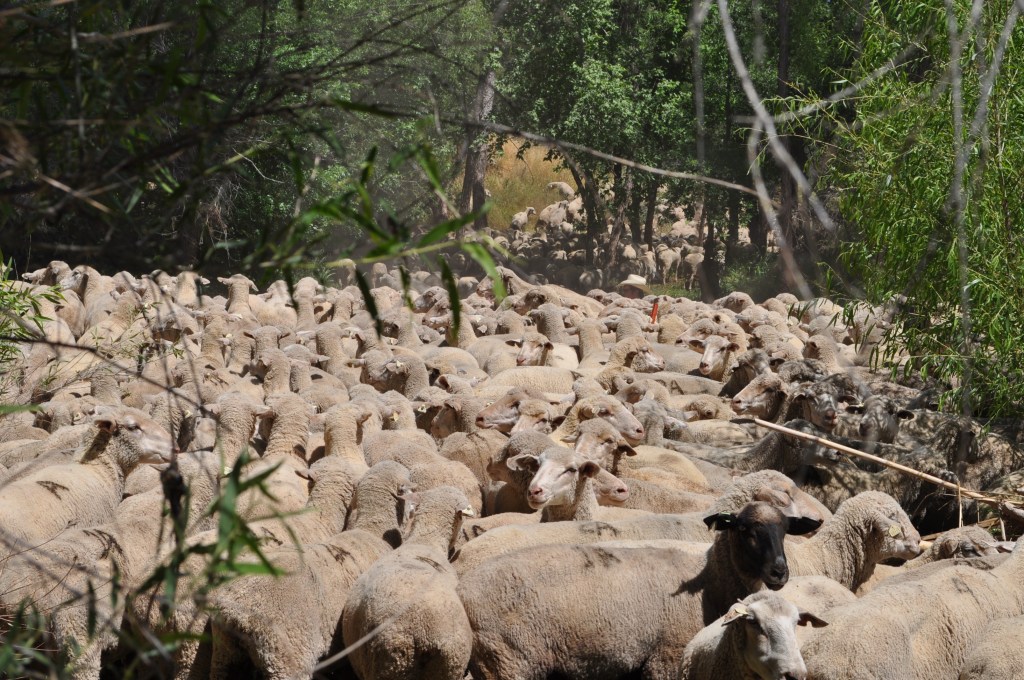
Why are you pushing us toward the water? I don’t want a bath!
Being at the right location to get that picture!
Herder, family and friends help move the sheep.
A Great Pyrenees helped across the river.

The Underpass

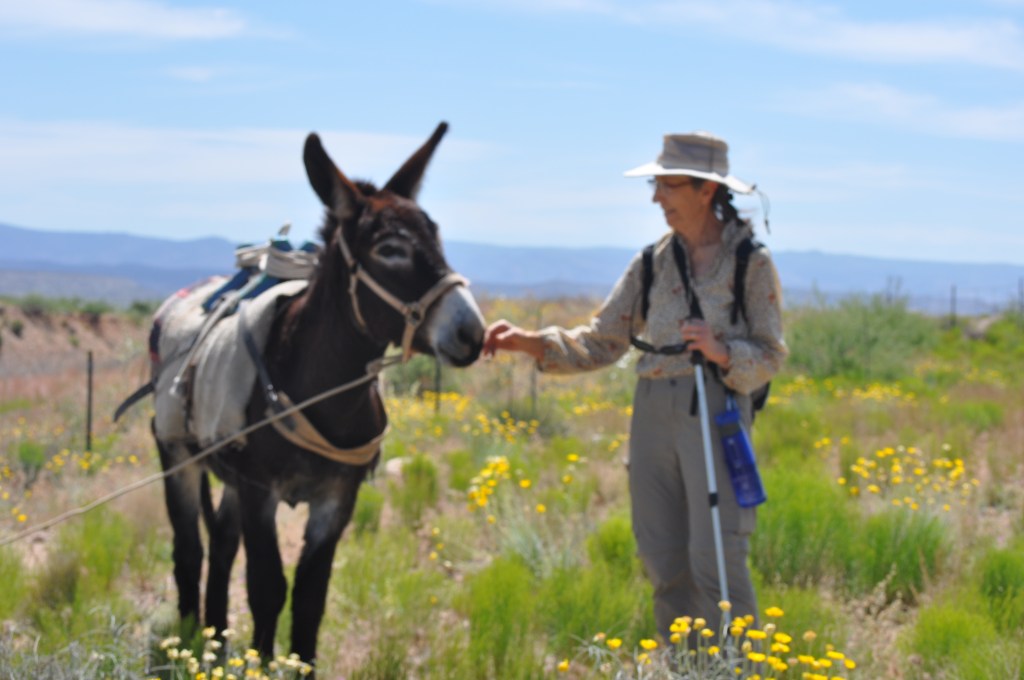
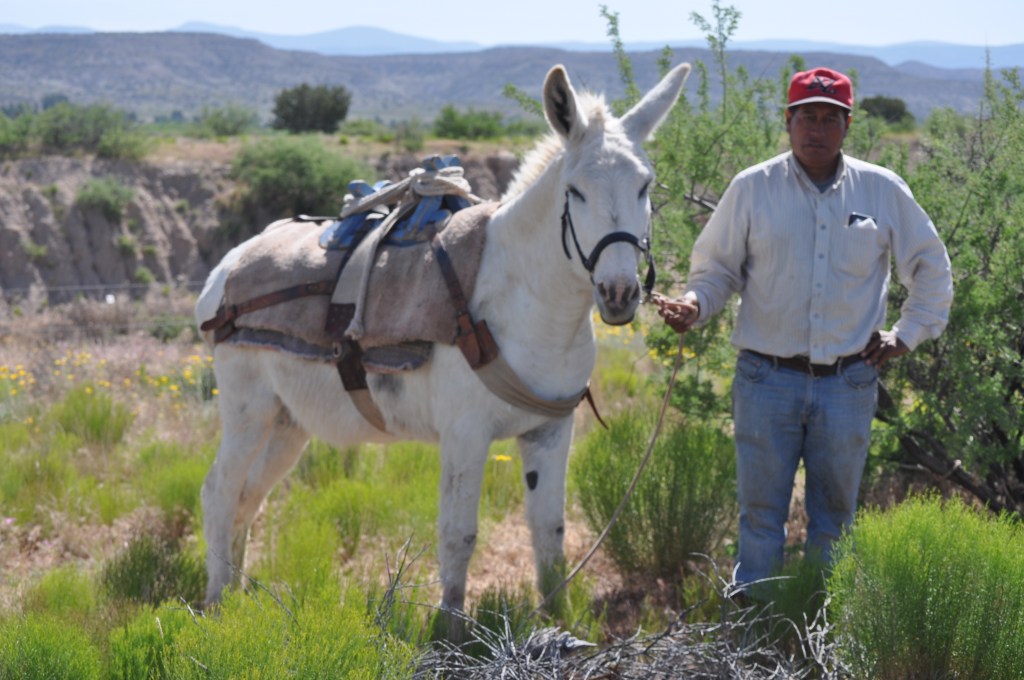
After walking around the sheep for more pictures my husband climbed over the fence and headed to our car. By this time, my friend Lila had gotten to the camp. We then proceeded to re-walk what my husband and I had just walked. The donkeys were still skittish, but we were able to touch a couple and Lila got her picture with one.  Then it was time to go.  We looked for another route back to our cars, but realized we would have many barbed wire fences to contend with if we did not return the same way my husband had come only in reverse; along the road and up over one barbed fence.

Lila makes a friend.

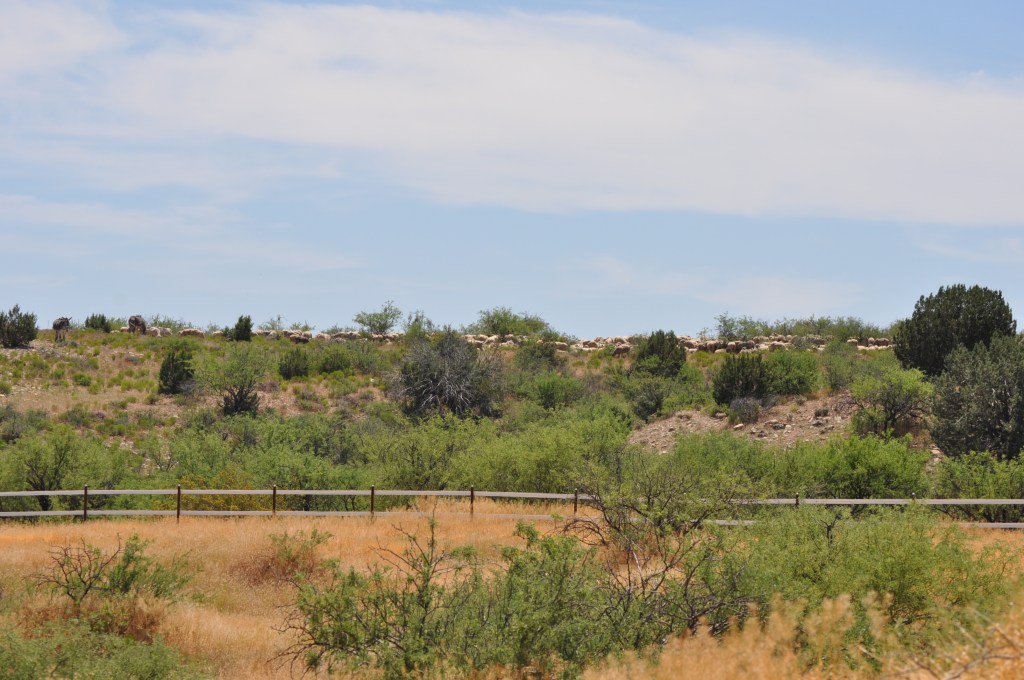
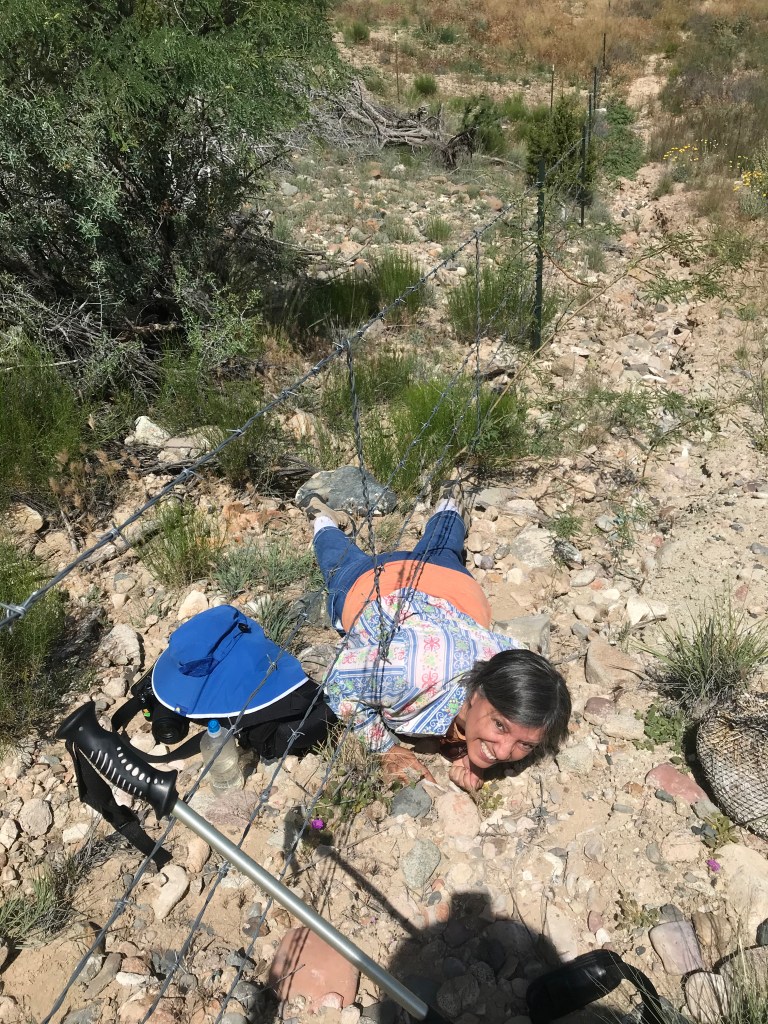
Leaving the sheep to graze and the herders to their siesta, Lila and I crawled under the fence, and we headed to our cars. It would be later this afternoon before the herders would proceed to move the sheep down the hill and under Highway 260. The herders would eat lunch and take a siesta. The sheep would continue to graze or sleep.

Herders’ Camp

Mid-afternoon the warning went out via phone calls and texts that the herders may be about to move the sheep. A crowd began to form to watch part of the trailing of sheep, an event that has occurring for over a hundred years in Arizona. A shepherd came to open the locked gates and told the onlookers to move their cars as they were parked in the path that the sheep would take. Cars were moved from the field and parked down along the road. More people came and parking directions were given to those drivers. My husband stayed back to do the directing as he had seen this event before.  A crowd of 15 or more people ventured down to view this trailing of the sheep that one day will be gone from our state. My husband waited until he could see dust being kicked up on the hill. He began to walk across the field staying out of the path he knew the donkeys and sheep would soon take.

The herders began to round up the donkeys and the boxes carrying camp supplies loaded onto them.  Once the donkeys were loaded, they began to move down the hill into the gulley and through the underpass. The dogs were called to start the sheep behind the donkeys. Dust rose in the air and excitement of the onlookers began to grow as only a few of those present had seen this event last year. One last attendee parked her car in the path of the sheep and came running across the field not wanting to miss this historic event.

Sheep on the move.

The donkeys came through the underpass and made their way to the top of the hill, but then stopped. A man, thinking he had found a great photographic location, had hidden behind bushes right next to the trail to film the progress of the sheep up the trail, but the donkeys were having none of it. They waited a moment and then turned around and went back down the hill. The sheep were trying to move through the underpass and now had to contend with the donkeys moving against them. The sheep proceeded to reverse course. Shouts were heard from the herders as they realized the donkeys were coming back toward them and bringing the sheep. The sheep became the first to move cautiously up the hill. My husband and I told those hiding in the bushes they were impeding the animal’s movement and needed to move away.

The donkeys came first or did they?

Here come the sheep!

On to our next adventure!

Still many of the onlookers stayed as close as they could. Once the sheep began their run across the field, forward momentum kept the sheep all running across the field and toward the next incline that they would climb. Donkeys were now intermixed with the sheep, but soon they were ahead of all the sheep as the herders directed the sheep to keep moving forward and telling the crowd to stay back. 

The donkeys figured it out.

Cars speeding along Highway 260 could now see the flock of sheep and the most curious of them stopped to photograph this rare event. A Great Pyrenees and the some of the collies were running with the sheep. As the last of the dogs came up the hill, one being carried by a shepherd, the gate was locked. The puppies in training ran to catch up with the flock, but not before most of the dogs peed on the lady’s car that was parked in the wrong location! I don’t think one of the dogs missed doing this.

That’s a lot of sheep!

The next gate had been opened and with the final passing of the sheep through it, it was fastened. Several of us began to walk with the sheep as they made their way up the limestone hill or around its side. There was a quickness to their gait as if they knew greener pastures were on the other side of the hill.  Most of the other onlookers now left and there were just three of us to follow, Lila, my husband and myself. We stayed behind the sheep and watched as they would be in a gully and then had to make their way up. Some found the path of least resistance while others kept trying to find their footing right where they were. Some gave up and found an easier path. Others were determined to climb right where they were. By watching their progress, us three hikers could also determine our route to follow.

Finding the easy path?

Out ahead, the donkeys were seen with the camp tender. One herder was slightly ahead but off to the right of the sheep keeping them moving forward with the aid of the dogs. The last herder was in the rear checking for any stragglers. He turned and waved and shouted he would see us tomorrow.

One last view.

We watched them climb one more limestone bluff and then we turned around to head to our cars.  By the time we had returned to our cars and drove toward Cottonwood, the sheep were in the green pasture munching on the green foliage. The herders were standing off to the side with a dog or two. The camp tender must have gone ahead to get the evening meal ready as he and the donkeys could not be seen.

Tomorrow, the sheep entrance into and through Thousand Trails and the river crossing.

On the Sheep Trail

It was early morning when we came upon the sheep camp. The sheep were grazing and laying in the grass. The seven donkeys had been unloaded and free to move around the top of the hill overlooking Highway 260 in the area of the Verde Valley, Arizona. The dogs did not bark or even come up to me when I walked up the hill. Most of the herder dogs had seen me before so I was not surprised. I called out and identified myself. I was invited to come up to the camp. As I approached the dogs were hunkered under the shrubs and bushes to get out of the sun. Even this early in the morning, it was beginning to heat up. A cool breeze was blowing which helped.

A fire had been built some time earlier as it didn’t have many flames, just hot coals left. A Dutch oven was sitting among the coals. I asked if they were preparing breakfast. But, no they had had their breakfast earlier before they moved the sheep to this location. The camp tender was preparing their lunch. Oil was added to the Dutch oven and the lid was put on. While the oil in the pot was heating, he cut up carrots, onions, potatoes, and some other vegetables which I did not see. A few minutes later, the lid to the Dutch oven was removed and the vegetables were dumped into the pot. The lid was once again returned to the pot and it was left to simmer.

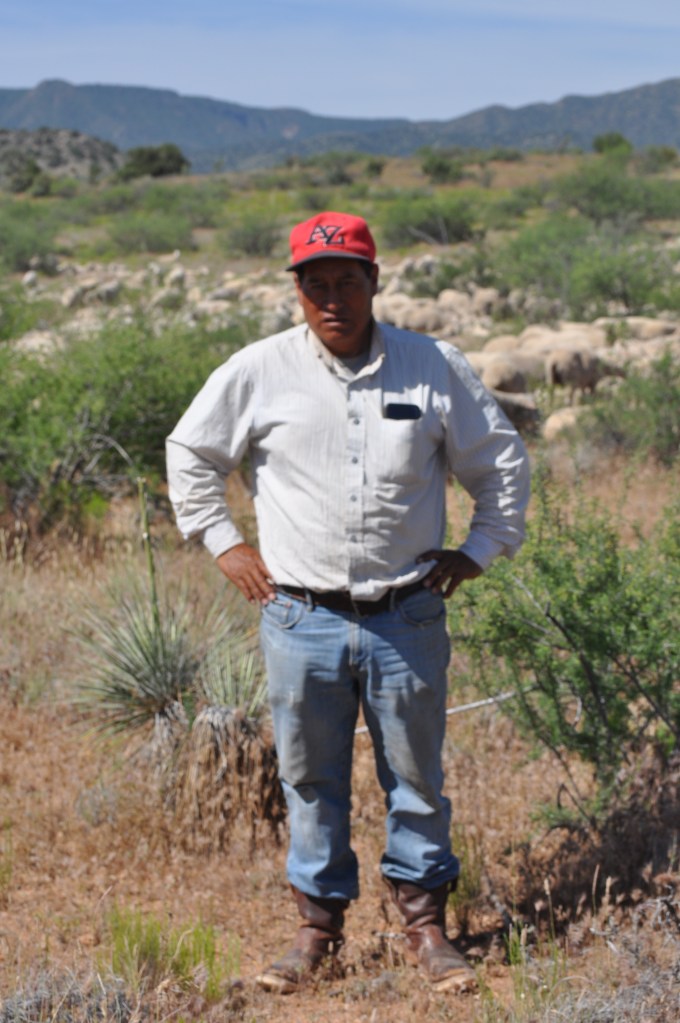
While I was watching the cook, a third herder joined the first two. I asked to take pictures of each of the herders, their camp, the sheep, and their activities. At first the three of them said no! Then as I started to walk away one said, yes, he wanted his picture taken and asked if he could have copies of my pictures I took that day. My Spanish is limited. Thank goodness for programs that will translate for you! I agreed as I knew I would see these herders again.

Jose, I believe was his name, proceeded to walk over to the burros and grabbed one of them. This is the picture he wanted me to take with his own camera and then allowed me to take pictures with my camera.

He then asked for me to take his picture with the sheep in the background. Once again, pictures were taken with his phone and my camera. In his broken English and my limited Spanish I learned that the three herders were brothers and from Huancayo, Peru. A smile came to his face when I told him I had been to their hometown.

We returned to the camp fire. I told him that I was with my husband, but he could not crawl under the barb wire fences as I did. He asked if my husband had pushed me under? I didn’t need a translation for these words and he graphically proceed to show me. All three of the herders had a good laugh about it. One of the pictures that I gave him was this one!

Stay tuned for the rest of the day’s activities.

A Thumb Nail Sketch

Browsing through old territorial newspaper one can find short little tidbits of information about people and an industry that help paint a picture. It’s what I call a “thumb nail sketch”.  Searching keys words brings up other newsworthy articles about the topic being searched that may otherwise go unnoticed. There isn’t always a great deal of information found this way, but it may give the researcher new names to look for.  Those names or stories can be crossed referenced in other newspapers of the time. Other archives may be searched leading to a more complete record of the industry.

Take for instance obituaries. The information in an obituary can give us a little information such as where and when the person was born, arrival in the country and/or into Arizona, their age at death, and their occupation.  While that may not seem like a great deal of information what it does is add names to those who were participants in Arizona’s sheep industry which may not have been known before. It may add other areas of the state to the distribution of the sheep and how many sheep were in the state at a given time. From these obituaries there may be enough information to track them through Ancestry.com and learn more about the person.  Here are just four obituaries found in the Arizona Wool Growers’ Association files:

Tom Jones, born in Wales came to the United States in 1908 and shortly after arriving in New York City made his way to Mesa. In his obituary in the Arizona Republic, May 9, 1967, it states that he was a retired sheep rancher. He died at the age of 82. A footnote to the obituary that was attached to a paper in a file of the Arizona Wool Growers Association, it noted, “Tom shipped wool through the Arizona Wool Growers Ass’n (Association) in 1951 and 1952, and thus held membership in the association. He was an “expert herdmen.”

Frank Ybanez was a Buckeye sheep company foreman who passed away May 12, 1967 at the age of 65 years. He was from France and was about to retire and return to his native country where he had a sister and two brothers. Frank was an early arrival to the state coming in 1920. It was stated in his obituary that he worked in the sheep industry in Arizona for over 40 years.

Frank Pina, 75, was in the sheep shearing business with his brother between 1926 and 1946. He died in Mesa Sunday, February 4, 1969.   He was born in San Angelo, Texas in 1894 and arrived in the Mesa area in 1924.

In an obituary for Henry Albers from the Arizona Republic, Thursday, December 10, 1970 there is no mention of his involvement in the sheep industry. The obituary was attached on a piece of paper along with a typed footnote. It seems Mr. Albers had a small sheep outfit in 1907 when the then secretary of the Arizona Wool Growers Association arrived in Arizona. Albers range was between Government Hill and Sitgreaves Mountain, north west of Maine Station on the Santa Fe. It is believed that in 1908 he sold his outfit to Charlebois. 

Tomorrow, I will share what I learned about the sheep industry in the southern part of our state from two different stories.

Poisonous Wool

An interesting newspaper story on poisonous wool was found in the Tucson “Arizona Weekly Citizen” for October 28, 1881. Death can occur when a shearer or a wool sorter carelessly handles wool from a diseased or dead sheep.

The story mentions wool sorters in England being subject to a peculiar disease when wool has been taken from sheep that had died from Anthrax, a malignant splenie fever that exists among sheep.

In the United States, another person’s death had also been attributed to wool. Mr. Naud, a prominent citizen of Los Angeles, had been sorting wool that had been placed in his care. Some of the clipped that he was sorting came from scabby sheep and “was, consequently, poisonous to a certain degree. After handling the wool he chanced to touch a small bleeding wound on his person and became inoculated with the poison from the wool. His blood became thoroughly impregnated with the poison, and after a long illness and great suffering from pyemia, he died.

“It is possible that the sheep in Arizona are not affected with disease to any extent, yet the greatest caution should be used to exclude the wool of sheep that have died or are suffering from any disease, from the better wool intended for the market.”

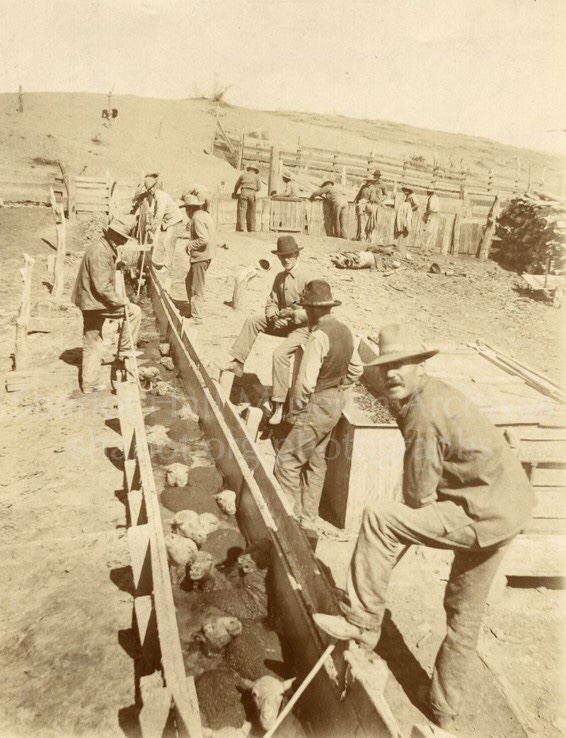
There were many dipping vats in Arizona to rid sheep of scabby in the early history of the industry. One of those dipping vats was at Cordes where many sheep were sheared each year. The sheep were run through the vats before leaving Cordes. I wrote about this topic in an earlier blog where scabby had been reduced if not eliminated in the years 1906 to 1916 because sheep owners were vigilant in this practice of dipping. The cost to dip a sheep ran between 2 1/2 to 3 cents. The picture of a dipping vat; it is the same one I used in the earlier blog.

Dipping Vat at Cordes. Date unknown. Unknown men.

There were other dipping vats within the state. One was at the Verde River Sheep Bridge and another on the west side of the San Francisco Peaks. There had to be other dipping stations within the state along the trails used by the sheep men as they drove their sheep northward each year.

One further comment and that is the story failed to mention whose wool Mr. Naud was handling; they may not have known or did not think it was necessary to mention the wool grower.

Two last comments – if anyone knows who any of the men were in the picture above, please send me a message and if anyone knows of other locations of dipping vats, I would appreciate that information as well.

Wool Industry Nov. 1881

In my research yesterday looking for any information on the death of George E. Johnson, who I previously wrote about, I find an interesting article on the status of the wool industry for the state dated November 18, 1881.

From the Weekly Arizona Miner, Prescott – “Papers in Southern Arizona have been very generously giving Northern Arizona credit for having 150,000 head of sheep. They could have made the number 350,000 head, and still have been below the mark. Recently C. P. Head & Co., through their agent, Hon. Hugo Richards, shipped from Holbrook, per Atlantic and Pacific R. R, 19 cars of wool weighing 300,000 pounds. This is the largest shipment ever made from Arizona, and reminds us very forcibly that a woolen factory should be established here, and thus save the exporting of wool and the importing of woolen goods. With a Territory of 40,000 white inhabitants and as many more Indians, we cannot but conceive that the establishing of a woolen factory would pay beyond calculation. Some of the finer woolen fabrics might be brought in from States, but such goods as the miner, teamster and laboring man requires, together with blankets of all grades, could be manufactured in Arizona at a great saving. We earnestly call the attention of outside capitalist to this rare chance for investment.”

In the same newspaper on page 3 we find this – “The largest single shipment of wool ever made by any Arizona firm is that of C.P. Head & Co. They shipped a few days since from Holbrook, per Atlantic and Pacific Railroad, 300,000 pounds, making a train load of nineteen cars.” This piece of information was also found in the Arizona Weekly Citizen, Tucson, dated November 20, 1881 under Prescott Paragraphs. It was common for newspapers to run stories from other newspapers within the state and out-of-state.

Author’s note: If we use 8 pounds of wool per head of sheep that would calculate to 37,500 sheep owned by C.P. Head and Co.

In searching the Tucson newspapers for October and November 1881, no substantiation of the number of sheep given by Southern Arizona newspapers was found. That does not mean that the information is incorrect; it just means that it has not been found yet. Although, usually one newspaper picking up information from another was written about fairly quickly so that is suspect. On the other hand, no mention of which newspaper contained the information that the Weekly Arizona Miner reported about. Phoenix newspapers have not been checked for this date. Holbrook did not have a newspaper that early, so no help there. On October 30, 1881, the Arizona Weekly Citizen, Tucson, reported on an article from the Miner stating, “the wool industry of northern Arizona is taking an important place alongside of the most formidable enterprises. Sheep can be brought to the Territory from either direction and herded upon the fine, juicy grasses, so abundant. The increase is estimated at 70 per cent. The wool of 2000 sheep will more than pay the expenses of herding, etc., therefore it will be seen at a glance that here is a chance for safe and remunerative investment.”

What is exciting about these articles is the early dates, October and November 1881, and the number of sheep already in the state. Sheep had began to be trailed here in the mid 1970s. Could it be possible that the number of head of sheep surpassed 150,000 or even 350,000 in just a few years? And, another question raised is who is C.P. Head & Co.? Haskett’s “History of the Sheep Industry in Arizona” written in 1936 lists those in the business in 1890 to 1906. C.P. Head & Co. was not on the list. In ten years, C. P. Head either sold out of the sheep business or the name was missed by Haskett. It will be another mystery to solve.

In conclusion, more historical facts have been learned about the sheep industry in Arizona and there are still more questions coming from these facts. So, stay tuned for updates.