May 1924 Sheep Sightings

News about the Arizona sheep industry was pretty dull during the month of May 1924. The events up to the middle of the month can be summarized as:

One new sheep brand was applied for by Reid Cashion L & C Co, Ashfork.
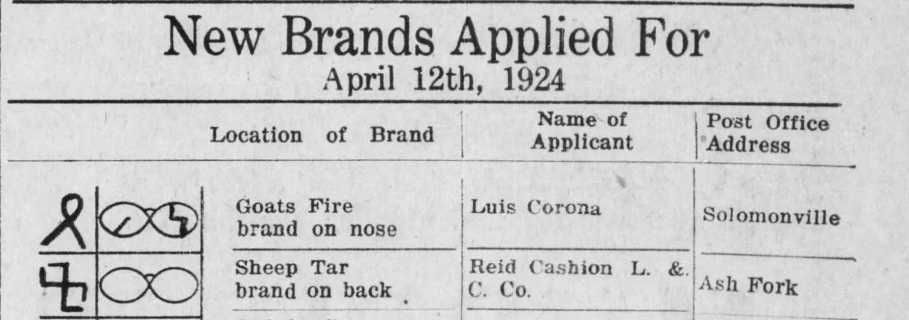
Several sheep men were fined for grazing sheep on Forest Reserves within the state. Their fine was $25 dollars or $458.40 in today’s dollars.

Sheep had mostly left their winter grazing land, the Salt River Valley, and headed to cooler northern environments. Grasses were reported on the range to be “pretty fair.” Several different sheep men were mentioned – Fermin Echeverria, Howard Sheep Co., Colin Campbell and sons.

An ad appeared suggesting the benefit of raising sheep.

An article on 21 May 1924 in the Arizona Republic gave wool prices for the western wool states.   Prices across the area ranged from as low as $ 0.32 to a high of $ 0.47 per pound or $ 5.87 to $8.62 repsectfully in today’s dollars. The article also said that wool was moving slow. Most of Arizona’s wool had been consigned to the Boston Market and only about half had been paid for. So getting into the sheep business may not have been lucrative at this time.

The biggest problem plaguing the sheep industry was the foot and mouth disease but because of the radical procedure put in place, no reports of it had been found in Arizona. Travel between California and Arizona had been restricted for both livestock and people. The tourist industry was hard hit economically in the state but all considered that a minor inconvenience to what could happen to the livestock and farm products, a major economic component of the state’s economy, if the dreaded disease was found in Arizona.

And that is the sheep news for the majority of May 1924. I will report on the rest of the month soon as I still need to finish my research.

I leave you thinking of a ewe and her lamb born in April:

Colin Campbell, Part II

A little of the known history of Colin L. Campbell:

Colin was born in Nova Scotia in 1853. He was one of two brothers who arrived in Arizona in the late 1800s. An exact date has not been determined by this author but research shows it had to be the early 1890 since he married Amelia in Winslow, Arizona, June 22, 1891.  (On ancestry.com a family tree for Colin shows her name as Mary Amelia Emelia Daze and she was called Minnie Daze; she had been born in Canada also.)  How Colin or his wife came to Arizona, why they came and how they met has not been discovered, yet!

What is known about the Campbell’s comes from many newspaper articles across the territory of Arizona. In the Coconino Sun, March 24, 1892, three names of interest popped up: Colin Campbell, W. H. Campbell and Wm. Daze the three men were admitted to citizenship. (Was Wm. a brother or father to Colin’s wife?)   In May of 1892, Colin purchased controlling interest in the Santa Rita Land & Cattle Company. With citizenship he could own land.

Colin and Amelia Daze Campbell had a son, Eugene Colin, born in November 1893, in Winslow. The birth information comes from Arizona the Grand Canyon State, Volume I where a series of biographies can be found and the biography about Eugene Colin. In several different editions of the Coconino Sun other information has been found. In 1894, he attended the Wool Growers meeting. Over the next 20 years, Colin is mentioned many times in the territorial newspapers. For example: He had property across the state as he paid taxes for improvements to his lots in Winslow in 1896 (Coconino Sun) and in 1897, he put up 25 miles of telephone lines connecting both of his “large ranches with the city of Nogales.” (Holbrook Argus)

Many newspaper articles still need to be researched as a date for entering the sheep business is unknown. Dates for buying and selling of sheep have been found but most of these are in the early 1900s. The earliest evidence of sheep raising comes from the St. Johns Herald, 1897, stating he sold 2,200 head of sheep for shipment back east. This newspaper listed him as part of the firm Hart & Campbell of Winslow. The Weekly Journal-Miner, October 1899, stated that he had shipped 200 head of fine merino bucks and had “sold a large number of this class of bucks during the past few years” and the newspaper noted, “at a good price.”  

More forthcoming once the rest of the newspapers have been researched. 

Colin Campbell, Part I

As I was reading the minutes of the Executive Board meeting for the Arizona Wool Growers Association for 1927, the death of Colin Campbell was referenced in glowing terms. He was a director of the board and his death resulted in a vacancy.  Reviewing these documents help understand problems associated with the sheep industry in Arizona and the records give some details of members albeit through their deaths. It was not unusual to find a nice biographical sketch written by them or at least what had been stated in the obituary of a local newspaper.

The minutes for their October 15, 1927, special meeting read: “The Arizona Woolgrowers Association has sustained a great loss in the death of the Chairman of our Board of Directors, Colin Campbell, which occurred on October 2nd, 1927. He was also member for Arizona on the Executive Committee of the National Woolgrowers Association.” The special meeting was called to replace him on the board of directors. While not germane, H. C. Caveness, general manager of the Grand Canyon Sheep Company, was nominated to fill the vacancy.

The Wool Growers continued their accolades:

“It is superfluous to state that the name of Colin Campbell was known in every wool growing (sic) section of the country. His name was heard around the campfires of the herders, at the meetings of woolgrowers, at the National Ram sale, and at all places where wool and sheep were discussed.

With a matured judgement on all things connected with sheep raising and the marketing of wool, with a keen understanding of its problems, with wide reading and a retentive memory, his opinions were eagerly sought and the course of action taken by him was generally followed.

He was a pioneer of pioneers in all matters relating to grazing and the preservation of our ranges, in the improvement of breeds and the production of high grade rams.

The esteem in which he was held was shown at his funeral in Flagstaff on October 4, 1927. All classes of the community were present and in fact it was a gathering of the people of Northern Arizona who met to give testimony to his wonderful acquaintance and his sterling worth.

The following editorial from the Prescott Journal Miner, October 4, 1927, is quoted, as representing the feeling of this Board of Directors: 

            ‘Not only Yavapai county but the whole state will feel the loss of Colin Campbell, whom death claimed at Ash Fork, Sunday. Of all the livestock men of this southwest, he was the peer, a pioneer who dared in a country not yet settled, down to the present state of things.

            Mr. Campbell was of a family who carved empires out of the wilderness, a sturdy stock that populated the far portions of the earth at times when life was not so easy as it is now. He was a brother of the redoubtable industrialist and political leader, Hon. Hugh Campbell, who for years led the sheep men of Arizona as President of their association and one of their outstanding members. Of no less worth has been the contribution of Colin Campbell to the work of making productive a land scarcely attractive to the farmer, the town builder or the miner.

            We know of no man who could gather so many friends about him. He was one of Arizona’s finest.’”

Colin Campbell distinguished himself in the sheep industry in the short time he lived in the state (1890?-1927). Next blog will look at his life in more detail.