May 1924 Sheep Sightings

News about the Arizona sheep industry was pretty dull during the month of May 1924. The events up to the middle of the month can be summarized as:

One new sheep brand was applied for by Reid Cashion L & C Co, Ashfork.
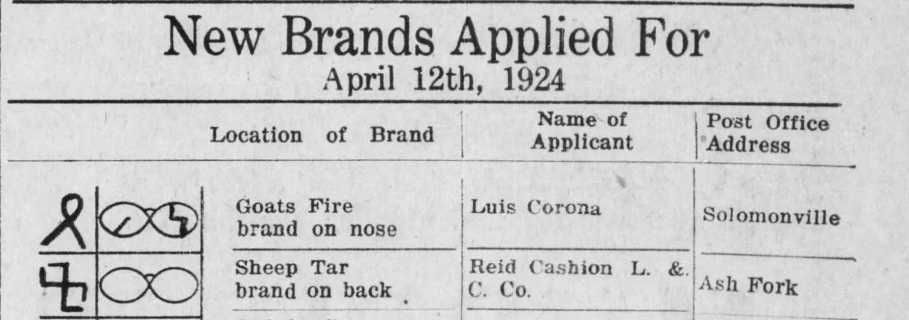
Several sheep men were fined for grazing sheep on Forest Reserves within the state. Their fine was $25 dollars or $458.40 in today’s dollars.

Sheep had mostly left their winter grazing land, the Salt River Valley, and headed to cooler northern environments. Grasses were reported on the range to be “pretty fair.” Several different sheep men were mentioned – Fermin Echeverria, Howard Sheep Co., Colin Campbell and sons.

An ad appeared suggesting the benefit of raising sheep.

An article on 21 May 1924 in the Arizona Republic gave wool prices for the western wool states.   Prices across the area ranged from as low as $ 0.32 to a high of $ 0.47 per pound or $ 5.87 to $8.62 repsectfully in today’s dollars. The article also said that wool was moving slow. Most of Arizona’s wool had been consigned to the Boston Market and only about half had been paid for. So getting into the sheep business may not have been lucrative at this time.

The biggest problem plaguing the sheep industry was the foot and mouth disease but because of the radical procedure put in place, no reports of it had been found in Arizona. Travel between California and Arizona had been restricted for both livestock and people. The tourist industry was hard hit economically in the state but all considered that a minor inconvenience to what could happen to the livestock and farm products, a major economic component of the state’s economy, if the dreaded disease was found in Arizona.

And that is the sheep news for the majority of May 1924. I will report on the rest of the month soon as I still need to finish my research.

I leave you thinking of a ewe and her lamb born in April:

Nothing Exciting Happened Feb 1924

Since there was little happening during the month of February 1924 in the Arizona sheep industry, I have just compiled all of the information here. Ranges were still pretty good for the sheep even though no rain had fallen over the previous five weeks. The sheepmen were only beginning to be concerned about the lack of moisture and were hoping that there would be some soon. Shearing was progressing in the Salt River Valley and elsewhere. Wool was being ready for shipment eastward. In most cases it was being sent to the west coast to be shipped by water to the East Coast mills. Water shipment would save the sheep men money on transportation cost.

It was estimated that 278,659 head of sheep and goats (there was no breakdown of numbers between the two animals) would be grazing on the ten national forests in Arizona for the upcoming summer grazing period.  Some newspapers reported that only eight national forests would be used for grazing. At the winter business meeting for the Arizona Wool Growers’ Association, the sheep men would receive information on the new grazing fee schedule. For 1924, sheep would be assessed $0.25 per head for grazing on forest service land. More will be written about this as found in the newspapers or other sources of information.  

Sheepmen and outfits mentioned in the February newspaper included M. J. Riordan, Harlow Yaeger, Nolan Snodgrass, S. W. Jacques, D. H. Henderson, Larkin W. Carr, Governor Safford (he was in the sheep business and was expecting to add to his flock), E. H. Duffield Sheep Company, and Howard Sheep Company. Of these names Harlow Yaeger deserves further comment as his wife died leaving him with two small children, Mary 7 and Lonnie, 3 to raise. At the time of her death, she was in a sanitarium in California, distraught over the death of her oldest daughter. Mr. Yaeger had his sheep in Diablo Canyon area. I am still researching through various sources if Jacques was a relative of my husband’s family as I have a document showing that was a spelling of the family name in France.

Lastly, valuation of sheep was reported for Coconino County and Navajo County for 1923.  In Coconino County there were 240,173 sheep valued at $1,200,865.00, with 4,529 bucks valued at $68,040.  There was a decrease of 9,000 sheep but the valuation was up by $202,725.  Navajo County had 55,381 sheep valued at $275,905.00 and 509 bucks at $7,635.00.  No reports of decrease in sheep were given for Navajo County. Valuation of a ewe was $5 per head and $15 per buck for both counties.  

While news of the sheep industry was sparse in February we did learn some information that furthers our knowledge of what was happening in the industry. Research of newspapers for March are being completed and any information of importance of the sheep industry will be posted.