Since there was little happening during the month of February 1924 in the Arizona sheep industry, I have just compiled all of the information here. Ranges were still pretty good for the sheep even though no rain had fallen over the previous five weeks. The sheepmen were only beginning to be concerned about the lack of moisture and were hoping that there would be some soon. Shearing was progressing in the Salt River Valley and elsewhere. Wool was being ready for shipment eastward. In most cases it was being sent to the west coast to be shipped by water to the East Coast mills. Water shipment would save the sheep men money on transportation cost.
It was estimated that 278,659 head of sheep and goats (there was no breakdown of numbers between the two animals) would be grazing on the ten national forests in Arizona for the upcoming summer grazing period. Some newspapers reported that only eight national forests would be used for grazing. At the winter business meeting for the Arizona Wool Growers’ Association, the sheep men would receive information on the new grazing fee schedule. For 1924, sheep would be assessed $0.25 per head for grazing on forest service land. More will be written about this as found in the newspapers or other sources of information.
Sheepmen and outfits mentioned in the February newspaper included M. J. Riordan, Harlow Yaeger, Nolan Snodgrass, S. W. Jacques, D. H. Henderson, Larkin W. Carr, Governor Safford (he was in the sheep business and was expecting to add to his flock), E. H. Duffield Sheep Company, and Howard Sheep Company. Of these names Harlow Yaeger deserves further comment as his wife died leaving him with two small children, Mary 7 and Lonnie, 3 to raise. At the time of her death, she was in a sanitarium in California, distraught over the death of her oldest daughter. Mr. Yaeger had his sheep in Diablo Canyon area. I am still researching through various sources if Jacques was a relative of my husband’s family as I have a document showing that was a spelling of the family name in France.
Lastly, valuation of sheep was reported for Coconino County and Navajo County for 1923. In Coconino County there were 240,173 sheep valued at $1,200,865.00, with 4,529 bucks valued at $68,040. There was a decrease of 9,000 sheep but the valuation was up by $202,725. Navajo County had 55,381 sheep valued at $275,905.00 and 509 bucks at $7,635.00. No reports of decrease in sheep were given for Navajo County. Valuation of a ewe was $5 per head and $15 per buck for both counties.
While news of the sheep industry was sparse in February we did learn some information that furthers our knowledge of what was happening in the industry. Research of newspapers for March are being completed and any information of importance of the sheep industry will be posted.
The June 19, 1897 issue of The Argus, Holbrook stated that one of their permanent sources of wealth was the sheep and wool industry. It went on to state that everyone showed an interest in being owners of sheep. Quoting, the newspaper stated, “It has been found to be a safe investment and exceedingly profitable. It beats stock speculations, gift-edge securities, money lending, bond purchasing or any other branch of business venture.” The newspaper further stated that a person could purchase sheep with a small investment and if was careful in their attention to the sheep business especially in husbandry they would reap benefits to the tune of being “comparatively well-to-do and enjoying a liberal yearly income.”
The newspaper continued, “Nature has lavishly fitted this section for the successful operation of this industry. The vast regions covered with nutritive grasses added to the varied altitudes in different localities, so that the flocks can be moved slowly from one place to another and obviate the extremes of the climate of one altitude, renders it a veritable paradise to the sheepman.” Sheep found shelter into the deep canyons and lower valleys of the county during the winter extremes. In summer when the heat began to be felt in these deep canyons and the lower valleys, the sheep could be moved to the slopes of the mountains where they would have “cool nights, the pure mountain water and the abundance of rich grass.”
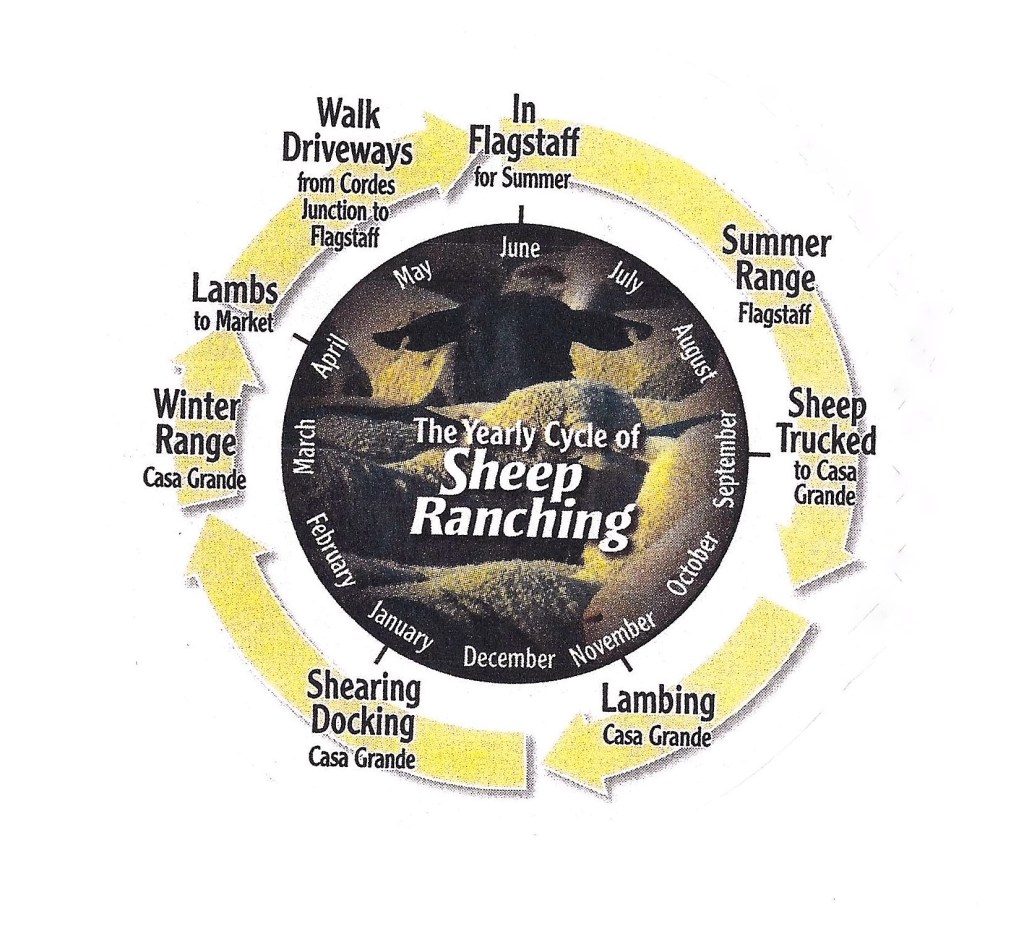
With following the sheep industry over the last few years and what was reported in the newspaper, it can best be described in what Carmen Auza called “The yearly Cycle in Sheep Ranching.” There are two differences from this chart to that as reported in the 1897 newspaper, and they are, the sheep were not moved long distances between summer and winter grazing land as they are today and mostly by truck, and lambing took place prior to shearing, not afterwards as in 1897.
The shearing season brings men work as the woolies all needed sheared. Shearing camps would be a frenzy of activity as fences were built, the shearing shed assembled and the sheep were brought in to be sheared. It was reported that over 100,000 were ranging in the county in 1897. More men could find jobs in the hauling of the wool clip to Holbrook for shipping. These activities took place from late March into May. Wool bags weighing upwards of 400 pounds were loaded on trains heading east. The Eastern wool buyers had already purchased the clip at the shearing camps. It was reported that in 1897, over a million pounds of wool was shipped from Holbrook. There was also additional wool that was on consignment from Winslow.
The newspaper went on, “During the last four years, while wool was on the free list, the sheep and wool industry languished. The Australian and European wool poured in and flooded our markets making the wool industry in the far West unprofitable through the lack of the cheap transportation by water which Europe and Australia enjoyed. Since the change of administration, with a reasonable prospect for the tariff upon wool to restored, the price of wool has been more than doubled, and the price of sheep has jumped from $1.25 per head to $2.75 and $3.00 per head. It is estimated that the wool sales in Navajo county last spring were $60,000 more than the year preceding, and the mutton sales will exceed last year by another $60,000. These excesses can be reckoned as clear profit to the sheep and wool growers of Navajo county, in addition to the increased value of their herds, due to the rise in the price of sheep. The sheepmen are jubilant and feel that the next four years to come will continue to be a season of golden harvests.”
During the 1897 season lambing season was in May. Most sheep owners had reported a 100 per cent increase in their herds so they were quite happy with their herds. Once lambing is over the flocks are slowly moved to their summer grazing areas in the cool pines of the mountains.
The newspaper reported that the sheep had no diseases. Sheep were dipped because of scab and sheep with scab were not allowed to be used for sacrifice as described in Leviticus 22:22. The disease may not have hit the area during this time but was definitely a problem in the west during the early 1900s. Dipping stations were established along the trails for the eradication of the disease in a flock and its spreading.
The newspaper also reported that there was greater profitability for the sheep owners if a scouring plant could be built in the area. Clean wool would ship at a lower cost than the unscoured and save the sheep owners money in freight cost. As the newspaper stated, “Dirt is cheap to pack up and ship to Boston at about three cents per pound. In the second place the wool would sell for vastly enhanced prices, enhancing the profits of wool-raising in addition to fostering a home enterprise giving employment to the laboring element in our midst. Then on the heels of this should follow a woolen mill. Few places on the face of the earth offer such unusual facilities for the profitable operation of a woolen mill. In numberless places along the Little Colorado, and on Silver Creek, and Show Low plenty of waterpower can be obtained at very little expense, and the raw material right at their door. These enterprises should be investigated and pushed to completion at once by our citizens. They are paying propositions and confer incalculable benefits upon this section.” The newspaper had high ambitions for the sheep industry in their county.
And that is a look at the sheep industry in 1897 as reported by The Argus, Holbrook and me, the jolly sheep lady.

 ArizonaSheepHistory.wordpress.com