Sheep in New York Central Park

Once in awhile it is good to know about sheep and their role in history in other parts of the United States so here is it:

Sheep grazed in New York’s Central Park beginning in 1864 and would be found there for the next 50 to 70 years. Two different sources give conflicting data as to how many years the sheep grazed Central Park! More research will be needed to determine the exact number of years that sheep were in the park.

First it is important to understand why Central Park was built. According to the website http://www.ny.com … “it is the first urban landscaped park in the United States”. The site continues, “The purpose was to refute the European view that Americans lacked a sense of civic duty and appreciation for cultural refinement and instead possessed an unhealthy and individualistic materialism that precluded interest in the common good.” The vision was a pastoral landscape for the rich to be seen and the poor would benefit from the clean air that such a landscape would give.

Construction in the park began in 1857 after a debate on its location. Frederick Law Olmstead, superintendent of the park, and Calvert Vaux, architect, won the park design. The city acquired 840 acres using eminent domain displacing approximately 1,600 people who had been living in the swampy, rocky terrain. Some of these people were squatters and others were legitimate renters; a school and a convent also were evicted. Those evicted did receive compensation, $700, which most felt was below the value of the land that they had improved. This land was chosen as it was not suited for commercial businesses as New York was beginning to develop. Without going through the construction stages or the budget constraints, the park was “less laboriously and meticulously designed, giving it a more untamed appearance.” (www.ny.com) The park became the “Park of the Wealthy.” It is interesting that this website does not state that sheep were ever grazed on its green pastures. So, how did the sheep get there?

Another website states that the two co-designers of the park wanted it to have a pastoral feel which would give it serenity and a romantic feel, just like an English country-side. Now remember, the park was built to bring a cultural feeling to the Americas which supposedly the Europeans thought the Americans lacked. How better than to have a English country-side feel in the city?

The 200 pedigreed Southdown sheep (Dorset today) were introduced to the park in 1864.  A structure was built to house the flock near 64th Street; Sheepfold. The sheep occupied the bottom floor and the shepherd with his family were housed on the second. Every day at 5:30 am, the sheep dog and shepherd would move the sheep across the street from their night dwelling to the park and returned them promptly at 6:30 pm each night. Crossing the road traffic, first horse drawn carriages and then cars, would be halted at both ends of the day.  Their grazing area became known as Sheep Meadow and that name remains today without the sheep, of course!

But, the sheep, who mowed the grass before lawnmowers and provided fertilizer, would not find a friend in the Parks Commissioner, Robert Moses. In 1934, with the park altered to accommodate kids and adult activities, the sheep were forced to go. Moses wanted the house that the sheep occupied turned into a restaurant (Sheepfold is now Tavern on the Green). Moses also saw that the sheep had the real possibility of becoming food for New Yorkers who had moved into the park with the onset of the depression. The sheep that were still here in 1934 were moved to Prospect Park (This is in Brooklyn, a park also designed by Olmstead and Vaux) where another flock was grazing. The sheep were later moved to the Catskills and never to return to Central Park. The date of 1934 would also mean that the sheep were there for 70 years!

Photographs of sheep in Central Park.  The second one on the right is a stereogram which dates to 1880.  The other pictures were taken between 1900 and 1906.  All pictures are from the Library of Congress Central Park collection. (large left LC-DIG-det-4a11102, top right LC-DIG-pga-14135 as it shows a view of New York City, bottom right LC-DIG-stereo-1s07191, large bottom LC-DIG-det-4a08822)


Just the facts in 1881!

Today is not about little stories of herders and sheep ranchers, it gives us a picture of the two animals that grazed on the land in 1881.  In the book Resources of Arizona, written in 1881 with the Authority of the Legislature, it states, “the sheep industry of Arizona, is one of the most lucrative branches of business in the territory.”  Of the eight counties at the time, two counties are listed with cattle and no sheep, one county where there are more cattle than sheep, and five counties with more sheep than cattle and one county with sheep and no cattle.

County                                              Cattle                                          Sheep

Yavapai                                            27,528                                           28,316

Pima                                                 18,000                                           50,000

Graham                                           12,500                                            13,000

Maricopa                                          6,000                                             15,000

Pinal                                                  5,000                                               2,000

Apache                                            10,000                                          300,000

Yuma                                                 4,000

Mohave                                             5,500

Total                                                88,528                                         408,316


At least as early as 1881, sheep were more important in the territory of Arizona than cattle, as there were 4.6 sheep to 1 cattle.  The value of sheep to cattle was not stated in the book for either animal in 1881.  The first year that I have found where value is included is in 1910 when there were 1,226,733 million sheep worth $4,400,514.  Twenty years later, the sheep were valued at $9,084,649 with an slight increase in their number to 1,339,905.  Still researching why the value of the sheep increased by more than 100%!


Early Sheep Stories

Reviewing old newspapers of Tucson I found some little tidbits written about sheep.  It seems that Nov. 12, 1859 46,000 sheep passed through Tucson on their way to California.  Of course, these were most likely sold for meat but it could easily have been to start a flock in California.  My guess is that they were sold to the miners for food.

December 8, 1875, the Native Americans living near what is today Maricopa stampeded a flock of 5,000 sheep.  They killed 20 and after rounding up the flock that they had stampeded, the driver gave them 5 more for their services.  Well, that is one way to get the majority of your sheep returned.

March 8, 1887 the newspaper reported that sheepmen started their own private war against cattlemen in the Tonto Basin after 20,000 head of sheep were stampeded by cowboys.  It would have been nice to know who were the cowboys but this is about the time of the Pleasant Valley War between the Tewksburys and Grahams.

More tidbits will be added as I continue to read the old newspapers in the state.  They have some fascinating  bits of history and I get sidetracked in reading them.  For other stories, see my book Where Have All the Sheep Gone?  Sheep Herders and Ranchers in Arizona – A Disappearing Industry.

The Blue Point Bridge: Salt River

There have been three bridges built over the Salt River with the earliest bridge being built in 1915 and the last in 1927.  The bridge is 22 miles from Mesa where those who trailed sheep on the Heber Reno Sheep Driveway began.

The first bridge was built in 1915 and it was a wooden cantilever type bridge and cost the Arizona Wool Growers Association (AWGA) $800.  Unfortunately, this bridge only lasted one season of use by the sheep ranchers.  The first bridge was replaced in 1916.  Materials from the first bridge were used to build the second bridge and with the $1200 for new materials, the total cost was $2000.  Cables for the bridge came from the US Reclamation Service.  This bridge last 10 years.  It had not been designed with regard to stresses and strains of the sheep going over it twice a year as they were trailed to their northern summer grazing pastures and then back in the fall for the winter to the Salt River Valley.  On March 3, 1927, the bridge was dismantled.  An engineer and a construction foreman were furnished by the Forest Service.  The Santa Fe Railway loaned to the AWGA the heavy tools necessary to complete the work.  Some materials were furnished at a small profit by: O. S. Stapley Company (new cables, steel and small tools; The Foxworth-Bush Lumber Company (lumber); and Arizona Grocery Company (food and meat for laborers.  The bridge was completed April 15, 1927 in time for the sheep outfits to use to trail their sheep northward for the summer grazing.  Corrals were built at both end of the bridge to keep sheep waiting their turn to cross.  The White River Sheep Company was the first outfit to take their sheep across the new bridge.  The 4,000 sheep in three bands took 50 minutes to cross!

In the next 22 years, maintenance cost was low.  Of the $1,500 spent over the years, $1,100 was spent in 1948 for new decking and sides.  The cost for those repairs were $923.50 for payroll; $163 for industrial insurance and $11.50 for 1 barrel of gasoline.  These costs were shared by all sheep outfits that used the bridge: Earl, HC., J.H., and F. Roy Dobson; Larkin Fitch; Laurance, Donald, and Frank Ellsworth; Paradise Sheep Co.; W. A. Ryan; Diamond Sheep Co.; Paul Versluis; and Guy Whitten.  These sheep outfits had approximately 45,000 sheep they were running on this trail in 1948.   It outfit paid according to the number of sheep in each outfit, thus those with more sheep, paid more.


Pete and Louie Espil

Sheep were important commodities during WWII and can be said for WWI, too, as the soldier’s uniform was all wool. Lamb was also shipped as meat for the troops.  It has been said that because lamb was the main meat in the diet of a soldier, they never ate it after returning from the war. But, the wool was more important and a high price was received for the fleece during this time.  Many sheep ranchers added to their flocks with the increase in price for the wool. But, getting back to the Espils….

Pete’s oldest son, M.P. (Pete) was unable to finish college as he took over for his father after an accident. The Espil sons added more land to their father’s original holdings and it was said that they ran one of the most efficient sheep outfits in Arizona and maybe even the West. It was during these times that they, the children, spending time with the men, learned the value of hard work from the adults who never gave up as this was their life.

When Pete, Sr. passed away in 1959, the two sons shared in the responsibilities of running the company. They continued to lease winter pastures from Goodyear Farms. Trucking was used instead of trailing the sheep as trails were limited with the encroachment of houses and businesses and the traffic congestion. The Espil Ranch was converted to cattle in 1977, but feeder lambs were still part of the winter operations in the far Salt River Valley. Unfortunately, the Espil sold the ranch with its livestock in August 1986 to the Navajo Nation.

A few reasons can be cited for selling. First, the conversion to cattle was a result of the federal government that hindered ranchers in defending the sheep from predators such as the coyote. Poisons had been outlawed. Second, the government also changed how laborers were brought into the United States and without the skilled labor who understood the nature of the sheep, domestic laborers wanted little to do with this type of work. A third reason was that the government began to allow cheaper meat and wool imports from Australia and New Zealand. Prices fell for the sheep rancher and they could not continue to operate their outfits.  Where prices were high during WWII and the purchase of wool uniforms for the soldiers, the sheep ranchers were able to make a living for their families.  But, those profits began to dwindle a few years after the end of the war. Louie stated that profits had been going down over the years and they were lucky to receive a six to eight percent profit. Profits had been as high as 20 to 25 percent.  He believed that the sheep industry would be totally gone from the western states if the government continued to put red tape in the way of the sheep rancher. He made this statement in the late 1970s! Over the next twenty to thirty years, most sheep ranchers sold their outfits stating these reasons and as a result of the encroaching civilization on the farm lands needed to raise their sheep in the winter and the additional cost of trucking sheep between winter and summer pastures. Today, only three families continue to raise sheep in large flocks in the state of Arizona, the Auzas (both father and son have separate outfits) and the Manterolas.

The Espil Sheep Company

06. Pete Espil, JP Pete Espil, Louis Espil

Pete Espil, Jr. , “Pete” Espil, Sr., Louie Espil and unknown buyer checking grade of wool. Circa late 1940s or early 1950s.

Today we continue the saga of Pete Espil and the Espil Sheep company.  In 1899 Pete became a naturalized citizen in the Superior Court of San Francisco. Citizenship was necessary for a man to be able to secure summer range for his 2,000 sheep with the U.S. Forest Service. Pete secured 175,000 acres with a 99-year lease in 1902. A cabin for living quarters and headquarters was built near Reese Tank, north of Humphreys Peaks. Water was an important commodity for any livestock operation and with the help of Frank Auza, Sr., another sheep herder, a metal tank was built at Pat Springs and later in 1926, a hand-built water pipeline was added to carry the water to the ranch. He added two other water tanks closer to where he grazed his sheep as his herd grew. Pete brought a section of land from the Otondo family, another sheep ranching family, near Lockett Meadow in the foothills on the western side of the San Francisco Peaks. A dipping vat can still be seen in Schultz Pass that he built for his sheep to rid them of parasites. The Deadman Ranger Station was added to his holdings and the station was converted into a home for his growing family for Pete had married a Spanish born girl, Isidora Aristoy, in 1913.  Isidora was half the age of Pete, being only 21.   They had two sons, M. P. (Pete), Jr. (1917) and A. L (Louie) (1922), and one daughter, Dora (1920).

In the early days of the industry, sheep were trailed each year from the northern summer pine forests to the Salt River Valley in the winter. It was necessary to secure a swath of land to be used for this purpose. Pete and other sheep ranchers purchased land that would later become the I-17 transportation corridor between Flagstaff and Phoenix. The trail was called the Black Canyon and Beaverhead-Grief Hill Sheep Trail and was used by many sheep outfits.  Part of the trail is still used today by two of the three remaining sheep families within the state, the Auzas and Manterolas, as they try to maintain the traditional cyclical movement of sheep between winter and summer grazing.

Pete continued to grow his operation adding more ewes and more land. As his outfit grew his troubles began.  In the 1930s questions were raised about Pete’s citizenship. When he was naturalized in 1899 there were three witnesses who accompanied him to the court. But a few things happened between 1899 and the 1930s. The San Francisco Earthquake of 1906 and the fire, which raged on for days, destroyed most of the town along with court records. At a Flagstaff salon, Pete told his friend of his trouble and unbeknownst to them, the conversation was overheard. An unscrupulous rancher pounced on this unfortunate turn of event for Pete and a court battle ensued for years as investigators were hired to find the witnesses to his citizenship.  After all the court battles, Espil lost part of his ranch and legal fees of $10,000.  But, one of his granddaughter’s told the author, that their grandfather said the sheepmen all had to work together, and he never made an issue of the loss he suffered.

Espil later in life became one of the largest sheep owners within the state basing his winter operations in Litchfield. He sons worked with him throughout their younger years. In 1936, he began to leased winter grazing land from the Goodyear Farms. His flock had grown to 8,000 Rambouillet ewes. He bred his ewes with one of the best purebred rams, Burton bucks, that he purchased from Idaho. From this union, the lambs outweighed other lambs in Arizona and when sold, fetch a better price. The lambs were milk fed and fed on the alfalfa and barley pastures that he leased. About 90% of the lambs were Kosher-killed and went to New York.

Grandchildren had fond memories of their grandfather and spending time out with the sheep. Their parents and grandfather would never drive by a feedlot or where a flock was grazing out in the fields without saying “Ohhhh, the smell of money!” In the winter time, the children would be found at the sheep camp as their fathers and grandfather would be found here with the many activities that fall brought to a sheep outfit. The winter months found the sheep herders in a camp all together as they dealt with the birth of the lambs. The herders slept in bunk houses and a family style table was used to feed them all. The children remembered the smells of the sheepherder’s bread, lamb stew, and pinto beans on his campfire. There were also the horse’s smells, hay, the alfalfa fields where the sheep grazed, and their remembrance of all the dust. Hens, donkeys, dogs, burros, pens for sick ewes and horses were part of the equation in this “sheep camp!” The children would help feed the leppies, those lambs unable to be cared for by an ewe and hunt the eggs that the hens laid around the sheep camp.

The life of Pete Espil and other sheep ranchers would not be told if not for the children and grandchildren willing to talk to the author.   The author, me, owns a great deal of gratitude to those who willing shared their stories of parents and grandparents. Their experiences of growing up among the sheep also needs to be told.  Read on and find out why!

Life as a sheep rancher came at a cost for the Espil men and their families, but it is true for any of the sheep ranchers. Fathers were gone from their wives and children when trailing the sheep from the winter-summer and back again grazing cycle. This could be as much as six weeks each trip. Fathers missed school events and many birthdays and other celebrations would be held at other times to accommodate the cyclical movement of the sheep.  When the family did celebrate, there was always plenty of food with lamb a main ingredient as it was roasted over a pit. Games were played by both children and adults.  Music was also a part of the celebration.

During the summers, the families would move to a home near the grazing sheep. The men spent time taking supplies to the herders each week, checking on each herder and his needs and the health of the sheep and it was a treat for the children to accompany the men. Children were expected to help at home and around the sheep camps.   More family stories from the children will be added in the next few weeks as I get time to write them up.


The Unfortunate Jean Pierre Espil, or was he?

Much is known about Jean Pierre Espil, at least most of his life here in Arizona, but, what is unknown is how old he really was, his route into the United States and how he arrived into the United States.  Here is just a few tales of Jean Pierre Espil and how he got started in Arizona.

Jean Pierre Espil was know as “Pete”.  The best estimate of his arrival into the Arizona territory would be the early 1890s.  Early information about Pete comes from the wife of L.A. (Louie), the third child of Pete and his wife, Isadora Aristoy.  Marion Ansley Espil had a special relationship with her father-in-law, learning many details of his early life and how he arrived in the United States and ultimately settling in Arizona.  Pete was born in Bagneres-de-Bigorre, Hautes Pyrenees, part of the French Basque country. The family and even Pete, never knew his correct birth date, although 1870 is the most likely date.  The family had heard two stories about “Pete’s” arrival into the United States; one story puts the arrival in New Orleans and the other, it was California. Pete told Marion he arrived into New Orleans, which allowed him and his cousin, Martin, to use their French, for they knew few English words and those were “fried eggs and ham.” Having to endure many meals of fried eggs and ham, he never ate them again once his English improved.

Pete’s and Martin’s reason for migrating to the United States was simple. In the Basque culture, the oldest son, of which neither were, would be the only one to inherit the family home and land leaving younger brothers to find other means to support themselves. Sometime in the late 1870s or early 1880s, Pete, who may have been as young as eight or as old as 12 (remember we don’t know when he was born), and Martin boarded a ship to the United States. Sticking with the story that Louie Espil’s wife told, they landed in New Orleans on a cargo ship; most likely working their way across the ocean, but, it has also been said that they were stowaways! From there, the two young men took the Santa Fe Railroad to California arriving in Los Angeles and then made their way to Sacramento by stagecoach. Martin had secured a sheep herder job prior to leaving France and Pete had hopes of also securing a job. Wet weather in the Sacramento area was not to Pete’s liking and he headed south to Long Beach doing unknown work. Later he found work with the sheep herding outfit, Miller and Lux Land and Livestock Company, back near Sacramento. His length of stay in California was affected by two factors. In the late 1890s and early 1900s, wool was the important commodity in raising sheep. Oil content of the wool greatly reduced its value and in the area were the sheep were grazed, oil from the ocean bottom would surface and drift into the inlets where the ocean water would mix with the fresh water and thus would get into the sheep’s wool. The other factor affecting Pete was that Mr. Lux was a gambling man and lost the wages of the sheep herders in a card game. So, after seven years of working for the company, Pete had experience but only a $20 gold piece to show for the seven years of hard work.

Pete boarded a train eastbound with maybe the thought of returning to his home land and maybe discouraged from his treatment the last seven years.   What we know is he got as far as Flagstaff, an environment with the mountains surrounding the town which made him feel like he was back in France.   Leaving the train, he met Harry Embach, a Philadelphia lawyer and a giant in the organization of the Arizona Wool Growers Association. The two men would remain friends for the rest of their lives. Embach helped secure him a job with the Babbitts.  It is unknown how many years he worked for the Babbitts or what his job was.  The Babbitts were known cattlemen, but they also had sheep.  He may have worked as a herder for them.

He next worked for Hugh Campbell, a banker and a sheep rancher. During this time, herders usually asked their employers to keep their wages until they requested them.  The herder could ask for monetary payment or in some cases, they would ask for sheep to begin their own herd, hoping to build up a herd to venture out on their own.  Until both herds were too large, the herder remained employed.  It would only make sense that Pete would be skeptical of asking his employer to retain his wages after his experience in California, but for some reason, he trusted Campbell.  Unfortunately, Campbell was just like Luz, as Campbell took Pete’s wages and a good portion of the bank’s money. But there was a silver lining for Pete as he made out better than in California.  The bank officials asked if he would run Campbell’s sheep until they could be sold; and for his work he would be paid with the lamb crop.  Pete was on his way to his own sheep company which he named the Espil Sheep Company.


“Olentzero”

No sheep family story today, but a custom found on the Spanish side of Basque Country at this time of year.  Olentzero brings gifts to good children late on December 24, in some parts of Basque Country, such as Ochagaira-Otsagabia, he comes on December 27th and in Ermua, it is December 31st.  Just knowing that he comes on different days in the villages helps explains that the story about him varies widely from village to village.  The first written account of Olentzaro dates to the 17th century.  Onentzaro was the earliest form of the word meaning “good” (onent) and “season” (zaro).  It may be older than Christmas as it corresponds to the feast held at the winter solstice.

During the reign of Franco (1939-1975) the tradition was banned as it was a symbol of regional separatism.  Franco was no friend to the Basque people.  But, that history has already been documented by others.  A good book to read on the Basque is called “The Basque History of the World” by Mark Kurlansky.  I highly recommend the book as there is much more to the Basque people and culture than most people know!

Getting back to Olentzero, he is a giant as the story is usually told.  On what ever day in your village he visits, you leave a pair of shoes out, but they cannot be left in a bathroom or bedroom.  The next day, children find presents left beside the shoes.

Now, granted there is more to Olentzero and the various stories that surround his being, but that will suffice for today.  Maybe one of my Basque friends can enlighten us with more on the story!

Jean Baptiste (JB) Etchamendy

IMG_7620

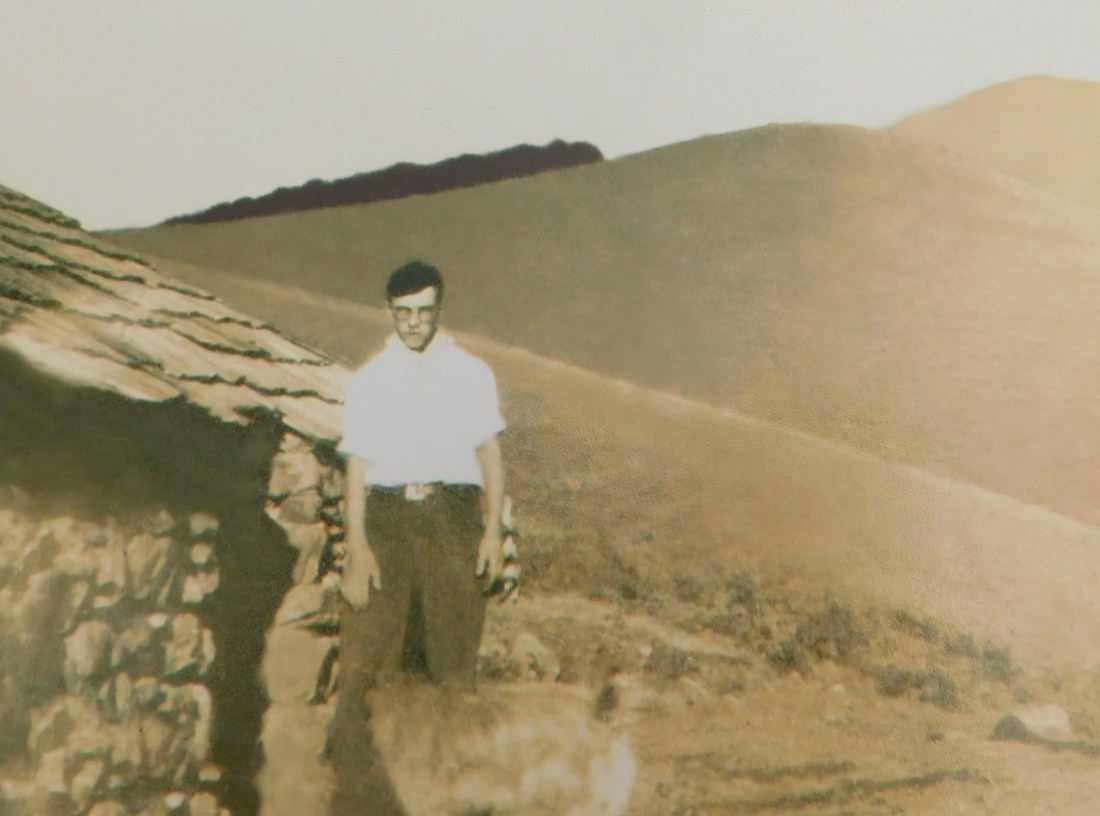
It is with sadness that I write about Jean Baptiste Etchamendy as he has gone to be with the Good Shepherd, our Lord and Savior.  Jean Baptiste was known to his friends and family as JB.  He was born in 1932 and died 2018.  He was born in the mountainous Basque village, Esterençuby, France. He was the third child out of seven brothers and sisters. His parents were Gratianne Guéçaimburu and Jean Etchamendy. JB lived a hard life as he grew up during WWII; France was under German occupation.  His family were sheep herders and life was hard, but JB learned many valuable traits during those years. He spent his summers in an “echola”, a little one room shack he called home while he shepherd the grazing sheep (see picture below).  It was here that he learned to make socks and sheep milk cheese every summer after being taught by his mother. With the economic conditions in France and not being the oldest son, he knew he could not have his own sheep company in France and he dreamed of migrating to America to seek his fortune.

DSCN1968a

His first attempt to migrate to the United States was interrupted with a call to serve his country in the French Army during the Algerian War.  France honored him with four medals for his service. Injuries to his arm did not keep him from his dream of coming to America which was realized in 1957.  He first worked for his mother’s cousin.  He then formed the Etchamendy Brothers Sheep Company with his brother Martin in 1965.  Martin returned to France and JB ran the company with the help of his wife, Barbara, whom he married in 1968.  They had three sons.  While the boys would work with their dad, he never encouraged them to be sheep ranchers.  JB sold his sheep outfit in 2000.

A story that was told during JB’s funeral was that during at least one live nativity scene at his church in Tempe, he brought in sheep from his flock.  I need to find out if he also brought in real shepherds that were tending his sheep in the winter.  The priest said he wish he had been at the church when JB did this.  I would have liked to seen that too!


Keep a Few Sheep

They pay better than any other class of farm animals.   That was the headlines in an Arizona newspaper back in 1893.  Why would an Arizona newspaper print such a story if sheep were not an important part of the economy of the territory, as we were a territory at this time? In its entirety with no editing expect what is in parenthesis.

A writer who appreciates sheep, and who succeeds in making a good profit on them, writes the Wisconsin Farmer, and says: I wish to impress upon my brother farmers, through the columns of your valuable paper, the importance of keeping at least a few sheep for several reasons. One is that they are such scavengers that they readily eat the seed of the vilest weeds and they are not like other farm animals, nothing grows after passing through them. Anyone traveling through the country can tell at a glance the farms that have a flock of sheep on them, by their neat appearance, no rag weed, the scourge of almost all of our cultivated land, is seen. I might go on and tell of other bad weeds, for their names are legion, but the sheep will in every instance annihilate them.

One other good reason is that they pay better for the food consumed than any other farm animal, and I now speak without fear of contradiction. No kind of stock will pay such profits on the cost as a flock of well-kept sheep. To illustrate: Two years ago in buying some feeders I got among them a rather small-sized ewe, and in sorting them out in the late fall I thought I would keep and breed her, for there was something about her that I liked. Her cost price was two dollars; the next spring she brought me two ewe lambs which she raised splendidly. She then met with an accident and had to be fattened, weighed 120 pounds, for which I got four and one-half cents or $5.40. Now I have sold to an Iowa man the two yearling ewes with sixty others, at $8 per head. So her increase brought me $16, making in all, $21.50. I think that the three fleeces of wool amply paid for their keep. I never got a chance to get much education and don’t presume to know what percentage I realized on the investment. (If my math is correct, I believe that is a 970% profit on just one ewe).

Another reason the sheep farmer has more time for recreation than the man who follows dairying, for instance, no matter what happens, rain or shine, that milk must be delivered on schedule time or there is a ruckus. Another reason is they are so docile and harmless, requiring less fencing and if by perchance they should break into the corn, they are not such gluttons and will not, like cattle, eat till they kill themselves, as is often the case. Another reason is that no stock, if properly bedded will make as much valuable manure and everyone knows that manure from sheep is the best. I might go on and state other advantages, but these will suffice. Don’t understand me that the sheep is everything and it needs no care. There is nothing to be without close attention, and sheep breeding and feeding are no exception to the rule.