Odds and Ends

Tonight’s post is an assortment of comments from Facebook friends that have given me permission to include them here. I have edited the comments where needed and added comments in parentheses. Bill Cowan allowed me to use his picture that dates back to 1919.

By George Groseta to AO Williams who had asked why wool is so expensive, and why he could never find American lamb if there are lots of sheep being raised in the USA – There are less than 5% of the big-time sheep operators in the United States especially the western United States that ran bands of sheep. President Clinton did away with the Wool Incentive Act of 1954, which was a tax on foreign wool that came in.  There’s also a big problem as far as different states because of predator control, also you have a labor hike & regulations.  Presently there are less sheep in the state of Nevada then if you go back to 1950s. And in Arizona, there were 25 to 30 big time sheep operations. We’re down to just two right (three if you count separately a father and son both in the industry) now because of the following:  you have the endangered species act, predators, labor; just a lot of things and that’s why there’s no American lamb anymore!!

img_9859

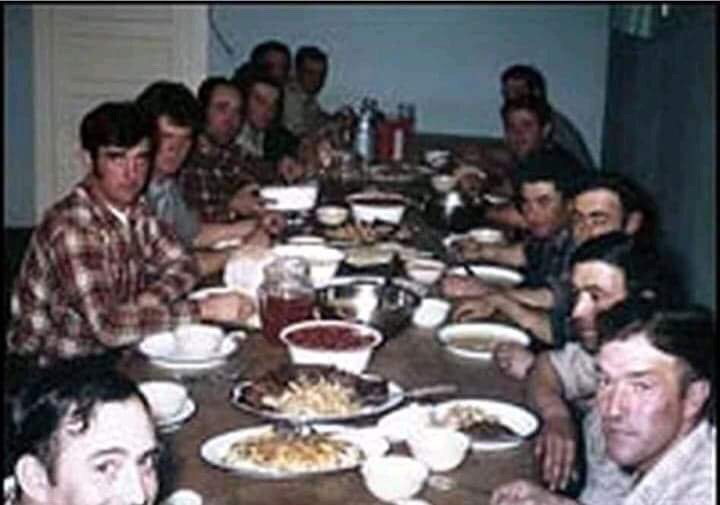
This picture is also from George Groseta.  It is men eating at Sheep Camp.  Anyone recognize any of the men?

The picture below is from Bill Cowan.

Sheep coming down off Anderson Mesa to drink on the east side of Mormon Lake. This may be Campbell and Frances outfit. 1919


Churro Sheep

When I visited the ranch in southern Arizona several weeks ago, they had a herd of about 300 churro sheep of which only some of them I photographed. Many of their sheep were down the road on another part of the ranch. These pictures are in another post and in the media section of this page. I will write more about them later. Today’s post is on the sheep at the Hubbell Trading Post.

My husband and I ventured to Ganado to see the sale of the Navajo-Churro Sheep. We also wanted to know more about the trading post and who ran it, Mr. Hubbell.  I have posted some information on this in earlier posts. After a stop at the National Park Visitor Center, we went to see the sheep.  One was the flock that remained on or near the trading post for visitors to see up close. The second grouping was those that were brought in that morning we visited to either sell or trade with other breeders. The sale was conducted by the Navajo Sheep Project who is responsible for preserving the breed and revitalizing the flocks found on the reservation.

The Navajo-Churro sheep are descendants of the Churra, an ancient breed originating from Spain and Portugal.  The first sheep came into the United States in 1598 with Juan de Oñate, a Spaniard who explored New Mexico. They are a hardy breed of sheep and survived very well in the environment of what would become the Navajo Reservation. The sheep were used for their wool to provide clothing and their meat for food by the early Spanish settlers.  These sheep became the central “focus of the Navajo economy, culture and arts” (blankets and rugs).

From a pamphlet at the Hubbell Trading Post visitor center run by the National Park Service comes the following information:

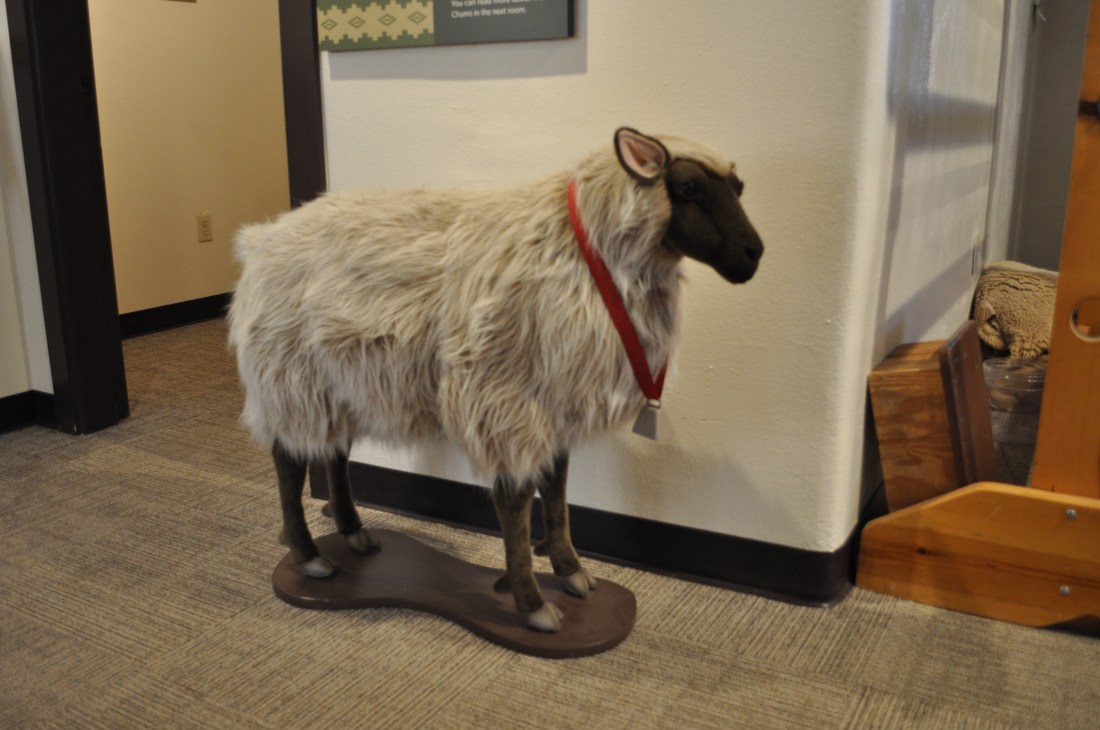
“Navajo-Churro sheep have coarse, long wool, including an outer coat and a soft inner coat. Their colors are varied in shades of white, tan, brown, black, and grey. They also have patterns of color. The sheep have long, wool-less legs and narrow bodies. (See picture below that was a model of the sheep found in the visitor center) Their bellies have little or no wool. Some rams have four fully developed horns, a trait shared by few other breeds in the world.

DSC_0131

Navajo-Churro sheep are highly adaptable to extremes of climate and resistant to disease. They breed easily and twins or triplets are not uncommon. The meat of the sheep is flavorful and has a low fat content. (A very good reason to eat sheep meat!)

The wool of the Navajo-Churro sheep is highly valued by hand spinners for the open locks and wide range of colors”.

The following pictures were taken the day of the sale. Notice the horns.  It is common for them to have four, even six. It was interesting to watch the woman pick out the sheep that they wanted.  They also knew what price they were willing to pay for them.

Hubbell Trading Post

Southwestern United States ancestral people have practiced trading for a long time. They traded long distances as evidence found in archaeological digs. Shells would come from as far away as the Pacific Ocean. Presumably there was an exchange of ideas too. Starting in the mid 1800s traders from the east came in wagons which carried a variety of goods that they hoped to trade for commodities of the local people. With the establishment of the Navajo Reservation in 1868, the Federal government made rules on trade with the native peoples. The government encouraged traders to have licenses and open permanent trading posts. One man to do so was Hubbell. He was first located two miles from Ganado and then he purchased William Leonard’s business in 1876. Thus, the birth of the Hubbell Trading Post which was in business until the 1960s by a Hubbell.  More information will be coming in the next post on the years Hubbell spent here.

Natives did not have currency and credit was extended to them with their promise to pay for any goods that they purchased at the trading post when they sold piñon nuts that they gathered, wool from their Churro sheep (it was reported that Hubbell shipped 100,000 pounds of wool to Gallup, but it is unknown was this in one year or over several years), firewood that they either gathered or cut, sheep and goats. Hubbell reportedly bought up to 10,000 lambs and goats each fall, corralled them until it was time to herd them to the railroad station in either Chambers, AZ or Gallup, NM. The animals would be loaded on rail cars to be shipped eastward. Later, the trading posts would accept handmade rugs and blankets, jewelry, carvings and baskets in exchange for the goods that the natives needed. Hubbell would bring in his goods to the trading post through his own freight business and take them to the other trading posts that he ran. He transported goods out of the reservation through his freight business.

Sheep kept at the Hubbell Trading Post as was the tradition when Hubbell owned and operated the post.

Hubbell Trading Post

The next few posts will be on the Hubbell Trading Post.  Today, just an introduction to the post with a few pictures from the National Park center. There is much to learn about Hubbell and his family as he was a friend to the Navajo and his biography is an interesting history of both him, his family and the Navajo or Dine people. J. L. Hubbell was born November 27, 1853 in New Mexico. He was self-educated and learned about the Navajo way of life, their culture and language while he was working for the U.S. Military.  He began to trade in Ganado in 1876.  He built a home for his wife, two sons and two daughters. His sons, Lorenzo, Jr. and Roman helped him run the trading post and continued upon their father’s death on November 12, 1930.  Hubbell was instrumental in getting the Navajo to weave rugs for sale at his trading post.

I haven’t finished the story of the Moroney’s, a relatively newcomer to the sheep industry and Thude’s, who were sheep ranchers in the early to mid part of the 1900s.  Their stories will follow over the next few weeks.

Southern Arizona Sheep Ranch

Just a few pictures from my trip to southern Arizona and a sheep ranch.  Dennis and Deb, the ranchers, were very hospitable.  We learned a great deal about their ranching lives and I will write more on it when I get it approved by them to ensure accuracy.  I don’t want to misquote anyone.  In the meantime, I hope you enjoy the pictures from their ranch.  They also have other animals, but never photographed them. These are churros.  Deb also processes the wool into beautiful yarn.

Mr. Pinchot outlines nine points for best management of grazing lands.

At the turn of the 1900s the controversy about who had the right to use the federal reserve land and cattle men making accusations that it was sheep who were doing all the damage to the forest was mentioned weekly in the newspapers especially in Williams and Flagstaff where many of the livestock men grazed their animals in the summer and Phoenix, an area that was used by both sheep and cattle men for their winter grazing area. Unfortunately, the letter mentioned in the newspaper that the secretary of the National Live Stock Association wrote to Pinchot was not printed in the paper, or at least it has not been found at this time in my research. As more of the concerns about the use of the federal reserves is found in the early newspapers, I will include them here. I have included the exact article written in the Williams News, November 9, 1901.

“Pinchot made suggestions as to a plan to which all trouble regarding grazing on the reserves can be resolved for all livestock in the western territories to the secretary of the National Live Stock Association. The secretary of the association wrote a letter in September and Pinchot responded to that letter. He was concerned with the cooperation between those grazing on public lands and the government. He wanted to insure the best management and condition of the range be maintained. He outlined nine points.

1. Consultation between the forest reserve officers and those who graze will decide on the number of livestock to be grazed on each reserve and to establish boundaries between cattle range and sheep range.

2. Local associations will assign ranges to each livestock person, but this is subject to approval.

3. Those grazing on the reserves along with the local associations will be responsible for adherence to the terms of the permit and prevention of fire and over-grazing. (how is this processed – herders having camp fires, number of days on each section, number of sheep?)

4. Sheep owners will have exclusive rights to the grazing area assigned and this will also apply to the cattle owners.

5. These permits will run for five years.

6. State residents will have rights over those trespassing and out-of-state owners of sheep.

7. Any questions arising during process will be decided locally and on their own merits in each separate case.

8. These grazing permits are generally summer assignments and provisions will be made for transit routes.

9. The emphasis of the government policy will be on regulation rather than prohibition except for the interest of over-grazing from all populations. Pinchot thought that these suggestions needed no further comments as it was to be to the best interest of all parties. These regulations would accomplish several things – 1. No monopolies; 2. Allow for new men to take up the livestock interest and not be shut out of the reserves; and 3. Each man would want to keep his range in good condition since he had it for five years and could probably renewal it.

FYI – Pinchot was the first chief of the United States Forest Service from 1905 to 1910.


Over one hundred years ago – sheep in Tucson area.

Last night I was presenting “History of Arizona Sheep Industry Since Territorial Days” to Tucson’s Corral of the Westerners and one of the gentleman, James Klein, came in with pictures of sheep taken in the Tucson area in 1917 and early 1918.  I love when I am able to get these historical pictures.  Southern Arizona wasn’t a big area for sheep.  Research has shown that many thousands of sheep were trailed across the southern portion of the state to California in the 1860s and 1870s, maybe the 1850s, but that date has not been documented, just suggested since we know sheep were taken to the miners in California after the gold rush began. One of the pictures was also of a large herd of cattle, but it was very grainy and very hard to see the cattle so I decided not to include.

I would love to know more of the family who took the pictures and if they knew anything else about the sheep.  The family was here as one daughter had tuberculosis and was being treated.  They were here for a very short period of time as she died in Feb. 1918.  The scrap book had other pictures and early postcards of their visiting various places around Tucson.  There were some early postcards of San Xavier del Bac and downtown Tucson.


Good rains reported for mid 1901 ensures good grazing range for all livestock!

Reading weather reports as they appear in the early newspapers help to tell the history of the livestock industry in Arizona. When the snows had been good, it meant reservoirs were filled and much of the water then goes into the rivers and ends up in the Salt River Valley.  Summer rains are also important to both cattle and sheep and when the rains slack off, the sheepmen and cattlemen become concerned about the forage for their animals and where they will obtain water for them.  With a heavy snow fall in the winter of 1901, it appeared that the land was drying out and the livestock men were becoming concerned for their livestock and livelihood.  But at the end of July a very heavy downpour of rain northwest of Williams made at least the sheepmen feel jubilant, especially James Walsh who had come into town and reported the good news. All reservoirs were filled and running over by the heavy fall of rain.

The next week another article in the Williams News appeared stating that the rains had been heavy over the northern portion of Arizona every day for the past two weeks. No data was given for the amount of rainfall, but it was reported that all dams and reservoirs were full and in fact they were overflowing. The newspaper assumed that the ranges were assured for a year at least.

At the end of October another interesting article appeared concerning permitting the grazing of sheep on the forest reserves of Arizona.  But it seemed that the Department of the Interior so no reason to bar the sheep. The Snips and St. Johns Herald newspaper reported that keeping the sheep off the reserves was really only a fight between the sheep and cattle men. Drought had hit the state and the cattle men were using their influence to convince the residents in the Salt River Valley and especially the farmers that the sheep were denuding the forests and causing the drought. The newspaper went on: “If our friends in Phoenix would learn the real fact in the case they would know that we have not lessened the water supply. We are just as much in favor of water storage as they are. The more water is stored the more rains we will have. The more rains we have the better the range, and the better our crops, though few they be”. As was reported in the Williams News, the Snips and St. Johns Herald continued “But fortunately we have had a good season and there is plenty of water and plenty of grass. Facts are stubborn things, and this one gives the lie to the hatched up theory of those who claimed that the sheep were causing the drouths. But we truly hope the strife has ended and that henceforth we know no north nor south, but only Arizona, a unit.”

In November the forest reserve question is raised again as how best to allow all livestock to graze on the reserves. I will post this in my next blog.

Duckworth American Wool

IMG_9364

Duckworth Sheep

Today, I am deviating from posting about families in the Arizona sheep industry to promote a company located in Montana that prides itself on being the only source-verified, 100% Made-in-the-USA Merino wool clothing company.  You can read more about their story on https://www.duckworthco.com/pages/sheep-to-shelf.  For those of you who do not wish to visit another website, I will post some of their information here.

In Dillon, Montana, a sheep ranch by the name of Helle raises sheep, and then they “carefully manage every part of the production process from raw fiber to finished garment. The ranch in Dillon sits one mile above sea level.  As the valley starts to warm in early summer, the sheep begin their 40-mile journey to graze in the high mountain pastures above 9,000′ in the Gravelly Mountains.  The extreme changes in altitude and temperature give the Helle Rambouillet Merino a longer staple length, more crimp and grater curvature.  The 4th generation ranchers have fine tuned this process creating a soft yet extremely durable wool for Duckworth garments.”  Their sheep have just recently come back down the mountain. As they wrote in their email “The young lambs shave grown larger and stronger, and were able to make the long journey home with ease.”  (Our two trails in Arizona are longer than 40 miles but the ewes and lambs only travel northward via the trails and are trucked back to the valley each fall).

The email continued, “After the spring shearing, each fleece is tested and given a grade to determine its end use.  The wool then travels to the Carolina’s where it is spun, knit, and dyed.  The garments are cut and sewn in three different US states, and shipped back to Montana for warehousing.

In addition to making great wool, the Duckworth Sheep to Shelf process removes thousands of miles from the traditional supply chain, resulting in a significantly smaller carbon footprint.”

Most of this information is quoted off of an email that I received from them last week.  I asked for permission to use it here as I truly believe it is important for the American consumer to think about the clothes they wear and where they are made and that includes where the fabric comes from – wool from American sheep and then processed here in the United States!  If you want to reduce the carbon footprint, what a great way to do it by buying American made products.  It keeps our sheep industry healthy, provides jobs for those raising the sheep, then all the people involved in shearing, sorting the fleeces, the transporting of the fleeces to a mill, and all those employees, etc., etc., etc.  Think of the jobs that are created in this process.  We use to have many woolen mills in this country especially when we had 55 million plus sheep across the country.  Today, there may be 6 million sheep, mostly found in the western states where there is land for the sheep to graze.  Sheep help keep our forest healthy by eating the undergrowth; that is when and where they are allowed to graze.  For helping to keep the forest healthy, sheep owners pay the forest service to graze their sheep for a few months each year and the sheep owners are told when and where and for how long the sheep can be on the land.  Forest fires have increased over the years as there have been a reduction in the number of sheep grazing.  But, this is a topic for another day.

I will close this blog reminding the consumer that the holidays are approaching and what a great time to purchase American made wool products.  There is wool that can be worn in Arizona in the summer time.  Wool quality has changed over the years.  There used to be shops in Williams that sold woolen undergarments so that would have to be a soft wool. I have talked in earlier blogs of the benefits of wool.  Please think about your next purchase.  And don’t forget to check out Duckworth Wool in beautiful Montana.