Researching the sheep industry in old newspapers I come across some of the most interesting items that I have heard mentioned by today’s auxiliary members but hopefully with this information and others that I found I am starting to piece together the rests of the puzzle.
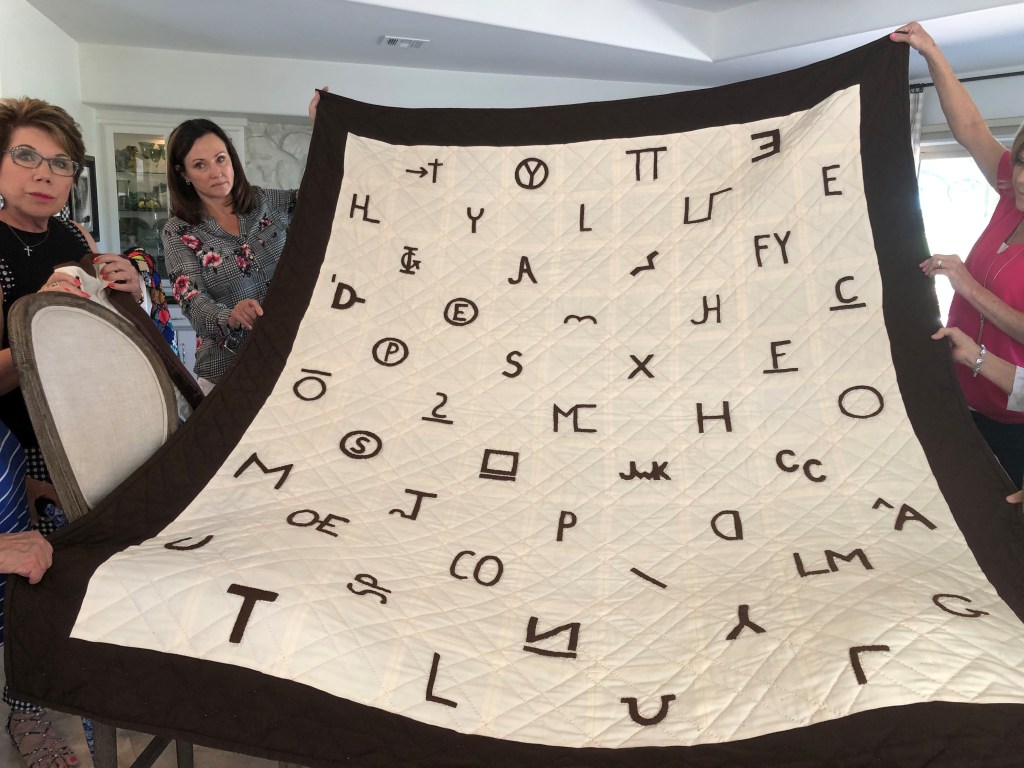
The Arizona Wool Growers’ Association Auxiliary met July 16 in Williams at the home of Albert Pouquette. The primary reason for the meeting was the installation of the new officers. Other business was the auxiliary was looking for old wool clothing to be used in their “Old with New” apparel display for the fall. The women were working on a big relief map showing the sheep trails in Arizona. They also wanted to have a men’s fashion show along with a men’s barbecue cooking presentation for their Education Promotion. They were preparing for their sheep industry education promotion week to be held in October at Chris-Town shopping center. Another project that the ladies would be working on was a wool quilt which would feature appliques of old sheep brands. This project was going to start on August 6 at Basilio Aja’s home south of Williams.
The question that is raised here is what happened to the map showing the sheep trails? And another question is this the quilt that the ladies finally made?
And just to let everyone know these were the officers of the auxiliary elected: Mrs. Jean Etchamendy, first vice-president; Mrs. M. P. Espil, second vice-president; Mrs. Arnaud Etchamendy, secretary-treasurer; Mrs. John Aleman, Jr, parliamentarian; Mrs. John Simpson, auditor; Mrs. Phillip Echeverria, historian; Mrs. Basilio Ajo, corresponding secretary; Miss Sylvia Manterola, lamb promotion chairman; Mrs. Steven Zvoner, state director of “Make It Yourself with Wool.”
If you recognize your brand or anyone else’s please comment on this post. Thanks.
Congratulations to John Sr. and Frances Aleman family for their nomination posthumously into the Arizona Farming and Ranching Hall of Fame. They will join other sheep families that have been honored in the past. The induction ceremony will take place in February 2024 at the Wigwam Hotel, Litchfield Park.
This blog has written about Frances Aleman in the past. Included is some information on John Sr. as well as Frances.
The Aleman family is only one of the many families who made the great sheep era here in Arizona possible. There once were almost two million sheep in Arizona and now there is only a few thousand, not counting those sheep on the Native American reservations or small flocks owned by individuals. The Aleman’s contributed in their own ways to its legacy in the promotion of lamb and wool both here in Arizona and nationally.
Juan Manual Aleman, a Spanish-Basque from the Pyrenees Mountains of Spain, was born August 1894. He came to America in March 1914 and started as a camp cook for a sheep company in Winslow, Arizona. A few months later he moved to Flagstaff and went to work for MP Espil & MI Powers at Frisco Mountain Sheep Co. He worked here for 12 years saving his money until 1926 when he partnered with Mike Echeverria in the Cross Mountain Sheep Company near Seligman, Arizona. In 1935 he joined in partnership with Joe and Leon Pouquette northeast of Williams, Arizona. After saving his money he was finally able to start the John Aleman Sheep Company in 1952. In 1967 his son, John Jr., joined him and they changed the name to John Aleman and Son Sheep Company.
He was an active sheep producer in Arizona for 58 years, a member of the Arizona Wool Growers Association of which he was a director for 27 years as well as a director for 20 years on the Kaibab Advisory Board. He was listed in Who Is Who in Arizona in 1958.
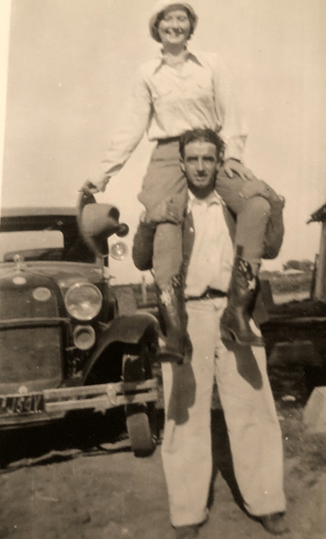
John met his wife, Frances Abbie Hendrix, who was born in Illinois and migrated out to Arizona from St. Louis in 1929, at her father’s Box H Ranch near St. Johns, Arizona. They enjoyed a very unique courtship riding the range on horseback and working with the sheep. They were married July 1936 in Phoenix. It was the beginning of a wonderful life they spent together for over thirty-six years.
Frances became very active in promoting lamb and wool and in 1948 she, along with Ora Chipman, of Utah, co-founded the Make It Yourself With Wool competition which was sponsored by the Women’s Auxiliary to the National Wool Growers’ Association. In 1968 the American Sheep Producers Council started the annual Aleman-Chipman Scholarship Award for the senior winner in honor of their contribution to introducing young people from across the country to the beauty of woolen garments.
In 1958, Frances, along with several other women in Arizona’s sheep industry, started the Arizona Wool Growers’ Auxiliary. She was the Charter President and served for twelve consecutive years. She also served in each of the National Women’s Auxiliary offices and was elected President of the national in January 1971 and served for two years. Then she served an additional two years as the National Press Correspondent later being appointed as the Historian Chairman for the American Sheep Industry. It was here that she spent over 3½ years gathering histories from sheep families across the country for the book “Sheep and Man An American Saga” printed by the American Sheep Producers Council in 1978.
Throughout these years, in addition to Make It Yourself With Wool, she organized and worked on many lamb and wool promotions including the National Miss Wool beauty pageant, demonstrations at numerous grade schools, high schools, ASU, UA, 4-H clubs, Boy and Girl Scouts, the Arizona State Fair and on television and numerous newspaper interviews.
An annual Lamb and Wool Fall Fiesta was held at Chris Town Mall where a complete sheep camp was set up including ewes and lambs and a sheep shearing exhibition. On the last day of the fiesta a full-fledged sheep camp dinner was served to an average of over 1,000 people. In 1968 she was named Woman of the Year by Chris Towners Business & Professional Women’s Club. She also served several years on the advisory board of the Town and Country Life Conference at the University of Arizona and was honored for her service.
She worked tirelessly to promote lamb and wool even while moving two times a year up and down the mountains between Buckeye and Williams, following her husband’s sheep outfit. As a young girl, Frances suffered with tuberculosis losing part of a lung which weakened her and caused many bouts of illness and hospitalization throughout her life. She had a strong will and recovered many times to return to doing the things she loved so dearly, her family, cooking and especially her passion, promoting lamb and wool wherever she could .
She was a devout Baptist and taught Sunday School at the First Baptist Church in Buckeye and helped to support two missionaries. Her husband John Sr. was a devout Catholic but they respected and supported each other’s beliefs.
Together they had one son, John Jr, who was born in 1943. He started working summers out at the Williams ranch at age 9, staying for a week at a time, helping the sheepherders, loading and moving the burros from camp to camp and hauling water, building fences and helping with the sheep. He joined his father in ownership in 1967 along with his wife, Claudia Jo Nichols whom he had married in 1961. They had two children, John III and Heidi Jo. The couple took over running the company when John Jr.’s father passed away in 1972. John Jr. and Claudia divorced in 1977. He ran the company until 1978 when he sold the ewes and the ranch to Joe and Carmen Auza. They continued to run feeder lambs together until 1980 when he married Kathy Wolfswinkel and started Aleman Sheep and Machine Company in Higley, Arizona.
John Jr.’s daughter, Heidi Aleman-Serrano, joined his wife, Kathy, in continuing to help with the annual Make It With Wool state competition and continuing to sponsor the Aleman Memorial Scholarship in memory of Frances, John Sr and John Jr. This year Make It With Wool will celebrate its 75th anniversary as a national competition. It is believed that Frances would be very happy that this competition is still going strong today. The family is proud of its part in the heritage of the sheep industry here in Arizona.
Today we look at some of the wool apparel for sale during 1923 as found in the Williams News.
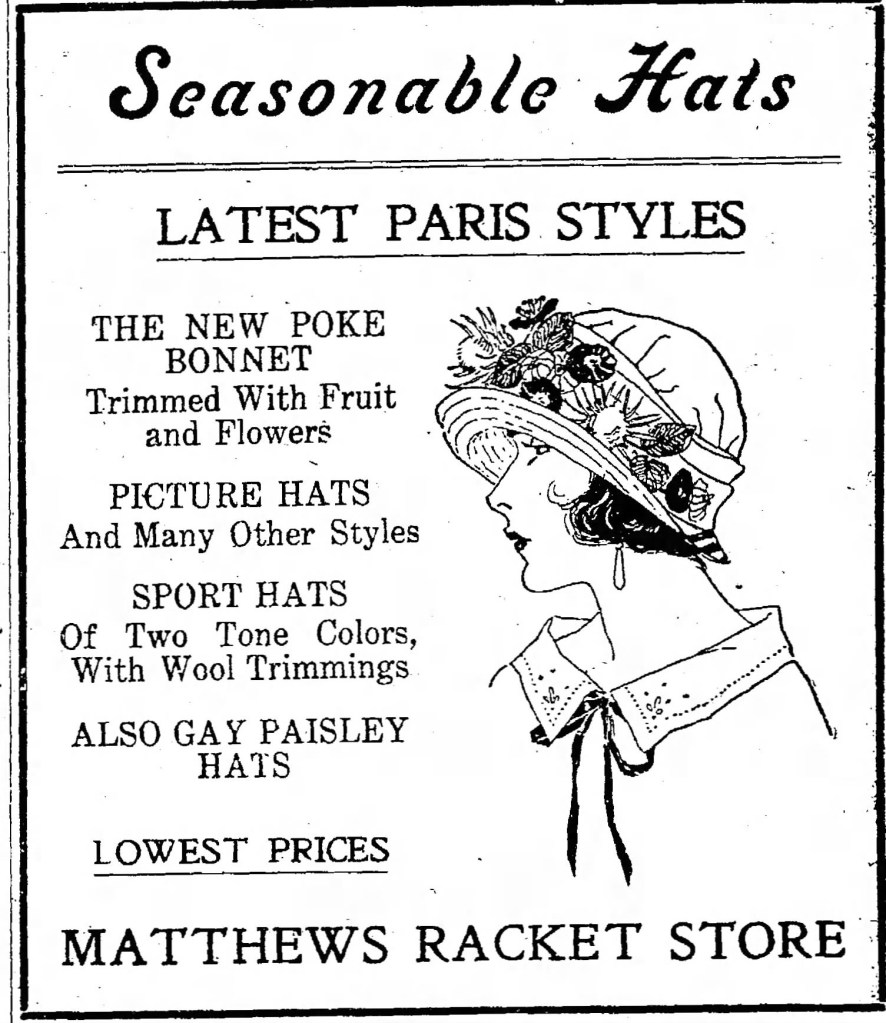
Babbitts and Duffy Bros. were the two main stores in Williams. Each had many weekly ads. There was one advertisement found during the year for Dial and England and one for Matthews Racket Store. Dial and England sold ladies wool hose (other items were sold but not germane to this blog) and Matthews had sports hats with wool trimmings (also other types of hats). Clothing sold at both Babbitts and Duffy Bros. were similar but Duffy’s seemed to be the store with the lower prices and it advertised as the store “where thrifty people trade”.
There was not a great deal of selection at either Babbitts or Duffy Bros. reviewing their ads for the year. Items included ladies’ wool skirts and suits with two pairs of trousers for both men and boys. Wool riding pants lace leg, double seat was available at Babbitt’s. Both stores had a selection of wool sweaters, knit caps, ladies and misses wool gloves, hose, men’s wool shirts and men’s socks.
For those who were “clever”, meaning could sew, wool batting was available for making comforters at Duffy Bros. Both establishments sold wool material.
And to finish our story on wool – from the May 4th edition of the Williams News, “there are still a few people who use the old spinning wheel, spinning yarn from the pure wool. Mrs. Robert Gleason of Pittman Valley is doing this, and has some fine yarn, ranging in color from pure white to jet black, that she has spun”.
At the July Wool Growers’ Convention in Flagstaff in 1923, some of the prominent men in attendance was E. A. Sawyer, Winslow (member of the executive board); John Hennessy, Flagstaff (member of the executive board); F. W. Perkins, Flagstaff (secretary-treasurer of the organization); E. H. Duffield, Cooley (2nd Vice President); Geo. F. Campbell, Flagstaff; Harry J. Grey, Bellmont; and Charlie Burton, Ash Fork (1st Vice President). Charlie Burton ran the meeting. Campbell and Grey were listed as “sheep men.”
Hugh Campbell who was president in 1923 was seriously ill and in fact, passed during the proceedings at the meeting. He had been ill for some time with intestinal cancer. During the meeting, a new president was elected: A. A. (Tony) Johns, Prescott.
Members of the executive committee elected were Colin Campbell (Ashfork): E. A. Sawyer (Winslow); Lou Charlebois; John Hennessy and Dannie W. Campbell, all of Flagstaff. The State advisory board were all reelected – John Hennessy; Mr. Chas. E. Howard (Phoenix); Colin Campbell, James Scott (Pinedale); and E. A. Sawyer.
Advisory boards in forest elected or re-elected members:
Coconino – John Hennessy, George Campbell, D. W. Campbell, A. J. LeBarron. These men were all from Flagstaff.
Tusayan – C. E. Burton (Ashfork), Lou Charlebois (Flagstaff), F. D. Bly (Williams), Colin Campbell (Ashfork), and Mrs. C. E. Howard (Phoenix).
Prescott – H. E. Campbell, A. J. LeBarron, John Hennessy, (all from Flagstaff) W. W. Perkins (Winslow), Colin Campbell Ashfork).
Sitgreaves – E. A. Sawyer (Winslow), E. B. Newman (Pinedale), Fred Purcell, G. H. Wilbur, (both from Heber) and James Scott (Pinedale).
Once again, this type of information helps to establish who were in positions of the Arizona Wool Growers’ Association and thus gives a picture of at least some of the men who were in the industry in 1923. This information came from the Coconino Sun, Flagstaff but did not list who were all the attendees as other years’ newspapers did.
Just a few more sheep stories that were reported in the Williams News for 1923. Not all pertain to Arizona but were included as some of these articles would have been of interest to the sheep men and maybe the public. Newspapers back in the day certainly carried more newsworthy stories to the public then they do today.
In the February 2, 1923, Williams News an article appeared on the many attributes associated with Williams. Besides the fact that it had prospered because it was the “gateway to the Grand Canyon” mention was made that the outlying country was “still grazed by profitable herds of cattle and well-paying sheep herds.” There were many sheep men who summered in the Williams area that I have previously wrote about – Aleman’s, Pouquettes, Wm. Pitts, R. E. Diahl, etc. It was also reported that J. F. Daggs, who had extensive sheep interests in the state, had passed in May 1923. His son had a home in Williams and was aslo connected with the sheep industry.
An interesting piece of information came from the William’s Woman’s Club November meeting. The women’s club held a meeting and discussed many things. One of which was how to beautify their town. Some one thought flower gardening worthy of our intensive attention, then came the water problem and finally the question of keeping the town herds, pet goats and sheep and range cattle out of their lawns and backyards. Just how this was to be done was not decided but the ladies thought perhaps they could cooperate with the Rotary Club and gain something definite in the way of means to make Williams the most beautiful town in Northern Arizona. It will be interesting to see if further information of a joint adventure with the Rotary Club produces any results of ridding the town of sheep and other livestock!
In December the Williams News reported on the Articles of Incorporation for the Chevelon Sheep Company by P.J. Moran, C.J. Babbitt and H.G. Babbitt. Once again, this information helps with names of the sheep companies and those who were in the business.
Among these 1923 newspapers were many articles that would have been of interest to those in the sheep business. One was “Department Film on Wool One-reel motion picture on phases of wool handling and marketing is released”. It had been prepared by the United States Department of Agriculture and could be borrowed from them. Another from the Department of Agriculture dealt with “Sheep are Particularly Subject to Parasites.” A third informational article was titled “Commercial Life of Ewe”. It stated that the life of a breeding ewe is six to eight years, depending on type of sheep, range, feed, care, etc. The first lamb is dropped when the ewe is about two years of age. Four to six more are gotten before the animal is discarded. Many sheep breeds the ewes have two and sometimes three lambs thus this number cited could have been low but it did say depending on the breed!
And for our conclusion: the humorous story – “Maxim for Moral Maidens – To keep a man from dancing – cheek to cheek with you, wash your hair in sheep dip.”
A few happenings in the sheep industry found in the Williams News. Most of these are about sheep raisers in the northern portion of the state but one deals with the Prescott area.
In one story found in the January 12th Williams News a group of nine sheep raisers purchased a section of land for a sheep driveway. The land was located 16 miles northwest of Prescott near the Cooper ranch (one of the purchasers) and four miles beyond the American ranch. It cost them $2,880 which in 2023 dollars would be $50,578.42. Unfortunately, more research will be needed to find how many acres were bought and the exact location for the trail.
Those part of the land deal included Nathan Bankhead, R. E. Daggs, Lou Charlebois, Charles E. Burton, George Campbell, R. F. Cooper, M. I. Powers, Peter Espil, Simon Pacquette and the Howard Sheep Company.
Some other information were sheep raisers visiting Williams:William Pitts and Mr. R. E. Diahl who had interests in the Howard Sheep Company. Finding these little tidbits gives me names of sheep raisers I might already know but sometimes it is a new one.
In 1923 there was the announcement of 10-year permits for stockmen who desired to graze cattle and sheep on National Forests ranges. This would take place in 1925. Permits of the past have only been for 5 years. But in an effort to help stockmen recover from the period of depression that it had suffered the past few years after World War I, they (the Federal government) felt that the increase time would help stockmen secure financial aid to carry on their grazing operations. New rates for grazing will also take place in 1925 occurring simultaneously with the new 10-year permits.
There are other mentions about sheep for 1923 in the Williams News which will be posted in the next day or so as I have the time to organize it. One will be about the range conditions for the year as it seemed that that changed very quickly from favorable to unfavorable.
While conducting research in the early Arizona Silver Belt newspapers, 1887 – 1908, for a presentation at the Miami Bullion Plaza Cultural Center & Museum a few mentions were made about the happenings in Globe and Miami relating to sheep. I like to gear presentations to the area I am in for more interest to the audience and to help fill in gaps in the sheep history of the state.
A good place to get some information about who owned sheep is looking at the Delinquent Tax List published each February. This will not give me all those who had sheep in any one year, it does tell me other things about these individuals that are on that delinquent list. For example, for tax year,1887, H. Sidow is listed on the Delinquent Tax List for 35 sheep and Redman for 20 sheep. In 1888, there were three men’s name who were assessed for sheep. Jacobs & Jorgenson had the most sheep, 2,000; Joseph Redman had 20 sheep, and James Wiley had 150 sheep. Redman was a butcher so that explains him having sheep as he was also assessed for his butchering equipment. Jacobs & Jorgenson seem to disappear from any mention in the newspapers after this date as does Wiley. Various news report had Redman traveling to collect sheep in parts of Gila County or elsewhere in the state. Sidow, Jacobs & Jorgenson, and Wiley’s name did not appear in similar announcements so it is unsure whether they were butchers.
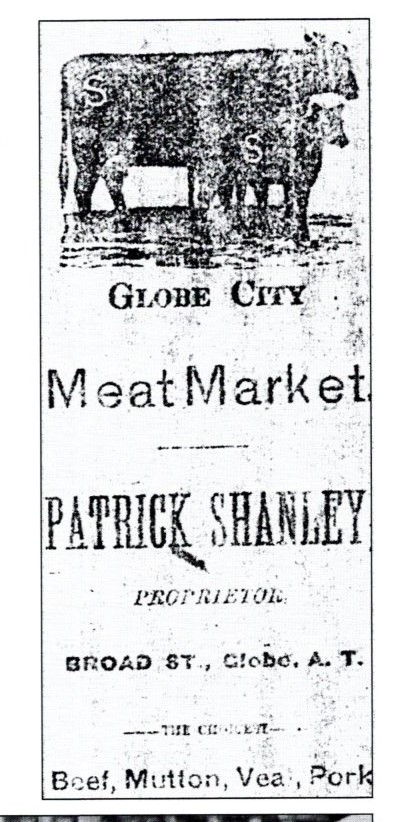
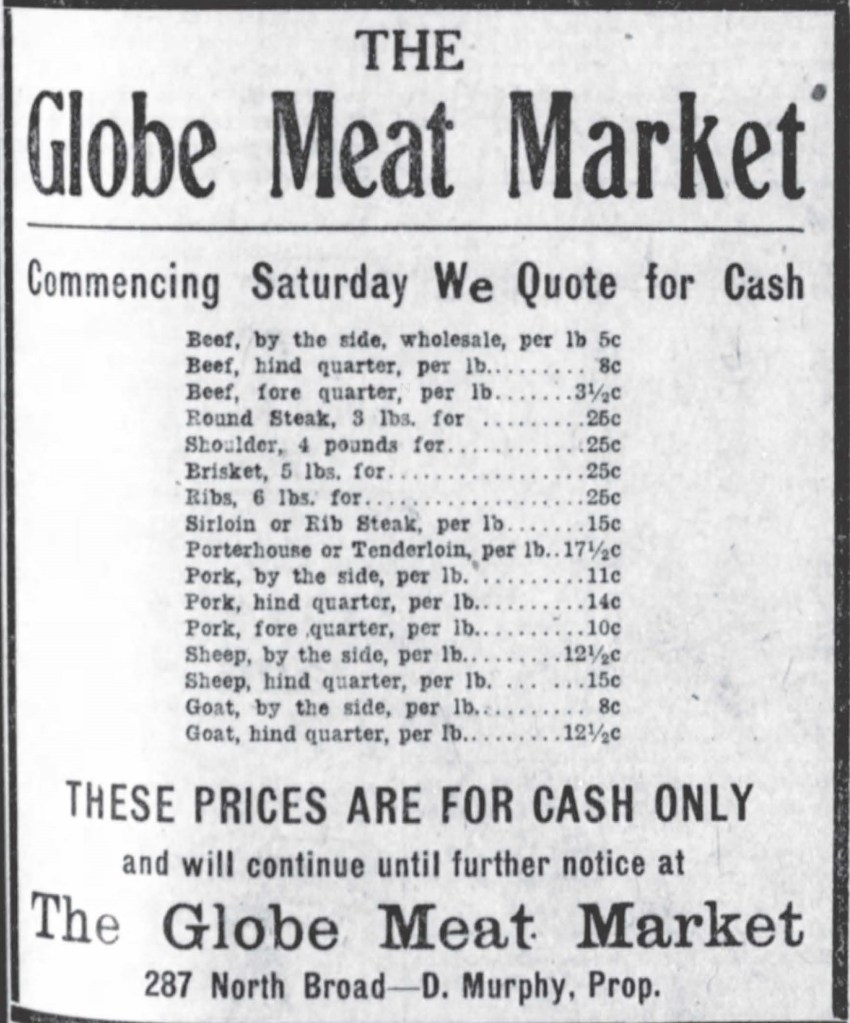
Looking at advertising in the newspaper gives other names that haven’t been mentioned before. Such is the case for Denis Murphy that ran the Globe Market; C. Bonne ran the Central Market. C. Bonne name had many mentions I found stating he had left to buy sheep in various parts of Gila County or the state. Denis Murphy was mentioned several times and there was debate whether he was selling goats meat as sheep meat. His ads changed to state that he sold only genuine sheep meat! P. Shanley had one mention that he bought a band of sheep. He did own a butcher shop as the ad below shows. But one thing is for certain, the citizens of the Globe/Miami area were eating lots of sheep meat as the Globe Market said they needed 2,000 sheep each year to keep up with demand! The other markets did not state how many sheep were needed. We also know the price various cuts of meat sold for.
Photograph courtesy of Janice Bryson from her book Irish Arizona.
A third market was the Peerless Market that also sold sheep meat. Unfortunately, I do not have one of their ads.
There are still other years to search in the Arizona Silver Belt; it all takes time. You can be assured that any new finding I will post them.
If you want to learn about the Arizona sheep industry and it’s long history of 137 plus years I will be presentation at the museum in Miami, Friday July 14th at 6:30 PM.
This year, 2023, marks the 137 year of Arizona sheep industry, raising sheep for their wool and meat. In 1886, sheep men realized the importance of joining together for the good of their industry and to preserve a way of life that many coming to the United States had participated in in their own countries but could not sustain that lifestyle in their own country for a variety of reasons. Sheep raising had taken place in Arizona from the time of the Spaniards who brought them into the pueblos of New Mexico and the Navajo brought them into Arizona. And Father Kino is also credited with bringing domestic sheep into Arizona in the late 1680s. But this was the first time the men joined together to promote the industry. While not germane, the cattle people didn’t organize as early as this. Forgive me if the date slips my mind!
In 1961, the 75th anniversary of the industry, The Arizona Wool Growers’ Association, took place in Flagstaff as it had in past years. The men and a few women would have the opportunity to “talk shop” – discuss common problems of the sheep raisers, the problems of the trade and seek ways of maintaining their rightful position in the ever-changing industrial world that had seen synthetics developed that resulted in a decline for wool to be used for fabrics. Today, there is no meeting of the sheep families in Arizona as there is only one family of three generations still in the business of raising sheep.
In 1961, sheep numbers had been decreasing and in fact, every year since the end of World War II when wool was used for service personnel uniforms, backpacks, blankets, and other items. Military uniforms, or at least dress blues, are once again being made from wool. But the amount of wool needed to produce these uniforms will never equal what had been used by the military in the past.
There are sewing contests across the country to promote the use of wool by both men and women. In Arizona the contest is sponsored by the few ladies and those interested who have joined together and are known as the Arizona Wool Growers’ Auxiliary. Each year, the contest is held in November and price money is given for the first, second and third place winners in each of the categories.
Other ways that were used in the past to increase the interest in and buying of wool and sheep meat will be presented in a future blog.




 ArizonaSheepHistory.wordpress.com