Mr. Gosney’s answers Mr. Bark

Mr. Gosney after being shown the interview printed in the December 5th newspaper stated, “Mr. Bark is certainly the champion anti-sheep agitator of the west. He seems to have fought the sheep industry so long and so hard that he is ready to believe and quote as true every wild rumor and is unable to state real facts involved in the question.” Mr. Gosney addressed all of Mr. Bark’s complaints leaving nothing out of his remarks: the drought, the number of sheep driven into the Salt River Valley, the abundant range feed this year, and the benefits sheep men added to the local economies of their counties.

Mr. Gosney first began that it was common knowledge in Arizona that a five-year drought was just broken when the territory had an abundant fall of snow and rain in the last twelve months. He further stated that there never has been or will there ever be 200,000 sheep driven to the Salt River Valley. (the two men’s numbers don’t seem to agree as Mr. Bark stated 300,000 and Gosney said 200,000 of which the newspaper never asked for correction).

Sheep from New Mexico had been brought into the territory Gosney said, agreeing with Mr. Bark’s statement. The reason that sheep came from the neighboring state was the range feed was very abundant and Arizona’s sheep could not feed on all of it. In answer to Bark’s claim that “sheep destroying the ranges and leaving nothing behind is pure nonsense,” Gosney said. The range was so abundantly covered with feed that the sheep would not have been able to eat even a “one- tenth” of it as they were trailed south. Gosney continued, “In fact nine-tenths of the feed on the southern ranges consumed by sheep could not be harvested by cattle or any other kind of stock; because it is inaccessible to water and only lasts for a short time, when it is abundant, then gone.” As for Bark’s comment that sheep have put the cattle men out of business, he adamantly disagrees as he also had interest in cattle and two factors eliminated his cattle: “climatic uncertainties and the activity of the numerous rustlers.”

Gosney also refuted the claim that the Salt River Valley watershed has been harmed by the sheep. He stated that the farmers in the Verde Valley would be the first to notice the reduced flow of water and they have not complained.

Gosney left nothing unturned in his refuted remarks to the claims by Bark. He made two last points on the benefits of the sheep men within the state. The first is that sheep were taxed in their home county and any sheep from Apache, Navajo or Coconino counties would have been illegally assessed in Maricopa County and this should be looked into as to why it was done. Sheepmen do pay their taxes and the totals paid by them in their home counties would be easily accessed for verification of this truth.

Gosney finished his defense of the sheep industry with the following: “The importance of the sheep business to the territories is generally underestimated. The income from this industry is (was) more than a million dollars and the great number of men employed annually and the heavy expense of caring for sheep and wool, all of which is(was) expended in the counties and districts where the sheep graze for the time being, makes it a matter of importance to the territory and to the people of those localities. The sheepmen are (were) among the best citizens of the territory. They are (were) imposing on no one, and they as well as the industry deserve fair consideration and treatment, and we sincerely hope the people and press of the territory will not be misled by intemperate agitators, into class or sectional strife.”

“If we are prepared for statehood let us prove it by being honest and fair to every citizen and every industry within our borders.”

This was the end of the two men’s square off as nothing more was printed in the newspaper for 1903 or the beginning of 1904.

James E. Bark, cattleman and E.S. Gosney, sheep man, square off.

The Pleasant Valley War may have ended in the early 1890s (1882-1892) however, the cattlemen still were making disparaging remarks about the sheep and the sheep men. In two different issues of the Williams News, one December 5, 1903 and the second, December 12, 1903, a prominent cattle owner, James E. Bark, and E. S. Gosney, president of the Arizona Wool Growers Association squared off with each citing their opinions of what they perceived of the others industry. This square off was a result of a statement made in the Phoenix Republican that 400,000 sheep were headed to the Salt River Valley and that sheep commanded the northern lands of the state.

On December 5th, Mr. Bark decided to answer this with what he perceived of the true problem with the sheep industry and how the sheep were ruining the forest reserves, the watershed of the Salt River Valley and adding little to the tax revenues of Maricopa County even though they benefitted from grazing in the county each winter.

He began by stating that before the influx of sheep in the Salt River Valley there were many cattle but that the herds had been reduced because the sheep had eaten everything, leaving nothing but higher branches on trees for the cattle. He further stated “there were many dozen cattlemen, each paying more taxes than all the sheepmen paid into this county (Maricopa) in 1902. He went on stating that if there were 300,000 sheep in the county, where were they when it was taxation time as the county only collected $99.85 on 60,700 sheep from Apache, Navajo and Coconino counties. His next point of contention was the destroying of the watershed, “is destroying our forests, tramping the watersheds of each little stream until the blessed rain when it comes can no more penetrate it than it could a sack of flour, but cuts gullies into it and washes it into the streams leaving nothing but a barren and hard subsoil or bedrock on which nothing can grow and destroying the greatest reservoir Salt River ever had or ever will have.” He continued that the sheep men say that the amount of rainfall is less than in previous years, but he disagrees with that statement and said he can prove it with the rain totals kept by the Weather Bureau!

His closing remarks “Action must be taken by the people of the Salt River Valley to stop the destruction of their watershed or give up the valley and the Tonto reservoir to the sheep. But can we afford to give it up for $99.85 per year?” Clearly, he did not care for the sheep industry.

Mr. Gosney’s answer will be in the next post.

The Progress of Arizona – Governor Brodie 1903 Report – Livestock

At the end of November1903, Governor Brodie’s statement on the progress of Arizona included many areas of the economy with the report ended with the status of the livestock industry but it is almost exclusively about the sheep industry. I have taken it verbatim from the newspaper.

“The Live Stock Sanitary Board submits a report in which it says that the live stock industry, as in the past, stands second in magnitude among the great industries of the territory. The passage of a live stock law by the last legislative assembly, says the sanitary board, marks a new era of prosperity and protection to those engaged in stock raising nd undoubtedly will reduce the cow thief and the rustler to a mere matter of tradition.

E. S. Gosney, of Flagstaff, Secretary of the Arizona Woolgrowers’ Association, reports at length on the sheep industry of Arizona for the current year.  Mr. Gosney estimates the lamb, sheep and wool crop of the season in this manner: sheep one year old and over, 500,000; lambs, 270,000; mutton, 250,000; wool clipped 3,500,000 pounds. The average price of wool for the season of 1903 was 13 cents per pound, giving a value of $455,000. The average price of lambs, $2.50 per head, but the sale of lambs at $675,000, making a total value of the sheep product of this territory for the season amount to $1,130,000.”

The cattle industry, well, they were absent in this report except their mention in the livestock board report. Surely, they had something to report for as we will see in the next post they surely wanted to complain about the sheep industry.


Our Way of Life is Vital to Yours

Frances Aleman wrote the following prior to her death in 1983 at the young age of 72. I am guessing that this was written in the 1950s or 1960s from what she had to say about transportation for sheep.  The railroads ended hauling of sheep early 1970.  I posting this today as I think it is very apropos on the livestock industry today and the bad publicity it is receiving, both for sheep and cattle.

“If the events of civilization could be traced throughout the ages, there is one animal that has followed the footsteps of man more perhaps than any other, and that is sheep.
Very apparent as the provider of food and fiber in Biblical times, sheep have also been a part of the American scene.”

“Certainly within the past 40 years the emphasis has changed. In fact, about 75 percent of the income from sheep now comes from the meat, with 25 percent from the wool, which is often referred to as nature’s miracle fiber.” (Author’s note: This is because of the low price for wool and fewer people wear wool even though there are great benefits to wearing the fiber and it is a product that is good for the environment.  I have written about this in an earlier blog)

“Sheep production today directly reflects the dramatic changes that have taken place in the modern world. At one time the center of the sheep industry was the Midwest, but as more intensive farming came to that area sheep raising shifted to the mountainous areas of the Rocky Mountain Region, yet with smaller farm flocks scattered throughout the United States. Sheepmen still graze large flocks in the rangeland of the nation, putting to good use the grasses and browse that might otherwise be waster. The livestock man is the nation’s number one conservationist, and wise land management allows him to continue to stay in business. He would be foolhardy to destroy these resources that preserve his way of life. Not only that, but his good land and water use encourages more wildlife to survive. The sheep not only help to improve the grassland, but they keep the forests cleared of underbrush that could contribute to the deadly forest fire.”(Author’s note: It would be an interesting study to track the demise of the sheep industry and the increase in western wildfires!)

“Added to all this is the economic impact which the sheep industry lends to our nation, providing jobs not only on the production side, but also for railroads and truckers, meat processors, salesmen, wool mills, garment manufacturers, retailers and countless other spinoffs from this basic animal industry.” (Author’s note: Sheep numbers are now at just a little over 5 million in the United States where at the time of WWII, there were 55 million.  Foreign governments that subsidize their sheep industry can ship meat cheaper to the United States then American sheep raisers can produce it.  Every time, an American buys sheep meat that is from Australia or New Zealand, that person is harming an sheep raiser here in the United States.  There are benefits to having sheep on the land as has been stated in this blog)

“In addition, the sheepman works closely with conservation groups to preserve the soil, water and wildlife and to allow multiple use of the land for fishing and hunting, hiking, camping, skiing, snowmobiling, and for those interested in preserving our heritage through wise use of the land.” (Author’s note – before you claim that livestock hurt the environment or put out methane gas, I hope you will check scientific facts and not be misled by the uninformed. In addition, if you call yourself a true environmentalist then you would be wearing natural fiber, i.e. WOOL!)

Sheep Happenings in 1903

As I have ben researching the Williams News for the year 1903 I was fortunate that January 10, 1903 listed 71 men and women involved in the Arizona Wool Growers Association.  I will list them at a later time.  The first three months of the year, the weekly newspaper, The Williams News, had quite a few mentions of the sheep industry.  Here are just a few of them:

Gus Reimer, who was called the jolly, elderly, ex-sheepman was now part of the San Bernardino Packing Company.  He was in charge of 2,000 sheep that were consigned to him as they were purchased from Frank Ebert.  Frank Ebert was not on the list as being a member of the Arizona Wool Growers Association.

James Walsh had sold all his sheep and was stocking his ranch north of Peach Springs with a high grade Hereford Cattle.

T.J. Evans, was on his way to Ash Fork with a large band of sheep belonging to the firm of Smith and Evans and would take them to the southern country for the rest of the winter.  This was in Local News for February 7th.  It seems late to be trailing sheep south.

Anyone who wanted to get their sheep sheared in the Salt River Valley this spring may find that unless the wool growers agreed to an increase in pay for the shearers, they may not get them sheared.  The current rate was five cents per sheep.  The shearers wanted a penny raise.

Also in February, the paper reported that one of  the largest sheep deals consummated in Arizona in recent yeas was closed in Phoenix. Ambrosio Candelaria sold his entire flock of sheep to the Ortega Bros. for $16,000. The sheep are in the Salt Valley waiting to be sheared.

Sometimes a name was printed with the news that the person was in town for a visit and the newspaper printed their occupation and where they were from.  Chas. Howard was one of these sheep men mentioned and he was from Ash Fork.  Another edition stated that P.H. Goesling, the well-known sheep man from Winslow, had found the bones of a man while hunting for stray sheep.  Nothing else is told about either sheep man, we do know that Howard was a member of the Arizona Wool Growers Association as his name appears on the list.  Goesling was not a member in 1903 which seems strange since he was a “well-known” sheep raiser.

Two pieces of information in the news concerned the wool.  “Wool is now being bargained for in Arizona from a quarter to one third more than it was sold for last season.  When the quantity is taken into consideration, this increase means the disbursement of a large amount of extra money throughout the territory.”  This news was followed a week later that the Williams News printed from The Gazette which stated that “$200,000 worth of wool has been clipped in the Salt River Valley this season.  The amount which passed through Phoenix warehouses is 1,200,000 pounds with about 100,000 more to ship.  The price of the wool shipped has ranged up to 16 cents a pound.  The wool was sacked this year but previous years it was baled.  The average weight of a sack of wool is 200 pounds.

Two last pieces of information stated there were about 35,000 sheep in the neighborhood of Seligman and permits had been granted for the grazing of 100,000 head of sheep on the San Francisco forest reserve for the upcoming season.  And that is the first four months of 1903.  I will add the list of members of the AWGA tomorrow.  And a couple of  sheep pictures with a pack donkey.


Taylor Sheep Company bought by the Bly Brothers July 1916 and the disease “scab.”

Looking through the Williams News for 1916, I have found a few tidbits of information on the sheep industry.  In July 1916 newspaper, there is an article about the Bly Brothers of William having bought out the holding of the Taylor Sheep Company, its water locations, range rights, tanks, rolling stock and pack outfits along with about 4,000 head of sheep.  Newt Arnold was the owner of the Taylor Sheep Company and he sold his ranch to the Bly Brothers and moved with his family to Los Angeles where they will remain for at least two months.  There was no follow-up in later additions as whether the Arnold’s returned to Williams.

There was also a lengthy article about dipping sheep to prevent sheep scab.  Scab was one of the drawbacks to anyone interested in getting into the sheep business but it can be easily controlled with dipping.  The cost to dip a sheep was between 2 to 3 1/2 cents per sheep with labor, fuel and the material for dipping the only cost to the owner.  It has been recommended that sheep should be dipped at least once a year.  Because so many sheep owners had been dipping their sheep, that from 1906 to 1916, there has been a reduction in this disease.  The article continued stating that even though it looked good for the reduction in the disease, sheep owners should not relax this practice and bring back scabs to the sheep. Dipping solutions that were more than ten days old frequently lose their effectiveness and needed to be checked to guarantee that the scab was prevented. The disease was highly contagious and the sheep spread it in a number of ways: infected roads that they crossed, on old bed grounds (where they rest), in sheds, on trails, and in pastures and ranges near to water places and the ground around water places.  During dry seasons, the disease remained dormant and thus many herders and sheep owner thought that the danger had passed. With the return of cold, rainy weather, the disease reappears.

Early newspapers seemed to carry many such articles to educate the sheep and cattle owners on caring for their livestock.  Some issues seemed to be dedicated to the topic of farming and ranching.  One article even had plans for barns and the best use of the area in a barn to economize the area.

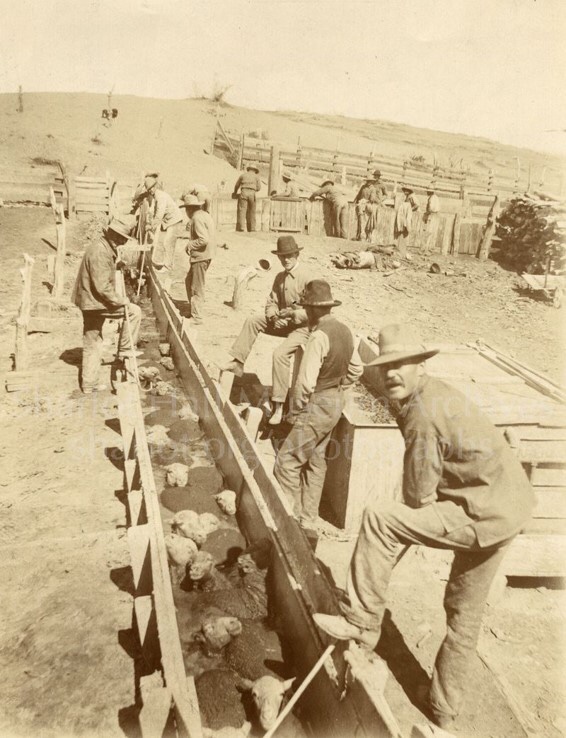
Dipping vats were found in the Cordes area as sheep passed this way when they were trailed north.  There were countless other locations too.  The picture below is taken in the Cordes area.

img_9010


Cowpunchers, sheep and goat herders to be trained to find minerals!

What?  Yes, this is an article that appeared in the Williams News, May 5, 1919. I have typed the full article here for your to read. “There is no business which offers better chances for finding a valuable mineral deposit than that of stock raising as followed on the Arizona ranges. These ranges located in the heart of the mining industry are certain to contain many, large, valuable mineral deposits which as yet have not been discovered and are only waiting to be found, opened up and thus make the fortunate discoverer independently wealthy.

The cowpuncher, sheep, or goat herder covers these mineralized sections and must know every foot of the country in which he is operating. These coupled with the fact that the stock take these men into draws, canyons, and other inaccessible places where the veins and mineral bodies are exposed so they can be easily seen and found. This makes the stock raising business a good line of business for finding valuable mineral deposits providing the stockman can recognize valuable mineral when he sees it.

To meet this demand from these up to date stockmen, the Arizona Bureau of Mines has arranged to give free lectures on how to test rocks so that any valuable metals that they contain can be detected. These lectures are to be given in the chief towns of Arizona and it will well repay all stockmen to attend.”

I scanned the rest of 1919 Williams News for any mention of the lectures and when and where they were held but came up empty handed. It leaves many questions unanswered like did the Arizona Bureau of Mines hold these lectures to teach how to determine if there were valuable metals in rocks that the cowpuncher, sheep or goat herder found, how many came to these lectures, where were the lectures or did the Bureau of Mines realize that this was a ludicrous idea? How many owners of sheep and goats would want their herders spending their days souring the landscape for minerals to test?  And if the cowpuncher, sheep or goat herder just happened to find such mineral wealth, wouldn’t they just go off, claim the mine for themselves, and leave their flocks that they were to watch and let the livestock to defend for themselves against predators?

Sheep Encounters Navajo Nation

Last week my church was involved in a Vacation Bible School for Pinon Gospel Church.  While there was not a great deal of time to explore the beautiful country of the Dine (Navajo) people, I did encounter sheep on a few days driving between Chinle were we stayed and Pinon. We saw sheep the first day driving into Chinle but was unable to photograph them. They were grazing right along the road; their form of roadside weed mowers.

Every evening we looked for them and finally Thursday evening they were at the same spot as we saw them the first night. Many of the pictures were taken while driving up and down the street.  The traffic was light for the most part and I could do U turns pretty easy. (I was fortunate their were no tribal police watching this stretch of road) The local people know to slow down when there are sheep along the side of the road; it is the tourist who fly by in a hurry to go… where? These sheep are someone’s livelihood so drive carefully when you see sheep along the road ways in Arizona!

Many days we saw the sheep in the distance grazing and these were easier to photograph.  The two pictures were taken with and without a telephoto lens.

On our drive home this past Friday, we spotted this group crossing the road with three herding dogs. Notice the small pup in the group; herding dog in training! The pup was very vocal about us stopping and so we did not linger. These sheep looked to be in better health (fatter) than the ones we saw in Chinle. It was just another day on the Arizona sheep trail by the jolly sheep babe! By the way, that is what #farmbabe, who I met at the Women in Ag Conference in Tucson, now calls me!

Increase Your Consumption of Lamb for Your Health and the American Sheep Industry!

An interesting article in the Williams News for June 27, 1919 was “Why Not ‘Mutton Monday'”?*  It wasn’t surprising that the article appeared in this newspaper as Williams has been a sheep grazing area since the late 1880s and continues to this day.  Lamb and mutton were sold in the local grocery stores as seen in the local grocery ads.  Here is the article in its entirety:

“The average housewife would be surprised to learn that in a year she buys for every member of the household only about 5 pounds of mutton and lamb as compared with about 71 pounds of pork and 67 pounds of beef.  If all American families used sheep meat one day a week in the average daily amount of other meats, that would mean more than 20 lbs. of mutton and lamb annually per capita, or four times its present consumption.

More than that, the head of the family, who pays the bills, would no doubt encourage purchasing mutton and lamb in larger cuts, instead of merely a few chops at a time, if he were made to realize the greater economy and the greater encouragement to production. In that connection a shoulder of mutton or a leg of lamb, being smaller than the average beef joint, should appeal especially to small families.”

Here are some of the benefits of eating lamb:

  1.  While lamb is considered a red meat it is considered to be healthy and a good source of protein. A four ounce serving gives 28 grams of protein but it is high in saturated fats.  Moderation in eating is suggested, but at least once a week will not be harmful
  2. With it being rich in iron and calcium, it helps prevent anemia.
  3. The omega-3 fatty acids means there is antioxidant protection reducing the appearance of wrinkles and age spots.  If you know any Basque, you will notice that the women never look their age.  It just might have something to do with them eating lots of lamb meat all their lives.
  4. Zinc helps your immune system and
  5.  Zinc, selenium and phosphorous are all necessary for good bone density.

Not only will your health benefit from eating lamb but you will be helping the American Sheep Industry and its producers.  Purchasing of lamb can be found in Fry’s and Sprouts during some holidays but it is seldom from US suppliers.  Rovey Dairy, 7711 W. Northern Ave., Glendale, Arizona has it on hand every Thursday to Saturday.  You can also call 623-939-2045.  If you do not live in Arizona, check your local sheep ranches and farms for availability in your area.  And, be careful at your local grocery store that you are buying US lamb products.  We want to help our industry!   You will pay more for US lamb but that is because consumers are buying imported products and not supporting US sheep ranchers.  Remember the health benefits too.

*https://azmemory.azlibrary.gov/digital/collection/sn82015761/id/5638/rec/906