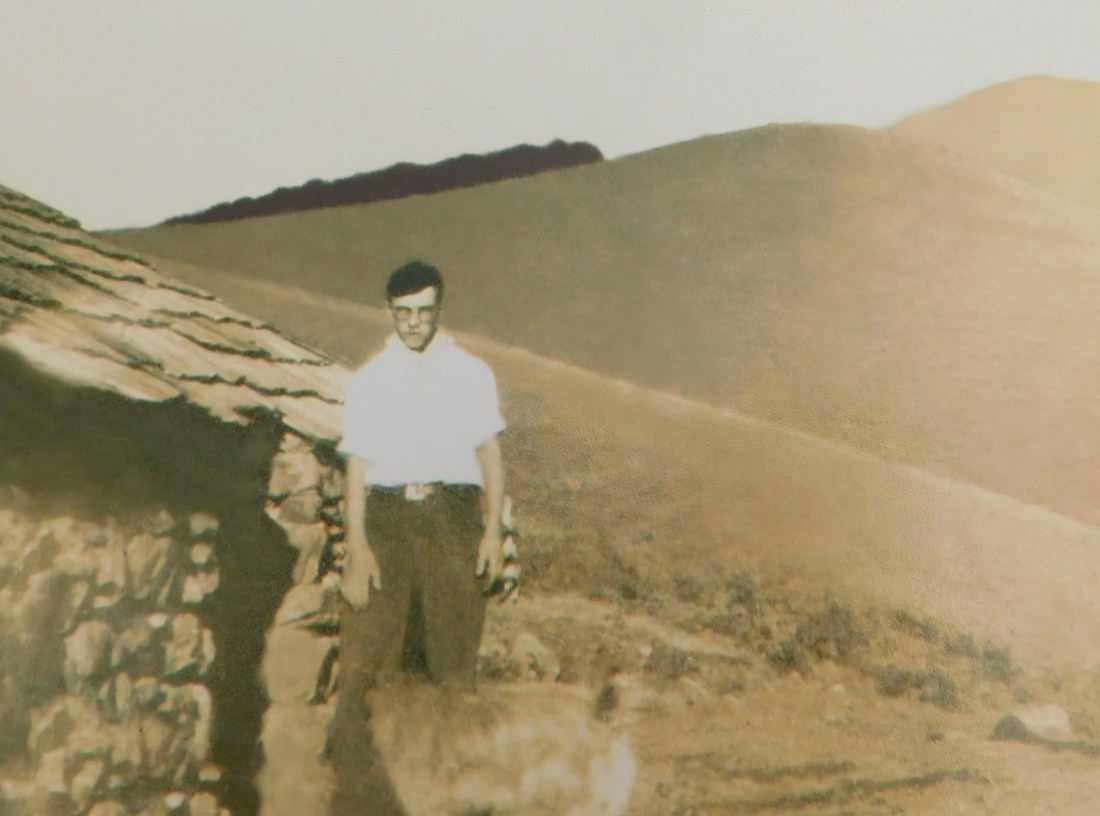
The Unfortunate Jean Pierre Espil, or was he?

Much is known about Jean Pierre Espil, at least most of his life here in Arizona, but, what is unknown is how old he really was, his route into the United States and how he arrived into the United States.  Here is just a few tales of Jean Pierre Espil and how he got started in Arizona.

Jean Pierre Espil was know as “Pete”.  The best estimate of his arrival into the Arizona territory would be the early 1890s.  Early information about Pete comes from the wife of L.A. (Louie), the third child of Pete and his wife, Isadora Aristoy.  Marion Ansley Espil had a special relationship with her father-in-law, learning many details of his early life and how he arrived in the United States and ultimately settling in Arizona.  Pete was born in Bagneres-de-Bigorre, Hautes Pyrenees, part of the French Basque country. The family and even Pete, never knew his correct birth date, although 1870 is the most likely date.  The family had heard two stories about “Pete’s” arrival into the United States; one story puts the arrival in New Orleans and the other, it was California. Pete told Marion he arrived into New Orleans, which allowed him and his cousin, Martin, to use their French, for they knew few English words and those were “fried eggs and ham.” Having to endure many meals of fried eggs and ham, he never ate them again once his English improved.

Pete’s and Martin’s reason for migrating to the United States was simple. In the Basque culture, the oldest son, of which neither were, would be the only one to inherit the family home and land leaving younger brothers to find other means to support themselves. Sometime in the late 1870s or early 1880s, Pete, who may have been as young as eight or as old as 12 (remember we don’t know when he was born), and Martin boarded a ship to the United States. Sticking with the story that Louie Espil’s wife told, they landed in New Orleans on a cargo ship; most likely working their way across the ocean, but, it has also been said that they were stowaways! From there, the two young men took the Santa Fe Railroad to California arriving in Los Angeles and then made their way to Sacramento by stagecoach. Martin had secured a sheep herder job prior to leaving France and Pete had hopes of also securing a job. Wet weather in the Sacramento area was not to Pete’s liking and he headed south to Long Beach doing unknown work. Later he found work with the sheep herding outfit, Miller and Lux Land and Livestock Company, back near Sacramento. His length of stay in California was affected by two factors. In the late 1890s and early 1900s, wool was the important commodity in raising sheep. Oil content of the wool greatly reduced its value and in the area were the sheep were grazed, oil from the ocean bottom would surface and drift into the inlets where the ocean water would mix with the fresh water and thus would get into the sheep’s wool. The other factor affecting Pete was that Mr. Lux was a gambling man and lost the wages of the sheep herders in a card game. So, after seven years of working for the company, Pete had experience but only a $20 gold piece to show for the seven years of hard work.

Pete boarded a train eastbound with maybe the thought of returning to his home land and maybe discouraged from his treatment the last seven years.   What we know is he got as far as Flagstaff, an environment with the mountains surrounding the town which made him feel like he was back in France.   Leaving the train, he met Harry Embach, a Philadelphia lawyer and a giant in the organization of the Arizona Wool Growers Association. The two men would remain friends for the rest of their lives. Embach helped secure him a job with the Babbitts.  It is unknown how many years he worked for the Babbitts or what his job was.  The Babbitts were known cattlemen, but they also had sheep.  He may have worked as a herder for them.

He next worked for Hugh Campbell, a banker and a sheep rancher. During this time, herders usually asked their employers to keep their wages until they requested them.  The herder could ask for monetary payment or in some cases, they would ask for sheep to begin their own herd, hoping to build up a herd to venture out on their own.  Until both herds were too large, the herder remained employed.  It would only make sense that Pete would be skeptical of asking his employer to retain his wages after his experience in California, but for some reason, he trusted Campbell.  Unfortunately, Campbell was just like Luz, as Campbell took Pete’s wages and a good portion of the bank’s money. But there was a silver lining for Pete as he made out better than in California.  The bank officials asked if he would run Campbell’s sheep until they could be sold; and for his work he would be paid with the lamb crop.  Pete was on his way to his own sheep company which he named the Espil Sheep Company.

 

“Olentzero”

No sheep family story today, but a custom found on the Spanish side of Basque Country at this time of year.  Olentzero brings gifts to good children late on December 24, in some parts of Basque Country, such as Ochagaira-Otsagabia, he comes on December 27th and in Ermua, it is December 31st.  Just knowing that he comes on different days in the villages helps explains that the story about him varies widely from village to village.  The first written account of Olentzaro dates to the 17th century.  Onentzaro was the earliest form of the word meaning “good” (onent) and “season” (zaro).  It may be older than Christmas as it corresponds to the feast held at the winter solstice.

During the reign of Franco (1939-1975) the tradition was banned as it was a symbol of regional separatism.  Franco was no friend to the Basque people.  But, that history has already been documented by others.  A good book to read on the Basque is called “The Basque History of the World” by Mark Kurlansky.  I highly recommend the book as there is much more to the Basque people and culture than most people know!

Getting back to Olentzero, he is a giant as the story is usually told.  On what ever day in your village he visits, you leave a pair of shoes out, but they cannot be left in a bathroom or bedroom.  The next day, children find presents left beside the shoes.

Now, granted there is more to Olentzero and the various stories that surround his being, but that will suffice for today.  Maybe one of my Basque friends can enlighten us with more on the story!

Jean Baptiste (JB) Etchamendy

IMG_7620

It is with sadness that I write about Jean Baptiste Etchamendy as he has gone to be with the Good Shepherd, our Lord and Savior.  Jean Baptiste was known to his friends and family as JB.  He was born in 1932 and died 2018.  He was born in the mountainous Basque village, Esterençuby, France. He was the third child out of seven brothers and sisters. His parents were Gratianne Guéçaimburu and Jean Etchamendy. JB lived a hard life as he grew up during WWII; France was under German occupation.  His family were sheep herders and life was hard, but JB learned many valuable traits during those years. He spent his summers in an “echola”, a little one room shack he called home while he shepherd the grazing sheep (see picture below).  It was here that he learned to make socks and sheep milk cheese every summer after being taught by his mother. With the economic conditions in France and not being the oldest son, he knew he could not have his own sheep company in France and he dreamed of migrating to America to seek his fortune.

DSCN1968a

His first attempt to migrate to the United States was interrupted with a call to serve his country in the French Army during the Algerian War.  France honored him with four medals for his service. Injuries to his arm did not keep him from his dream of coming to America which was realized in 1957.  He first worked for his mother’s cousin.  He then formed the Etchamendy Brothers Sheep Company with his brother Martin in 1965.  Martin returned to France and JB ran the company with the help of his wife, Barbara, whom he married in 1968.  They had three sons.  While the boys would work with their dad, he never encouraged them to be sheep ranchers.  JB sold his sheep outfit in 2000.

A story that was told during JB’s funeral was that during at least one live nativity scene at his church in Tempe, he brought in sheep from his flock.  I need to find out if he also brought in real shepherds that were tending his sheep in the winter.  The priest said he wish he had been at the church when JB did this.  I would have liked to seen that too!


Keep a Few Sheep

They pay better than any other class of farm animals.   That was the headlines in an Arizona newspaper back in 1893.  Why would an Arizona newspaper print such a story if sheep were not an important part of the economy of the territory, as we were a territory at this time? In its entirety with no editing expect what is in parenthesis.

A writer who appreciates sheep, and who succeeds in making a good profit on them, writes the Wisconsin Farmer, and says: I wish to impress upon my brother farmers, through the columns of your valuable paper, the importance of keeping at least a few sheep for several reasons. One is that they are such scavengers that they readily eat the seed of the vilest weeds and they are not like other farm animals, nothing grows after passing through them. Anyone traveling through the country can tell at a glance the farms that have a flock of sheep on them, by their neat appearance, no rag weed, the scourge of almost all of our cultivated land, is seen. I might go on and tell of other bad weeds, for their names are legion, but the sheep will in every instance annihilate them.

One other good reason is that they pay better for the food consumed than any other farm animal, and I now speak without fear of contradiction. No kind of stock will pay such profits on the cost as a flock of well-kept sheep. To illustrate: Two years ago in buying some feeders I got among them a rather small-sized ewe, and in sorting them out in the late fall I thought I would keep and breed her, for there was something about her that I liked. Her cost price was two dollars; the next spring she brought me two ewe lambs which she raised splendidly. She then met with an accident and had to be fattened, weighed 120 pounds, for which I got four and one-half cents or $5.40. Now I have sold to an Iowa man the two yearling ewes with sixty others, at $8 per head. So her increase brought me $16, making in all, $21.50. I think that the three fleeces of wool amply paid for their keep. I never got a chance to get much education and don’t presume to know what percentage I realized on the investment. (If my math is correct, I believe that is a 970% profit on just one ewe).

Another reason the sheep farmer has more time for recreation than the man who follows dairying, for instance, no matter what happens, rain or shine, that milk must be delivered on schedule time or there is a ruckus. Another reason is they are so docile and harmless, requiring less fencing and if by perchance they should break into the corn, they are not such gluttons and will not, like cattle, eat till they kill themselves, as is often the case. Another reason is that no stock, if properly bedded will make as much valuable manure and everyone knows that manure from sheep is the best. I might go on and state other advantages, but these will suffice. Don’t understand me that the sheep is everything and it needs no care. There is nothing to be without close attention, and sheep breeding and feeding are no exception to the rule.

The Scott Brothers

Some of the history of the Scott Brothers was written about in Where Have All the Sheep Gone? Sheep Herders and Ranchers in Arizona – A Disappearing Industry new information on them have come to light.  There were four brothers, Raleigh, Robert, James and George, of which three definitely have connections to sheep.  Their uncle, Felix, was also a sheep man.  All the Scott’s were from Oregon.  Robert and James came after their uncle, Felix, and encouraged George to follow them to the Arizona territory.  Besides the name of the fourth brother, Raleigh, little is know of him.  More research may unearth new information on him and add to the Scott story.

More is known about George than the other brothers.  George had originally set up his camp in Forestdale, then moved to an area just south of Show Low.  A few years before he came, the Mormons had built a log cabin at Forestdale.  This was 1870.  George had the cabin taken apart, numbered each log, then the logs were moved to his new camp and put back together.  On this land the brothers built Scotts Reservoir to insure a water supply for their livestock.  It is known that James had his camp near Pinedale and Robert owned land where the Scotts Pine Meadow is located today.

George married the widow of the father of Sante Jaques, Anna Christina Jaques.  Jaques is well documented in the abovementioned book.  It was Scott who introduced young Jaques to sheep.  George had 16,000 sheep.  He would trail his sheep each winter to the Salt River Valley, but first he would burn his pasture land to rid it of the small trees beginning so they would not get a foothold on his pasture.  In the Salt River Valley, George had 320 acres which he kept in alfalfa which allowed his sheep to have winter feed.  In good years, he would sell his lambs to eastern markets prior to heading the ewes and rams back up the trail to summer grazing leases.

Before the Pleasant Valley War, the sheep trail was forged by the sheep herders and the sheep.  There was no exact trail.  Then a mile wide stretch of land was established for the herds.  The trail began in east Mesa, cross the Verde River at Blue Point and then up the Mogollon Rim to their summer grazing in the White Mountains.  If the land was dry because of dry winter conditions, the sheep would be taken by railcar to the White Mountains. George had grazing leases on the Apache Reservation.

Many locations are named after the Scotts and other sheep men in this part of Arizona- Scotts Reservoir and Scotts Pine Meadow, (Joseph) Sponseller Lake and Mountain, and Morgan Flat after William Morgan.

2018 Best Book Awards

I have the humble privilege to announce Where Have All the Sheep Gone? Sheep Herders and Ranchers in Arizona – A Disappearing Industry won as a Award Winning Finalist in the History: United States category of the 2018 Best Book Awards sponsored by American Book Fest. There were more than 2,000 entries and 400 of them, of which I was one, won in the Winner or Finalist category.  I am extremely grateful for this award especially as this is my first book.  Now, on to my next book telling the stories of more sheep families who made the industry.

Joseph Pouquette

A favorite saying of Joseph Pouquette was “Eat lamb-wear wool.”  It is more than a saying as it was a way of life for the Pouquettes.  Joseph was born January 6, 1888, to French parents in Ventura, California where his dad, Pierre, was in the sheep business in the 1880s. Shortly after his birth, the family returned to their home country of France.  When they did return to the United States, they took up the sheep business in the Ash Fork area.  Joseph married Marguerite Bordenave in 1915 and the couple moved to California for a year.  Within a year, he was back in Arizona where he purchased 3,000 sheep.  During 1918 and 1919 he served in the army during the first World War.

In 1920, he moved his family and sheep to the Williams area setting up his summer home and sheep camp.  He would trail his sheep between Williams and Wickenburg, his winter range.  The family would travel by train with “chickens, wood stove and everything” that would be needed for the summer months in the Williams area.  He had two sons who also went into the sheep business with him, Pierre and Albert.  His grandsons also ran sheep.

Three generations of Pouquettes were proud sheep men in Arizona.

There are other Pouquettes that will be written about in the next couple of weeks such as Albert Pouquette and his sons who were sheep men in the Williams area and Simon Pouquette, who was born in France in 1890, but was naturalized in 1910, is still being researched and his connection to the sheep industry.


Weathering Mother Nature!

Reading family histories in the Arizona Pioneer Ranch Histories gives us interesting pieces of information on the families trying to make a living in early Arizona, detailing the hardships of the land, diseases, attacks from native Americans, attacks from wildlife on the settlers and their livestock, living far from neighbors and a town and the associated lack of companionship, and relating weather conditions that destroyed what they had built in a single season. One example is the devastating snowstorm in the winter of 1937-1938. Tom Pollock had both cattle and sheep. The cattle were grazed in the Big Chino Valley and northward across what would be Interstate 40 on toward the Grand Canyon. He also had sheep at the Willaha Ranch just south of the Grand Canyon. While Pollock was able to save most of his cattle and move them further south, he lost 1,000 sheep in that storm. Of course, official records of drought or record rainfall can be found within the national weather service records but, when the information comes from those who lived through it, it has a different perspective, a more personal look, then just numbers given from some data base.

Another sidebar fact that will need verifying is this the same Mr. Pollock that owned the Arizona Central Bank in Flagstaff?

Pelote or pelota, Basque national sport

At boarding houses frequented by Basque sheepherders in Arizona and other parts of the west, two of them had frontónes courts.  The Basque would play their hand game of pelote or pelota.  It is said to be across between handball and squash.  One can be still found at the Tourist Home in Flagstaff.  The Tourist Home today is a bistro today selling sandwiches, soups, and alcohol.  When the boarding house was turned into the bistro, the owners preserved the remains of the frontónes court or which can be found on the north side of the building.   There is evidence that a second frontónes was present in Flagstaff at the Martin Boarding House which was just a couple blocks west of the Tourist Homes.  It was just one of the activities that the Basque would partake of at the boarding houses.  Card games were also common; one was Mus.