Sheep Happenings in 1903

As I have ben researching the Williams News for the year 1903 I was fortunate that January 10, 1903 listed 71 men and women involved in the Arizona Wool Growers Association.  I will list them at a later time.  The first three months of the year, the weekly newspaper, The Williams News, had quite a few mentions of the sheep industry.  Here are just a few of them:

Gus Reimer, who was called the jolly, elderly, ex-sheepman was now part of the San Bernardino Packing Company.  He was in charge of 2,000 sheep that were consigned to him as they were purchased from Frank Ebert.  Frank Ebert was not on the list as being a member of the Arizona Wool Growers Association.

James Walsh had sold all his sheep and was stocking his ranch north of Peach Springs with a high grade Hereford Cattle.

T.J. Evans, was on his way to Ash Fork with a large band of sheep belonging to the firm of Smith and Evans and would take them to the southern country for the rest of the winter.  This was in Local News for February 7th.  It seems late to be trailing sheep south.

Anyone who wanted to get their sheep sheared in the Salt River Valley this spring may find that unless the wool growers agreed to an increase in pay for the shearers, they may not get them sheared.  The current rate was five cents per sheep.  The shearers wanted a penny raise.

Also in February, the paper reported that one of  the largest sheep deals consummated in Arizona in recent yeas was closed in Phoenix. Ambrosio Candelaria sold his entire flock of sheep to the Ortega Bros. for $16,000. The sheep are in the Salt Valley waiting to be sheared.

Sometimes a name was printed with the news that the person was in town for a visit and the newspaper printed their occupation and where they were from.  Chas. Howard was one of these sheep men mentioned and he was from Ash Fork.  Another edition stated that P.H. Goesling, the well-known sheep man from Winslow, had found the bones of a man while hunting for stray sheep.  Nothing else is told about either sheep man, we do know that Howard was a member of the Arizona Wool Growers Association as his name appears on the list.  Goesling was not a member in 1903 which seems strange since he was a “well-known” sheep raiser.

Two pieces of information in the news concerned the wool.  “Wool is now being bargained for in Arizona from a quarter to one third more than it was sold for last season.  When the quantity is taken into consideration, this increase means the disbursement of a large amount of extra money throughout the territory.”  This news was followed a week later that the Williams News printed from The Gazette which stated that “$200,000 worth of wool has been clipped in the Salt River Valley this season.  The amount which passed through Phoenix warehouses is 1,200,000 pounds with about 100,000 more to ship.  The price of the wool shipped has ranged up to 16 cents a pound.  The wool was sacked this year but previous years it was baled.  The average weight of a sack of wool is 200 pounds.

Two last pieces of information stated there were about 35,000 sheep in the neighborhood of Seligman and permits had been granted for the grazing of 100,000 head of sheep on the San Francisco forest reserve for the upcoming season.  And that is the first four months of 1903.  I will add the list of members of the AWGA tomorrow.  And a couple of  sheep pictures with a pack donkey.


Taylor Sheep Company bought by the Bly Brothers July 1916 and the disease “scab.”

Looking through the Williams News for 1916, I have found a few tidbits of information on the sheep industry.  In July 1916 newspaper, there is an article about the Bly Brothers of William having bought out the holding of the Taylor Sheep Company, its water locations, range rights, tanks, rolling stock and pack outfits along with about 4,000 head of sheep.  Newt Arnold was the owner of the Taylor Sheep Company and he sold his ranch to the Bly Brothers and moved with his family to Los Angeles where they will remain for at least two months.  There was no follow-up in later additions as whether the Arnold’s returned to Williams.

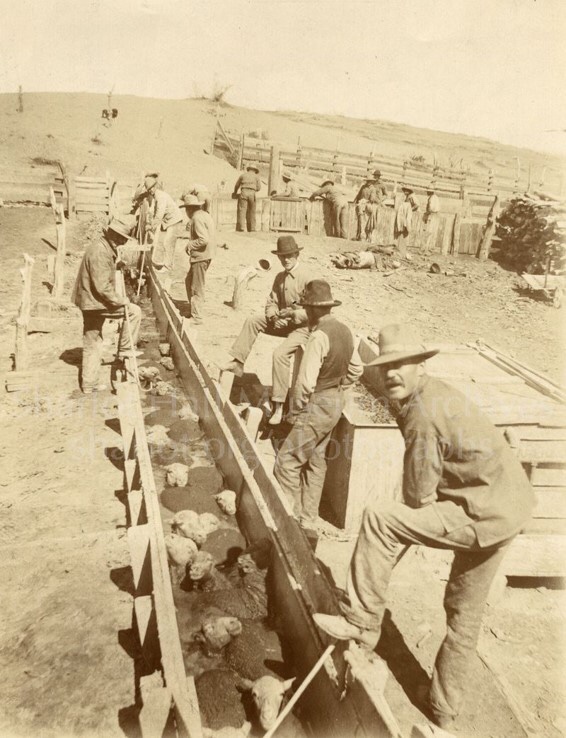
There was also a lengthy article about dipping sheep to prevent sheep scab.  Scab was one of the drawbacks to anyone interested in getting into the sheep business but it can be easily controlled with dipping.  The cost to dip a sheep was between 2 to 3 1/2 cents per sheep with labor, fuel and the material for dipping the only cost to the owner.  It has been recommended that sheep should be dipped at least once a year.  Because so many sheep owners had been dipping their sheep, that from 1906 to 1916, there has been a reduction in this disease.  The article continued stating that even though it looked good for the reduction in the disease, sheep owners should not relax this practice and bring back scabs to the sheep. Dipping solutions that were more than ten days old frequently lose their effectiveness and needed to be checked to guarantee that the scab was prevented. The disease was highly contagious and the sheep spread it in a number of ways: infected roads that they crossed, on old bed grounds (where they rest), in sheds, on trails, and in pastures and ranges near to water places and the ground around water places.  During dry seasons, the disease remained dormant and thus many herders and sheep owner thought that the danger had passed. With the return of cold, rainy weather, the disease reappears.

Early newspapers seemed to carry many such articles to educate the sheep and cattle owners on caring for their livestock.  Some issues seemed to be dedicated to the topic of farming and ranching.  One article even had plans for barns and the best use of the area in a barn to economize the area.

Dipping vats were found in the Cordes area as sheep passed this way when they were trailed north.  There were countless other locations too.  The picture below is taken in the Cordes area.

img_9010


Cowpunchers, sheep and goat herders to be trained to find minerals!

What?  Yes, this is an article that appeared in the Williams News, May 5, 1919. I have typed the full article here for your to read. “There is no business which offers better chances for finding a valuable mineral deposit than that of stock raising as followed on the Arizona ranges. These ranges located in the heart of the mining industry are certain to contain many, large, valuable mineral deposits which as yet have not been discovered and are only waiting to be found, opened up and thus make the fortunate discoverer independently wealthy.

The cowpuncher, sheep, or goat herder covers these mineralized sections and must know every foot of the country in which he is operating. These coupled with the fact that the stock take these men into draws, canyons, and other inaccessible places where the veins and mineral bodies are exposed so they can be easily seen and found. This makes the stock raising business a good line of business for finding valuable mineral deposits providing the stockman can recognize valuable mineral when he sees it.

To meet this demand from these up to date stockmen, the Arizona Bureau of Mines has arranged to give free lectures on how to test rocks so that any valuable metals that they contain can be detected. These lectures are to be given in the chief towns of Arizona and it will well repay all stockmen to attend.”

I scanned the rest of 1919 Williams News for any mention of the lectures and when and where they were held but came up empty handed. It leaves many questions unanswered like did the Arizona Bureau of Mines hold these lectures to teach how to determine if there were valuable metals in rocks that the cowpuncher, sheep or goat herder found, how many came to these lectures, where were the lectures or did the Bureau of Mines realize that this was a ludicrous idea? How many owners of sheep and goats would want their herders spending their days souring the landscape for minerals to test?  And if the cowpuncher, sheep or goat herder just happened to find such mineral wealth, wouldn’t they just go off, claim the mine for themselves, and leave their flocks that they were to watch and let the livestock to defend for themselves against predators?

Sheep Encounters Navajo Nation

Last week my church was involved in a Vacation Bible School for Pinon Gospel Church.  While there was not a great deal of time to explore the beautiful country of the Dine (Navajo) people, I did encounter sheep on a few days driving between Chinle were we stayed and Pinon. We saw sheep the first day driving into Chinle but was unable to photograph them. They were grazing right along the road; their form of roadside weed mowers.

Every evening we looked for them and finally Thursday evening they were at the same spot as we saw them the first night. Many of the pictures were taken while driving up and down the street.  The traffic was light for the most part and I could do U turns pretty easy. (I was fortunate their were no tribal police watching this stretch of road) The local people know to slow down when there are sheep along the side of the road; it is the tourist who fly by in a hurry to go… where? These sheep are someone’s livelihood so drive carefully when you see sheep along the road ways in Arizona!

Many days we saw the sheep in the distance grazing and these were easier to photograph.  The two pictures were taken with and without a telephoto lens.

On our drive home this past Friday, we spotted this group crossing the road with three herding dogs. Notice the small pup in the group; herding dog in training! The pup was very vocal about us stopping and so we did not linger. These sheep looked to be in better health (fatter) than the ones we saw in Chinle. It was just another day on the Arizona sheep trail by the jolly sheep babe! By the way, that is what #farmbabe, who I met at the Women in Ag Conference in Tucson, now calls me!

Increase Your Consumption of Lamb for Your Health and the American Sheep Industry!

An interesting article in the Williams News for June 27, 1919 was “Why Not ‘Mutton Monday'”?*  It wasn’t surprising that the article appeared in this newspaper as Williams has been a sheep grazing area since the late 1880s and continues to this day.  Lamb and mutton were sold in the local grocery stores as seen in the local grocery ads.  Here is the article in its entirety:

“The average housewife would be surprised to learn that in a year she buys for every member of the household only about 5 pounds of mutton and lamb as compared with about 71 pounds of pork and 67 pounds of beef.  If all American families used sheep meat one day a week in the average daily amount of other meats, that would mean more than 20 lbs. of mutton and lamb annually per capita, or four times its present consumption.

More than that, the head of the family, who pays the bills, would no doubt encourage purchasing mutton and lamb in larger cuts, instead of merely a few chops at a time, if he were made to realize the greater economy and the greater encouragement to production. In that connection a shoulder of mutton or a leg of lamb, being smaller than the average beef joint, should appeal especially to small families.”

Here are some of the benefits of eating lamb:

  1.  While lamb is considered a red meat it is considered to be healthy and a good source of protein. A four ounce serving gives 28 grams of protein but it is high in saturated fats.  Moderation in eating is suggested, but at least once a week will not be harmful
  2. With it being rich in iron and calcium, it helps prevent anemia.
  3. The omega-3 fatty acids means there is antioxidant protection reducing the appearance of wrinkles and age spots.  If you know any Basque, you will notice that the women never look their age.  It just might have something to do with them eating lots of lamb meat all their lives.
  4. Zinc helps your immune system and
  5.  Zinc, selenium and phosphorous are all necessary for good bone density.

Not only will your health benefit from eating lamb but you will be helping the American Sheep Industry and its producers.  Purchasing of lamb can be found in Fry’s and Sprouts during some holidays but it is seldom from US suppliers.  Rovey Dairy, 7711 W. Northern Ave., Glendale, Arizona has it on hand every Thursday to Saturday.  You can also call 623-939-2045.  If you do not live in Arizona, check your local sheep ranches and farms for availability in your area.  And, be careful at your local grocery store that you are buying US lamb products.  We want to help our industry!   You will pay more for US lamb but that is because consumers are buying imported products and not supporting US sheep ranchers.  Remember the health benefits too.

*https://azmemory.azlibrary.gov/digital/collection/sn82015761/id/5638/rec/906

Early Newspaper Ads for Woolen Suits for Both Men and Women.

I often look at the ads in the early newspapers to see what items are selling as I am curious if lamb’s meat was a regular item available in these grocery stores. Most often mutton is listed with at least one grocery store. But what caught my eye this time was the fashion show that the Babbitts were putting on. No expense was overlooked it seemed from the advertisement as music, dancing and entertainment was to be a highlight of the fashion show. The show would have all the latest women and men’s fashions from head to foot. However, the ad did not mention that any of the garments were made from wool! But continuing looking through other ads in the newspaper I found that woolen goods were considered a good investment back 100 years ago and were much in style for both men and women.
One ad for March 1919 was for Easter Suits. W. H. Allison, the service tailor, was agent for Victor Ladies Tailoring Co., Chicago. His ad begins recognizing the value of good clothes and that the price in the beginning may be high, but at the same time, those clothes will last a longer time and be in fashion longer than other clothes. His ad listed styles in women’s and misses’ high-class suits, coats, dresses, skirts, waists, and petticoats as ready to wear and made to measure of the finest all-wool grades. I have added the ad from the March 21, 1919 newspaper which I retrieved from https://azmemory.azlibrary.gov/digital/collection/sn82015761/id5568/rec/892

IMG_8545

W.C. Rittenhouse also had an ad in the same newspaper which stated “a wealth of exclusive, serviceable patterns in Spring and Summer woolens are offered” at his store to be “tailored to order, costing no more than the other kind.”

Babbitt-Polson Co. placed an ad in the April newspaper (April 4, 1919) for men’s “waist-seam suits” that were either “single or double-breasted variations, slanting pockets, crescent pockets, slash pockets, cuffs, piping on the collar and cuffs” made by Hart Schaffner and Marx of all wool. Later in May, another ad with more details about the Hart Schaffner & Marx all-wool suits was placed stating that the suits were “Special Prices for Peace-time” at $37.50.  Wow!  What a bargain; can’t find a woolen shirt at that price today let alone a complete suit!

Now, I must find who produced the woolens.  It is reasonable to assume that the wool was a product of the United States as there were many woolen mills and millions of sheep in the early 1920s in the United States.

A Better Night’s sleep with wool?

Now we have all see the cartoons and ads for counting sheep to help you fall asleep but there are many benefits to having wool bedding and bed clothes in getting a better night’s sleep.
1. Wool is breathable. Wool can absorb up to 30 per cent of its own weight in moisture vapor. Wool, with this ability and worn next to your skin, means it is extremely breathable, and comfortable to wear in extremes and changes of temperature. The wool fibers creates pockets of air, which leads to a natural form of insulation. When the weather is cold, wool clothing stays warm and when the temperature rises, it helps you to stay cool. A wool turtleneck or V-neck sweater also wicks sweat and other types of moisture away from the body, keeping you dry and preventing dampness, which can lead to chills. This also makes exercising in wool clothing ideal at any time of the year.

2. Wool is a flame-retardant fabric as it does not burn easily. In fact, wool will put out a flame itself when ignited. Many fire departments use wool in their clothing to protect firemen from flames, and its status as a natural fire retardant means that it doesn’t need to be treated with artificial retardants – thus providing further protection from potentially harmful chemicals as the firemen fight the fire and as house occupants try to escape the flames. Wool does not melt, drip or stick to the skin causing burns, and when subject to extreme heat it produces less smoke and less noxious fumes giving people a better chance to survive house fires.

3. If you have allergies, wool may be the best fabric to wear. It seldom will attract mold or bacteria. Dust mites need moisture for their survival. Without moisture in the bed clothes and sheets, asthma and allergy sufferers will have less breathing problems. A great benefit of wool is it contains lanolin, a natural antibacterial property and it will deter the growth of mold, dust mites and bed bugs. Maybe hotels should use wool bed sheets!

4. Wool can also help in supporting joints and associated pains that occur at night. As an elastic fiber wool supports joints and body pressure points as we sleep. Wool allows movement at night with less pain and it’s a great benefit for those who suffer from arthritis or rheumatism. Wool pajamas or bed coverings provide a more restful sleep period, as the fabric supports the body and prevents little aches and pains from setting in during the night.

5. Wool is a light and strong and durable fiber, but it is extremely strong and resistant. It resists tears more readily than other fabrics and lasts longer than cotton or synthetic fibers. In addition, it is comparatively light weight makes it suitable for casual wear and maintains your comfort level even in the summer. When treated with chemicals, worsted wool is smooth and durable, making it a popular fabric for skirts, suits and pants. Many may consider this a determent to wool, however.

6. Wool bedding is a sustainable and lasting fabric and if properly laundered will last far longer than other fibers. This is because of its natural elasticity and flexibility that was already noted in an earlier blog.

7. And one that everyone should like is wools ability to stay in place. Wool batting comes off the roll in one continuous piece and when hand-tufted into your topper or comforter will stay securely in place. No shifting over time and no bare spots; a result of its natural elasticity and flexibility.

And so why haven’t you thought about wool fabrics for your bedding and bed clothes. It is a good choice for children to wear as bed clothes with its resistant to fire. It keeps many allergens and other critters out of your bed. If the price of such items keep you from purchasing, remember wool outlasts cotton and silk! Wool is better for the environment is another reason to consider.  “And now you have the rest of the story” as Paul Harvey would say!

A few limitations of wool fabrics

My last blog discussed the many benefits of wool fabrics.  Today I will discuss the very few limitations of the use of having wool fabrics as either clothing or rugs in your home.  A. Moths find wool fabrics extremely tasty.  Other types of fabrics that you may wrap your woolen garments in for storage will not deter them in their quest to get to the wool.  This is easily prevented.  Moths you see in your home are not the kind that eat clothes.  Clothes moths don’t like light so you won’t see them.  Moths will lay eggs on your clothes and the larvae will eat the fabric.  Always laundry your woolens prior to storage for the summer.  If you have wool carpet, keep it clean from stains and yes, vacuum it a lot.

B. Using moth balls as a deterrent has drawbacks.  The most obvious is its smell, but it also contains pesticides.  Clothes must be aired before wearing and the smell of the moth balls can still linger.  Don’t want to smell like moth balls? – use lavender which leaves a very pleasant smell on your clothes, not pesticides.  Unfortunately, lavender will not kill moth eggs or larvae so you still need to watch for the hidden moths in your home.

C. Bleach and wool fabrics do not mix!  Even a small amount will harm the fibers making them stiff and yellow; larger amounts will dissolve your garment.

D. Older woolen fabrics should never put in the dryer.  Shrinkage will result from the combination of heat, friction and pressure.  However, there are new woolens that may be laundered and tumbled dry.  Be sure to check the label before home washing.  IF you have to use a dry cleaner to clean your garment, always air dry before wearing as chemicals are used in the process unless you frequent an eco-friendly cleaners.  Never store your garments in the plastic bag that the cleaner returns your garments.  This may turn your garments yellow especially if left for a long time in the plastic.  This is true for all fabrics!

E. A mild detergent must be used if you do launder as many laundry soaps contain strong alkalis which cause the wool fibers to lose their soft luster.

F. Wool fabrics can be damaged by excessive and direct heat from an iron so always use steam when pressing any woolen garment.  If use dryer on wash-dry woolens, use the lowest setting and don’t forget those woolen dryer balls!

From the above list it is obvious that woolen garments have few downsides and with wool being a eco-friendly product, it should be a favorite item to have in your wardrobe. There are many wools today that can be worn all year even in warm to hot climates.  That reminds me of another story for another day about the English requirements of wearing wool prior to cotton fueling the industrial revolution.

I will be posting in the next day or so, how wool could be your answer for a better night’s sleep.  So stay tuned.  If you like this post, please like and follow this webpage.  Thank you.  I will be adding family stories again next week as I am still gathering newspaper stories and talking with families.

The Versatility of Wool

At the Flag Wool and Fiber Festival June 2, 2019, part of my presentation was on the versatility of wool. Some of these facts may be obvious to some of you and some may be new.  We are all concerned about the environment, wool needs to be presented as a fiber that has many benefits to the person using the wool, either through wearing it or using it in their home, and has very few limitations.  The limitations will be discussed in another blog.

  1.  Wool is 100% natural as it grows on sheep.  It is not based on petroleum or other harmful elements, contains no artificial chemicals.
  2. Wool is a renewable resource since it grows on sheep.  As long as there is grass to graze on, water to drink, air and sunshine, sheep will produce a new fleece every year.  Shearing sheep is like a person getting a haircut.  It is not harmful to the animal and actually needs to be shorn off for the health of the animal.  If not sheared each year, it would be like a person putting on a fleece at the beginning of the year, then the start of the next year, donning another fleece and continues until the person can’t stand up.  Shearing sheep has been an occupation since the beginning of the domestication of the animal.
  3. When the wool is turned into fabric, it uses significantly less energy than man-made fibers.  Wool production produces lower carbon dioxide emissions and for all you environmentalist, has a low carbon impact on the earth; a win-win for all!
  4.  Sheep consume biomass carbon (carbon converted through photosynthesis) when they eat grass and thus is it transformed into amino acids of the wool fibers
  5.  Wool is biodegradable and can be returned to the soil, or marine environment where it decomposes and releases valuable nitrogen based nutrients back into the ground or ocean.
  6.  Wool reduces microsynthetic fiber pollution as wool biodegrades relatively rapidly and does not accumulate in the environment as synthetic fibers do.  Man mad fibers soak up toxins in the environment which can be eaten by fish which in turn can be part of the food chain for man.  Synthetics are much more harmful to the environment when they are part of the food chain.
  7.  In most cases wool is an easy to care for fiber and stain resistant.  The protective outer layer of a wool fiber is a natural resistant to stains.  When used in carpets, the overlapping scales means that dirt sits on the surface of the rug and is easily vacuumed and removed.  In the same way, spills will not absorb quickly and thus can be easily blotted up.  Similarly, wool carpet and clothes do not attract static electricity and that means lint, dirt and dust with no static does not cling to garments or carpet.  The absorption property of wool means that it will take harmful pollutants from the internal air in a building (think your home) and since it does not release it back to the atmosphere makes your air cleaner!
  8.  Wool also has great sound insulation properties and can be used to limit the spread of sounds in a building. (think children’s bedroom!)
  9.  If a wool dryer ball is used in your clothes dryer, the amount of time necessary to dry clothes decreases.  Your electric bill is reduced and the time for doing the laundry is reduced.  The wool dryer ball also keeps a consumer from using fabric softeners and, that in itself, is a savings to the consumer.  The bouncing balls fluffs your clothes and that helps reduce the drying time and using these balls means your clothes do not have the artificial fragrances from a dryer sheet.  I highly recommend the use of these dryer balls and they can be purchased on line.  I bought mine at Mystic Pines Fiber Processing in Williams, Arizona.  They have a webpage where these and other items can be purchased from them.  www.mysticpinesfiber.com
  10.  When wool is dyed, it absorbs color deeply and uniformly.
  11.  Wool has a unique crimp providing it with a natural elasticity and the fabric will return to its natural shape, resist wrinkles and creasing.  Wool fibers can be bend more times (20,000 times) over cotton (3,000) and silk (2,000) without breaking and thus makes wool fabric resistant to tearing.

Limitations of wool which only amounts to five things will be discussed tomorrow.